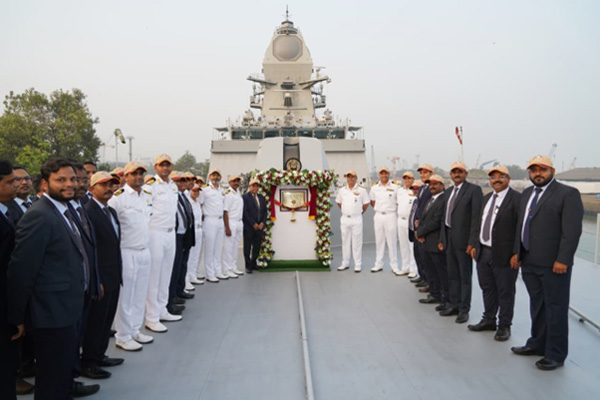
- Fourth Nilgiri-class P17A vessel boosts maritime strike power
- Accelerated build timeline reflects India’s rising shipbuilding prowess | Advanced weapons, sensors and propulsion mark a major technological leap
- 75% indigenous content underscores Aatmanirbharta drive
NE DEFENCE BUREAU
MUMBAI, NOV 29
The Indian Navy on Friday received Taragiri, the fourth ship of the Nilgiri-class (Project 17A) advanced stealth frigates, marking a key milestone in India’s march toward self-reliance in warship design and construction. Built by Mazagon Dock Shipbuilding Ltd (MDL), the cutting-edge vessel was handed over in Mumbai, the Navy announced.
Taragiri (Yard 12653) is the third P17A frigate constructed by MDL under the seven-ship programme. Designed as a versatile multi-mission platform, the frigate is equipped to meet emerging maritime threats and significantly enhance the Navy’s surface warfare, anti-air, and anti-submarine capabilities.
Notably, Taragiri is the fourth P17A ship delivered within the last 11 months—an outcome of streamlined processes and experience gained during construction of earlier vessels. The build period for Taragiri was reduced to 81 months, compared with 93 months taken for the lead ship INS Nilgiri. The remaining three frigates—one at MDL and two at Garden Reach Shipbuilders & Engineers (GRSE)—are slated for progressive delivery by August 2026.
A modern reincarnation of the erstwhile INS Taragiri, a Leander-class frigate that served the nation for 33 years (1980–2013), the new Taragiri represents a major leap forward in stealth, automation, firepower and naval engineering. The vessel reflects the Indian Navy’s Integrated Construction philosophy, with the Warship Design Bureau leading the design and the Warship Overseeing Team (Mumbai) supervising construction.
Project 17A ships feature an advanced weapons and sensor suite superior to the earlier Shivalik-class. Taragiri is fitted with BrahMos ship-to-ship missiles, MFSTAR radar, the MRSAM air-defence complex, a 76mm Super Rapid Gun Mount, close-in weapon systems, and anti-submarine rockets and torpedoes. Its Combined Diesel or Gas (CODOG) propulsion configuration—comprising a diesel engine, gas turbine and Controllable Pitch Propellers (CPP)—is managed by a state-of-the-art Integrated Platform Management System (IPMS).
With 75% indigenous content, the P17A programme involves over 200 MSMEs and has generated employment for about 4,000 personnel directly and over 10,000 indirectly. The delivery of Taragiri showcases India’s maturing capabilities in warship design, modular construction and maritime engineering—reinforcing the country’s commitment to Aatmanirbharta in defence shipbuilding.