NE HEALTH BUREAU
PUDUCHERRY, SEPT 25
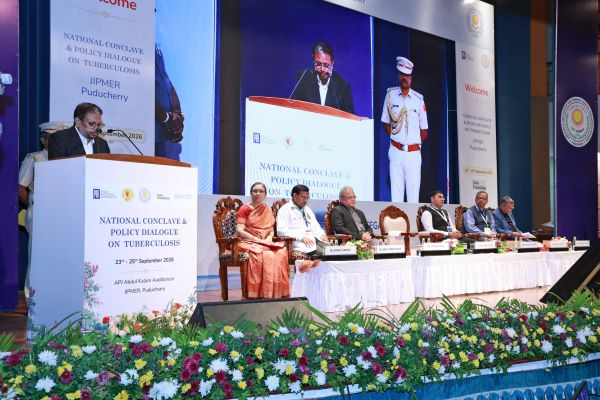
What if the next breakthrough in India’s battle against tuberculosis is not simply finding more cases—but understanding who is getting TB, how the disease is changing and which drugs can defeat it before treatment fails? That question took centre stage at JIPMER’s three-day National Conclave and Policy Dialogue on Universal Drug Susceptibility Testing (UDST) using Targeted Next-Generation Sequencing (tNGS), which concluded in Puducherry on Friday.
The National Conclave on UDST using tNGS for Tuberculosis concluded at #JIPMER.
Hon’ble Lt. Governor of Puducherry Shri K. Kailashnathan called for genomic approaches, early detection, community participation & technology-enabled interventions towards TB Mukt Bharat by 2030. pic.twitter.com/eNKIAQrOSH— JIPMER – Official (@OfficialJipmer) September 25, 2026
From targets to total elimination
Puducherry Lieutenant Governor K. Kailashnathan, speaking at the valedictory ceremony at the APJ Abdul Kalam Auditorium, called for a decisive shift from a target-driven approach to a holistic, community-centred TB elimination strategy.
He urged deeper research into changing TB patterns, particularly among youth, young married women and students—groups that, he indicated, require greater attention as India seeks to move from controlling tuberculosis to eliminating it.
Kailashnathan reiterated the national vision of a TB Mukt Bharat, while commending JIPMER and partner institutions for bringing together policymakers, genomic scientists and clinical experts to deliberate on the future of precision TB diagnosis and treatment.
Take the TB fight beyond hospital walls
The Lieutenant Governor underlined that elimination cannot be achieved through hospitals and laboratories alone. Active case-finding, nutritional support and anti-stigma interventions, he stressed, must penetrate local communities where vulnerable people live, study and work.
Puducherry’s progress provides a platform for that wider push. The Union Territory recorded an 88% treatment success rate in 2025 and now has 36 designated TB-free villages.
The challenge, however, is to convert such gains into sustained community-level elimination by identifying infections early, ensuring treatment adherence and confronting the social stigma that can delay diagnosis and care.
Can genomics make TB treatment more precise?
The concluding day of the JIPMER conclave turned the spotlight on policy, financing and implementation pathways for incorporating genomic testing into the National TB Elimination Programme (NTEP).
Discussions centred on the potential roadmap for pilot tNGS testing in Puducherry and neighbouring regions. Universal Drug Susceptibility Testing, supported by targeted next-generation sequencing, could help strengthen the understanding of drug resistance and support more precise treatment decisions.
The dialogue thus connected advances in genomic science with the practical realities of public-health implementation—an essential bridge if precision TB care is to move from specialist institutions into wider community healthcare.
Puducherry’s laboratory for the next TB strategy
The three-day conclave brought together policymakers, genomic scientists and clinical experts to examine how genomic diagnostics can complement India’s TB-elimination architecture.
For Puducherry, the discussions also open a potential pathway to test how tNGS, active case-finding, nutrition, community engagement and anti-stigma measures can work together rather than as isolated interventions.
The larger question now is whether India can transform TB elimination from a programme measured largely by targets into a living, community-driven strategy capable of detecting changing disease patterns and responding with precision—a challenge that assumes greater significance as the country looks towards Viksit Bharat @2047.