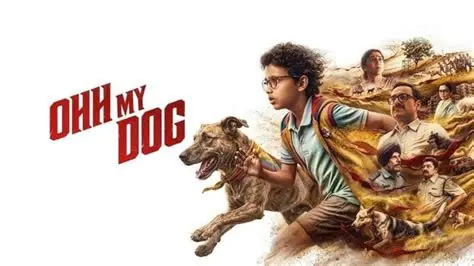
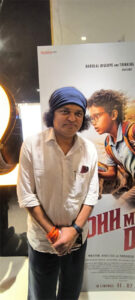
- ‘Ohh My Dog’ goes far beyond a child-and-dog tale to confront crime, greed, organ trafficking and moral collapse
- Director Amit Rai says every ‘hero’ is defined by action and behaviour—not age or species
- “Dogs are best thing that can happen to a man. They change you forever”
- Technology, he says, is only a means; intuitive intelligence remains the real power
- From innocence to justice, the filmmaker seeks to make cinema both a mirror and a solution
SEO KEYWORDS: Ohh My Dog, Amit Rai, Ohh My Dog director interview, Amit Rai exclusive interview, child and dog film, Mahi Rai, Geeta Agrawal Sharma, animal empathy, human animal coexistence, organ trafficking, crime and corruption, cinema and social issues, Karma, family film, Navjeevan Express
R MANICKAVASAGAM
What if a child sees the truth that adults have learned to ignore—and a dog possesses the loyalty that humans have forgotten? That is the provocative emotional universe Amit Rai enters with Ohh My Dog, a film that may wear the innocent face of a child-and-dog story but, beneath it, takes an unflinching look at crime, corruption, organ trafficking, moral decay, empathy, justice, loyalty and the timeless force of Karma.
In an exclusive conversation with Navjeevan Express Editorial Advisor R. Manickavasagam, Rai reveals why his four-legged protagonist “conceived the story” for him, why a hero need not be human—or even an adult—and why cinema must do more than reflect society: it must also offer a way forward.
EXCLUSIVE: AMIT RAI SPEAKS TO NAVJEEVAN EXPRESS
Ohh My Dog appears on the surface to be a child-and-dog family story. But beneath the innocence, what is the deeper human truth you wanted audiences to discover? Is the film ultimately about unconditional love, betrayal, justice—or the consequences of our choices?
The film is about love, justice and bonding, yet it has more things to say. The story is also about loyalty, the concept of ‘Dharma’, and resilience against all odds. It is also about empathy towards animals and the concept of co-existence. We humans are at the top of the animal kingdom, yet we are not the smartest species. We have been utterly selfish towards other species and have many times treated them with disdain and selfishness. Not only towards other species, we are equally selfish and brutal towards our own fellow human beings. The level of disdain and criminal tendencies that we exhibit for each other in our society is numbing. If this attitude goes unchecked, not only are we doomed, but others will perish along with us for sure.
This film is my attempt to spread awareness of love and mutual co-existence.
You have dealt with socially relevant and morally complex subjects before. What made you choose the seemingly innocent world of a child and his dog this time? Was there a darker social reality behind the original idea?
The idea of the film originated with the frustration I feel from certain things that happen around us. Like any conscious individual, I feel both baffled and helpless.
Talking about the subject of the film, the subject of this film is equally relevant and morally complex like my previous films, as it deals with an equally pertinent subject.
The protagonist of the film may be a kid and a dog, but they are heroes for sure. They refuse to relent when others give up and keep working towards their goal without respite.
To be a ‘hero’ lies in the act and behaviour and not in age or a species.
Your film appears to touch upon the uncomfortable reality that crime often survives not merely because criminals exist, but because people in positions of authority sometimes look away—or become complicit. How far does Ohh My Dog question the complicity of the police or the system in allowing crime to flourish?
No crime happens without the connivance of authorities or sometimes because of their amnesia. If someone is grieving or suffering, it is a failure of the system. I wanted to show how crime rackets come into existence and how they prosper. For every penny that is illegally earned, it trails up in the system till it reaches the top. But every illegal penny earned is at human cost, at human suffering, and every human suffering weakens the social fabric; it weakens the belief in the system, belief in moral values, and it collectively leads to disenchantment.
As a concerned citizen, I wanted to highlight it and I have tried to do it through this film.
One of the most disturbing realities today is the alleged kidney-theft and illegal organ-trade racket involving elements of the health mafia. Did real-world stories of organ trafficking, medical exploitation or vulnerable people being targeted influence your treatment of crime in the film? Can cinema expose such a nexus more powerfully than conventional discourse?
During the research of my film, I learned a lot about organ trade and what I learned is truly sickening. I still cannot believe how someone who is involved in such a nefarious act can live a normal life among us without any qualms. Come to think of it, are these people not fathers, brothers, husbands, friends, relatives? How can they sleep peacefully after butchering people for their organs, selling and buying them? How do they feel when they look into their own eyes or into the eyes of their nearest and dearest ones? What can be more demonic than this? What is even scarier is that such demons are living among us, as our near and dear ones.
I have tried the medium of cinema to raise my concern and try to expose them.
When crime is protected by money, influence or institutional silence, ordinary people can feel that justice is impossible. Does Ohh My Dog suggest that karma eventually catches up with those who exploit innocence, or is that the idealistic justice that cinema allows us to believe in?
What we explore in cinema is the value systems that we have been brought up on, the stories that we heard and the moral lessons we have imbibed from them. I am not giving any opaque idealistic justice; I am just reiterating something that has been said in our culture from times unknown. We believe and adhere to the principle of ‘Karma’ and know that karma finally catches up. Look around us and you will find the answer.
The child in Ohh My Dog is shown as tech-savvy and seemingly ahead of the police in connecting the dots and uncovering the truth. Is this deliberate? Are you making a larger point that technology, when placed in the hands of an intelligent and determined individual, can become a powerful tool to detect, prevent and even control crime—and perhaps sometimes succeed where the conventional system fails?
It is not about technology; it is about intelligence and its application. The kid in my film may be tech-savvy, but what about the dog? He is not gadget-driven, yet he is as efficient and lethal as the kid.
They both operate through intuitive intelligence, and that is what matters. Let me give you an example. In my remote village in Bihar, people can look at the sky and rightly guess that it is going to rain after two days, and it rains. During one monsoon season, I saw an elderly man looking at a sudden surge of butterflies, and he predicted that the river water was heading towards their village and would reach there by the next evening. And the flood water reached us by the next afternoon. Similarly, I met an uneducated man in Ranthambore who stared at the pug marks in the soil and correctly predicted the number of tigers that had gone through that route and when. Later on, the camera confirmed his prediction.
Technology is the means to an end and not the end itself. Use technology, but first develop intuitive faculties to use the technology in the best way.
There is a fascinating contrast between the innocence of a child and the moral corruption of adults. Did you deliberately use the child’s worldview as a mirror to expose how complicated—and compromised—the adult world has become?
Every corrupt person was an innocent child once, and that defines the worldview of my story. It is in a child where integrity is not compromised, love and passion are uncorrupted, and enthusiasm borders on naivety. The struggle and triumph in my story can be conceptualised only through this prism. By the way, in the film there is a 55-year-old child who fights and triumphs along with a 12-year-old child. It has nothing to do with age, by the way.
A dog represents loyalty without calculation, while human beings often make choices based on greed, fear or self-interest. Was the dog deliberately conceived as a moral counterpoint to the adult world? What does this child-dog bond reveal about qualities that adults sometimes lose?
I have been a dog parent for a long time and have observed the unconditional love and affection dogs offer to you. It is so humbling. Frankly, I didn’t conceive the dog in the story; rather, the dog conceived the story for me. In all those cuddling and pampering, he whispered the story to me.
Dogs are the best thing that can happen to a man. They change you forever. If we humans learn to love like dogs, this world will be a different place.
Family films can easily become preachy when they tackle social issues. How did you ensure that the film’s ideas about crime, morality, empathy and justice emerge organically from the story rather than sounding like a sermon?
I have been a dog parent for a long time and have observed the unconditional love and affection dogs offer to you.
I don’t make strategy while writing a story. I write a story because I feel the urge to say it. While I have an inclination for my story to be socially commentative, I am equally aware of the commercial success of a film. I try to find a balance between the two.
Your film places a child at the emotional centre of a world involving adult conflicts and wrongdoing. In a society where children increasingly encounter violence, corruption and exploitation through news and social media, what do you believe cinema owes young audiences—innocent escapism, uncomfortable truth, or both?
Cinema not only offers reflections; it also offers solutions. Cinema should oscillate between reflection and solution. Today’s kids are so different from the kids of my generation or, say, a generation above me. They are more focused, informed and ready to take on the world in a much better way than ever before. The character of the film exemplifies the new-age kid who, though innocent, is a go-getter, who is exposed to too much violence and social vices, yet still has the sagacity to make their world through. I want the same for all the kids. They should not remain insulated from the trappings of the modern world but should not be caught in it either. I believe in the calibre of the new-generation kid and their capacity to take the world forward.
If a child watches Ohh My Dog and later asks his parents, “Why do bad people sometimes escape punishment, and why do good people suffer?”, what answer would you want your film to leave behind?
The answer lies in the concept of Karma that I have mentioned earlier. No good deed goes unregistered and no bad deed goes unpunished. It is all a matter of time.
Children and animals are perhaps the most unpredictable performers. What was the most difficult sequence to shoot with the child and the dog—and did either of them ever do something completely unscripted that actually improved the scene?
Shooting with kids and animals is one of the most difficult things to do. It requires a completely different level of planning and execution. We had to plan extensively for months before going on the shoot. Still, in spite of intense preparation, things went massively haywire during the shoot. But I must give credit to my entire team for making this film happen in spite of unsurmountable difficulties.
The most challenging sequence in the film was to shoot with around 250 dogs and manage to get the desired shots. It was the most challenging thing to do, and it stretched the energies of my team to their limit. My God, I don’t know how we pulled it off.
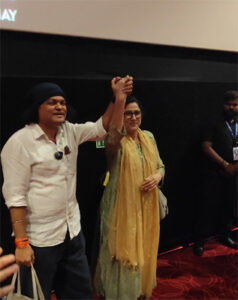
There is also a larger question of filmmaking ethics. What safeguards did you put in place to ensure that the child artist was protected from excessive working hours, pressure and loss of personal space, while the dog was treated safely and humanely throughout the shoot?
We followed all industry protocols, not only for the artists and animals but also for the crew members. All SOPs and safety processes were laid well in advance and managed to the T.
Medical staff, pet trainers, bouncers, local police, local administrative support, emergency parameters—everything was in place during the shoot.
In an industry increasingly driven by action spectacles, sequels and star power, why should a family spend its money and time on Ohh My Dog? What is your strongest emotional and cinematic selling point?
I have an honest story to tell, having both entertainment and lessons. There is so much an audience can take back with them to their home.
It is a story told by heart and honesty, and I know that the honesty and emotion will reach the audience.
Finally, Amit, if Ohh My Dog is remembered not merely as a cute child-and-dog film but as a story about innocence confronting greed, crime and moral corruption—with technology helping uncover the truth and karma eventually catching up with the guilty, would that be the most satisfying legacy for you? And if audiences remember the dog more than the human stars, would you call that an actors’ failure—or the director’s greatest success?
Every story discovers its own destiny and legacy. It will be very improper for me to set paradigms of how the film will be remembered, who will be remembered by the audience or forgotten by the audience and how, whose success it will be accounted as and whose failure it will be adhered to. It is all speculative, and let us leave it to the audience to figure out the legacy parameters. I just wanted to reach the audience, which I did, and now the ball is in their court.