- IIT Gandhinagar study finds nitrogen-focused crop restructuring could cut fertiliser pollution by 13.4% while reducing agricultural water demand by 18.6%
- Model shows 86.8 billion cubic metres of annual water savings and 8.7% lower farm greenhouse-gas emissions without compromising baseline calorie production
- Marginal shift from rice and wheat to maize, jowar, bajra and ragi could generate $1.19 billion—or nearly ₹10,000 crore—in avoided annual socio-environmental costs
- Researchers say the answer is not to abandon rice and wheat, but to grow the right crop in the right place and build markets that make the transition viable for farmers
NE AGRICULTURE & ENVIRONMENT BUREAU
GANDHINAGAR, AUG 21
What if India could tackle fertiliser pollution, groundwater stress and agricultural emissions with the same policy lever—without compromising the country’s food-energy needs?
A new study by IIT Gandhinagar (IITGN) and the Helmholtz Centre for Environmental Research (UFZ), Leipzig, offers a striking answer: put nitrogen surplus—not water alone—at the centre of crop-planning decisions.
Published in Nature Communications, the study models how a carefully targeted restructuring of India’s cereal cropping pattern could simultaneously reduce nitrogen pollution, water consumption and greenhouse-gas emissions while maintaining baseline calorie production. The nitrogen-focused strategy cuts nitrogen surplus by 13.4%, water demand by 18.6%, and agricultural greenhouse-gas emissions by 8.7%.
Most strikingly, the model estimates 86.8 billion cubic metres of annual water savings as a co-benefit of the nitrogen-led strategy and about $1.19 billion (nearly ₹10,000 crore) a year in avoided socio-environmental costs associated with nitrogen pollution.
The big shift: From water-first to nitrogen-first
For years, India’s agricultural sustainability debate has focused heavily on saving water, particularly as groundwater tables decline in parts of the country.
The IITGN-UFZ research challenges that hierarchy.
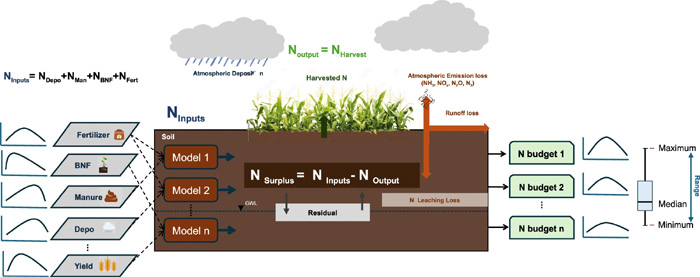
The study defines nitrogen surplus as the difference between nitrogen entering the agricultural system and nitrogen leaving it through crop production. That surplus is a key indicator of potential reactive-nitrogen losses to the environment, with consequences for air pollution, water quality, ecosystems and climate.
“Indian agriculture pulls two emergency levers at the same time, too much fertiliser and too much groundwater. We have been trying to fix this one at a time,” said Professor Udit Bhatia, corresponding author and Associate Professor, Department of Civil Engineering, IITGN.
“What this analysis shows is that there is a single lever, nitrogen surplus, that meaningfully moves both. When we optimise for nitrogen surplus, water savings follow on their own.”
The numbers bear out that proposition.
While a water-focused restructuring could deliver a larger direct reduction in water demand, the nitrogen-focused pathway produces a far stronger reciprocal benefit: its 18.6% water saving is about 4.6 times the nitrogen-saving co-benefit achieved through a water-focused strategy.
Why rice is at the centre of the equation
The science behind the finding is rooted in the resource intensity of India’s cereal landscape.
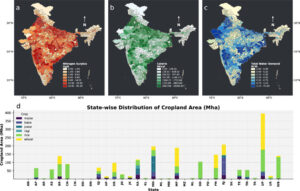
Rice and wheat dominate India’s cereal system, accounting for the largest shares of cereal calorie production and occupying about 74% of cereal cropland in the study’s baseline. Rice is particularly resource-intensive, requiring nearly 1,490 cubic metres of water per tonne and about 177 kg of nutrients per hectare, according to the study’s cited data.
Rice also carries a climate burden because flooded paddy fields generate methane.
The model therefore identifies a relatively simple but consequential intervention: reduce rice and wheat cultivation at the margin in districts where alternative cereals can perform well, and expand crops such as maize, jowar, bajra and ragi.
Under the nitrogen-focused configuration, rice area falls by 8.8% and wheat by 12.1%, while the combined share of maize, jowar, bajra and ragi rises from 24.5% to 32.2% of cereal cropland.
Crucially, however, the researchers are not advocating a wholesale replacement of rice and wheat.
The model preserves existing cultivation patterns and imposes constraints designed to retain baseline calorie production, while alternative cereals can expand only in districts where there is documented cultivation history.
This makes the proposal a targeted crop reallocation rather than a blanket crop-switching prescription.
86.8 billion cubic metres: The water bonus
The study’s most compelling environmental insight is perhaps that water conservation need not be pursued in isolation.
The nitrogen-focused restructuring reduces annual consumptive water demand by 18.6%, equivalent to 86.8 billion cubic metres, while simultaneously lowering nitrogen surplus by 13.4%.
It also cuts nitrogen leaching by 11.3% and nitrogen emissions by 13.9% nationally, demonstrating that a change in crop geography can reverberate through the wider nitrogen cycle.
The climate dividend is significant too, with agricultural greenhouse-gas emissions falling 8.7% under the nitrogen-focused strategy. The study attributes the broader environmental gains to the interconnected effects of reducing resource-intensive cereal cultivation.
“Pursuing food, water and clean air together requires a pivot point, and optimising for nitrogen surplus moves several goals at once,” Professor Bhatia noted.
“Reducing soil pollution also captures water savings, whereas optimising for water alone leaves soil pollution unaddressed,” he added.
The millet opportunity—and the market test
The proposed restructuring could also give India’s traditional coarse cereals a larger role in the national food system.
Jowar, bajra and ragi require less water and can offer better nutrient-use efficiency in suitable agro-climatic zones. Their expansion, however, cannot simply be ordered from policy offices.
Farmers respond to prices, procurement, markets and profitability.
The study’s projected restructuring consequently points to a parallel requirement: stronger procurement, storage, logistics and market support for alternative cereals in regions where such systems are currently weak.
That could also reshape India’s interstate cereal trade.
As rice and wheat flows decline from some major producing States, the model projects increased movement of maize, jowar, bajra and ragi, including new alternative-cereal trade links between States. The researchers say such changes could inform future decisions on procurement, storage and logistics.
Professor Bhatia cautions against blanket prescriptions.
“The point is about growing the right crop in the right place, and pairing any push toward coarse cereals with the markets and support that let farmers make that choice without losing income.”
₹10,000-crore question: can policy follow the science?
The economic implications make the research particularly significant.
By translating reductions in nitrogen leaching and nitrous-oxide emissions into health, ecosystem and climate-related costs, the study estimates $1.19 billion annually in avoided socio-environmental costs.
That figure is not a projected cash saving to farmers or the government; rather, it represents the estimated societal costs of nitrogen pollution avoided under the modelled restructuring scenario.
The researchers are also clear about the study’s boundaries.
The model examines cereal-to-cereal restructuring. Pulses and legumes, which could offer additional nitrogen-management benefits, were not included and could be considered in future research. The calorie constraint preserves food energy rather than the full nutritional profile of diets. Real-world adoption would also depend on farmers, procurement systems, markets and consumers.
Professor Kumar, co-corresponding author and computational hydrologist at UFZ, points out that nitrogen-centric strategies are gaining attention internationally, including in the European Union and China. India, however, has an unusual advantage: its vast agro-climatic diversity provides greater scope for reallocating crops while preserving food security.

For Dr Shekhar Sharan Goyal, lead author and research scientist at UFZ, the timing could not be more relevant.
“Our study arrives at a moment when India is actively rethinking the future of its agricultural system,” he said.
“This is a modelling study, not an implementation plan. But it suggests that nitrogen surplus deserves a more central place in the way India thinks about sustainable agriculture,” he added.
The message emerging from the IITGN-UFZ study is therefore neither “abandon rice” nor “grow more millets”.
It is more nuanced—and potentially more transformative:
India may not have to choose between food security, water security and environmental protection. It may simply have to become smarter about where it grows what.