R ARIVANANTHAM
CHENNAI, AUG 20
Can the South’s development success become its political disadvantage? Can a decades-old river dispute be transformed from a flashpoint into a framework for cooperation? And can the Southern states persuade New Delhi that demographic responsibility should strengthen—not diminish—their voice in Parliament?
மாண்புமிகு ஒன்றிய உள்துறை மற்றும் கூட்டுறவுத் துறை அமைச்சர் திரு.அமித் ஷா அவர்கள் தலைமையில் இன்று (20.8.2026) மகாபலிபுரத்தில் நடைபெற்ற 31-வது தென் மண்டலக் குழுக் கூட்டத்தில், மாண்புமிகு தமிழ்நாடு முதலமைச்சர் திரு.ச.ஜோசப் விஜய் அவர்கள் கலந்துகொண்டு வரவேற்புரையாற்றினார்.… pic.twitter.com/SCjYxlZrqG
— CMOTamilNadu (@CMOTamilnadu) August 20, 2026
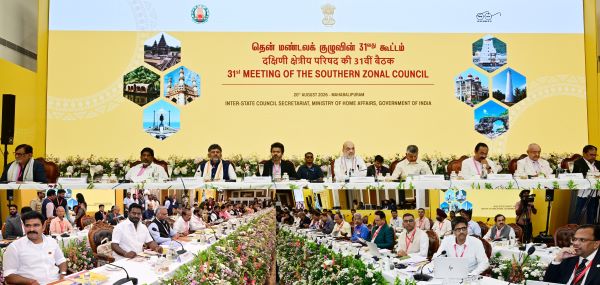
Those questions acquired fresh urgency on Thursday as Union Home Minister Amit Shah chaired the 31st meeting of the Southern Zonal Council at Kovalam near Chennai, bringing the political leadership and senior officials of the region around one table at a particularly consequential moment for federal politics.
- 31st Southern Zonal Council turns into a high-stakes forum on political representation, federal balance and inter-State water security
- Shivakumar seeks 1971 Census as delimitation base, 543 Lok Sabha seats frozen for 25 years
- Karnataka CM says population control must not become a “penalty” for the South’s political voice
- Mekedatu pitch puts Cauvery once again at the heart of Karnataka-Tamil Nadu dialogue
- Vijay-Shivakumar interaction acquires significance amid continuing Cauvery tensions
- Satheesan’s “key interaction” with Vijay adds another political dimension to a conclave designed for Southern cooperation
The deliberations brought into sharp focus three of the South’s most politically sensitive fault lines—delimitation, inter-State water sharing and regional development. Karnataka Deputy Chief Minister D K Shivakumar placed the question of parliamentary representation squarely before the Council, while the long-running Cauvery water-sharing dispute and Karnataka’s proposed Mekedatu balancing reservoir added a potentially combustible water dimension to the proceedings.
The meeting also acquired a distinctly Tamil Nadu political resonance with Chief Minister C Joseph Vijay, seated next to Shivakumar, interacting with his Karnataka counterpart against the backdrop of the Cauvery dispute. Kerala Chief Minister V D Satheesan separately described his interaction with Vijay on the sidelines as a “key interaction.”
The Council comprises Tamil Nadu, Kerala, Karnataka, Andhra Pradesh and Telangana, besides the Union Territories of Puducherry, Andaman and Nicobar Islands and Lakshadweep. It is a statutory inter-State forum created under the States Reorganisation Act, 1956, intended to promote cooperation and coordination on issues of common interest. Tamil Nadu’s recent nominations to the Council included Ministers R Nirmalkumar and A Rajmohan, with Vijay serving as ex-officio member.
Delimitation: Shivakumar puts the South’s political weight on the table
The most politically consequential intervention came from Shivakumar, who urged the Council to adopt a resolution asking the Union government to retain the 1971 Census as the basis for delimitation, keep the Lok Sabha’s present 543-seat strength unchanged for the next 25 years, and accommodate women’s reservation within those existing seats.
His argument was built around a fundamental federal question: should States that successfully implemented population stabilisation be exposed to the possibility of diminished political representation?
“The southern states’ success in controlling its population must not become a reason for reducing its political voice,” Shivakumar said.
He added:
“We welcome the assurance that no southern state will lose seats. But representation is not only about numbers. It is about weight, and about voice.”
The Karnataka leader called for the 1971 population basis to be respected and the overall strength of the Lok Sabha to remain unchanged.
“I am confident that all the chief ministers here will support me in what I say. Let the 1971 basis be honoured, and let the strength of our voice be protected,” he said.
The demand also sought to connect delimitation with the implementation of women’s reservation. Shivakumar argued that reservation for women should not have to wait for a fresh delimitation exercise and proposed that it be accommodated within the existing 543 Lok Sabha seats.
His intervention places the Southern Zonal Council at the centre of a national debate over the political consequences of demographic change—particularly for States that have substantially slowed population growth compared with several parts of northern India.
The 543-Seat question: Can representation grow without diluting the South?
At the heart of the argument is a constitutional and political paradox.
India needs delimitation to reflect population changes and ensure equitable representation. Yet the Southern states contend that a purely population-driven redistribution could reward States with higher population growth while penalising States that invested for decades in education, public health and family planning.
That is why Shivakumar’s proposal to retain 543 seats for 25 years assumes significance. Rather than opposing women’s reservation, his formula seeks to place it within the existing numerical framework.
The issue is no longer merely about the number of constituencies. It is increasingly about what constitutes equitable representation in a Union of States whose demographic trajectories have diverged sharply.
The Southern Zonal Council, therefore, provided an unusual institutional setting for that argument to be articulated collectively.
Mekedatu: “Help us help you” — Karnataka takes the Cauvery case to the Southern Table
If delimitation represented the South’s political anxiety, Mekedatu represented the region’s water anxiety.
Karnataka’s proposal for a balancing reservoir at Mekedatu has long been opposed by Tamil Nadu, which maintains that the project could affect its interests in the Cauvery basin.
Shivakumar used the Council platform to present Karnataka’s position while simultaneously making an appeal for dialogue with Tamil Nadu.
Recalling a conversation with Andhra Pradesh Chief Minister N Chandrababu Naidu while walking into the meeting, Shivakumar said:
“Chandrababu Naidu ji told me that we need to solve the Cauvery water issue between Karnataka and Tamil Nadu.”
He then made his appeal directly:
“Let me assure you, every drop of water from the Mekedatu project will help farmers in Tamil Nadu and Puducherry. Help us help you.”
That formulation is significant because it attempts to reposition Mekedatu not simply as a Karnataka project, but as part of a larger argument about water management, storage and downstream agricultural interests.
Tamil Nadu, however, has consistently opposed the proposed balancing reservoir, arguing that the project could affect the State’s established interests in the Cauvery waters. The dispute has remained one of the most enduring inter-State water conflicts in the South. Recent developments have seen Tamil Nadu reiterate its determination to protect its rights and pursue legal avenues over Mekedatu.
Vijay-Shivakumar moment: Political differences meet federal necessity
Against this background, the interaction between Vijay and Shivakumar carried significance beyond the optics of a formal meeting.
The two leaders were seated next to each other during the Council proceedings, providing an opportunity for direct engagement at a time when the Cauvery question remains politically sensitive.
For Tamil Nadu, the Mekedatu issue is fundamentally about safeguarding downstream water interests. For Karnataka, the project is projected as a storage and drinking-water intervention with broader basin-management implications.
The Council’s very purpose, however, is to create a platform where such differences can be aired within a framework of institutional dialogue.
That is where Thursday’s meeting could prove more important than the individual statements: the South’s most difficult disputes were being discussed not in isolation, but within a forum explicitly designed to find common ground.
Satheesan-Vijay interaction adds another Southern political thread
Kerala Chief Minister V D Satheesan also highlighted his interaction with Vijay on the sidelines of the meeting.
Sharing photographs, Satheesan said: “On the sidelines of the Southern Zonal Council meeting in Mahabalipuram (Mamallapuram), had a key interaction with Tamil Nadu Chief Minister C Joseph Vijay. P K Kunhalikutty (Minister for Industries and Information Technology of Keralam) was also present.”
Separately, Shivakumar said the conclave gave leaders an opportunity to engage with chief ministers, deputy chief ministers, ministers and senior officials from across the southern region.
He said shared priorities and issues concerning the progress, development and interests of the region were discussed and reiterated Karnataka’s commitment to working with neighbouring States to strengthen the South and contribute to a stronger India.
That sentiment captures the larger purpose of the Southern Zonal Council: cooperation without erasing differences.
Amit Shah’s Southern Table: From water to security, from investment to federal coordination
The Southern Zonal Council is not confined to political disputes.
The meeting brings together the region’s political and administrative leadership to deliberate on inter-State cooperation, economic development, infrastructure, investment, water-sharing arrangements, internal security, crime prevention, education, healthcare, technology and other matters requiring coordination.
Ahead of the meeting, reports indicated that the agenda was expected to include inter-State issues, development priorities, water sharing, security and follow-up on decisions taken at earlier Council meetings.
The Council’s institutional importance is underlined by its composition: five major southern States and three Union Territories sit within the same framework, giving the forum an unusually broad regional mandate.
For Tamil Nadu, the setting also marked an important moment for the newly formed C Joseph Vijay-led government, whose representation in the Council was formally notified in July.
The bigger question: Can the South turn differences into a common voice?
Thursday’s meeting leaves behind a question larger than delimitation or Mekedatu.
Can the South articulate a common federal agenda without requiring all five States to agree on every issue?
The answer may lie precisely in the structure of the Zonal Council.
Tamil Nadu and Karnataka can disagree over Cauvery. Southern States can differ over individual development priorities. Yet they share common concerns over infrastructure, investment, logistics, technology, education, healthcare, demographic change, internal security and their collective role in India’s economic future.
The delimitation debate adds another layer: the South increasingly wants its contribution to national development to be recognised as a strength rather than converted into a representation penalty.
That is why Shivakumar’s formulation—“representation is not only about numbers. It is about weight, and about voice”—may ultimately prove to be one of the defining political messages emerging from the Kovalam conclave.
And in a region where the Cauvery can divide two neighbouring States, the larger challenge before the Southern Zonal Council is to demonstrate that dialogue can still make the South speak with one voice when its collective interests are at stake.