- Global spiritual leader calls on world leaders to turn inward for peace and resilience
- UN Headquarters hosts ‘Healing the World from Within’ session with diplomats and ambassadors
- Meditation highlighted as a vital tool to address stress, conflict and global polarisation
NE SPIRITUAL BUREAU
NEW YORK, DEC 20
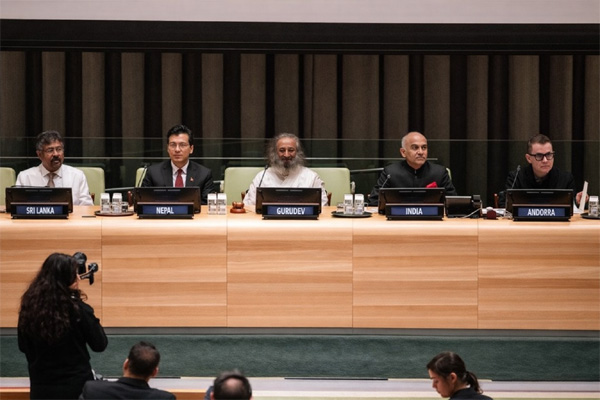
“Today, we are living in circumstances that are no less than a war zone,” said humanitarian and spiritual leader Gurudev Sri Sri Ravi Shankar while addressing a distinguished gathering at the United Nations Headquarters in New York on Friday, December 19. Speaking ahead of World Meditation Day 2025, observed annually on December 21, Gurudev urged global leaders and communities to reconnect with inner stillness through meditation, describing it as essential for restoring peace at both individual and societal levels.
The keynote session brought together diplomats, ambassadors, UN officials and community leaders for an evening dedicated to inner well-being, reflection and collective calm. The event was organised as part of the global lead-up to World Meditation Day, which was designated by the United Nations in 2024, underscoring the growing international recognition of mental and emotional well-being.
With over four decades of engagement across more than 180 countries, Gurudev’s work spans humanitarian relief, conflict resolution, youth leadership and mental well-being. From refugee camps and conflict zones to global institutions and community platforms, his long-standing vision of a stress-free and violence-free society consistently places inner peace at the core of social harmony.
The UN gathering was convened under the theme “Healing the World from Within,” reflecting the increasing emphasis on inner well-being as a foundation for resilience, cooperation and peacebuilding. Drawing on his experiences across diverse global communities, Gurudev shared insights on easing stress, reducing polarisation and nurturing hope in an increasingly complex and divided world.
Sharing a powerful example from conflict-affected regions, Gurudev said, “In Ukraine, 8,000 people meditated and found peace. Many of them were soldiers who, at the time, felt a deep sense of darkness within, with no hope. They were depressed and unable to sleep. Meditation helped them regain their spirit.” Stressing the urgency of inner transformation, he added, “In such a situation, it is extremely important for us to turn inward.”
The keynote address concluded with a guided meditation led by Gurudev, briefly transforming one of the world’s most recognised diplomatic spaces into a moment of shared stillness. Participants described the experience as deeply grounding, offering a rare pause for reflection amid the intensity of multilateral engagement.
The session also built on the momentum of World Meditation Day 2024, when Gurudev was invited by the United Nations to lead a global meditation that reached more than 8.5 million participants worldwide, both online and in person.
Since its inception, World Meditation Day has emerged as a unifying platform for governments, international organisations and civil society to acknowledge the role of inner well-being in public health, social cohesion and peacebuilding. Across schools, workplaces, community centres and humanitarian settings, meditation is increasingly being embraced as an accessible practice to foster emotional balance, clarity and compassion.
Rooted in India’s ancient wisdom traditions and carried forward through Gurudev’s lifelong work with The Art of Living, meditation has gained global acceptance as a universal human skill, transcending religion and nationality. As the world moves toward the observance of World Meditation Day on December 21, 2025, the UN gathering in New York stood as a compelling reminder that shared moments of inner stillness can strengthen dialogue, understanding and collective intention at the global level.