NE NEWS SERVICE
WASHINGTON, DEC 14
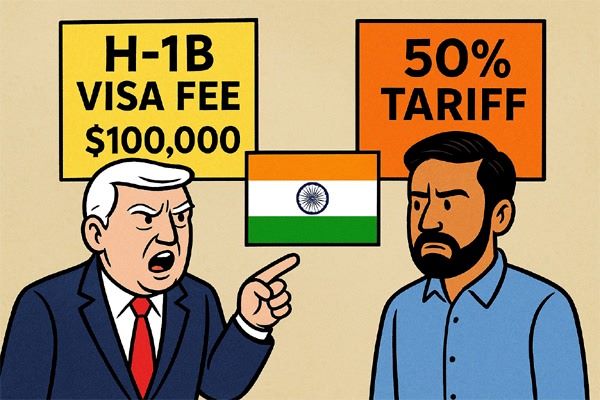
A growing backlash is building across the United States against key economic and immigration policies targeting India, with 20 states filing a lawsuit against President Donald Trump’s $100,000 H-1B visa fee, even as Democratic lawmakers move to terminate steep tariffs of up to 50 per cent on Indian imports, calling both actions illegal and economically damaging.
- 20 states sue over $100,000 H-1B visa fee, calling it unlawful and harmful
- California AG says fee will worsen labour shortages in education and healthcare
- Democratic lawmakers move to terminate up to 50% tariffs on Indian imports
- Resolution led by Raja Krishnamoorthi challenges misuse of emergency powers
- Visa curbs and tariffs seen as undermining US–India economic partnership
States Challenge ‘Illegal’ $100,000 H-1B Visa Fee
Lawsuit says DHS overstepped authority, bypassed rulemaking
The Trump Administration’s $100,000 charge is an unnecessary and unlawful obstacle designed to shut out the skilled workers America depends on.
No president can ignore Congress, ignore the Constitution, or ignore the law. pic.twitter.com/etJXoxxG71— Rob Bonta (@AGRobBonta) December 13, 2025
Twenty US states have filed a lawsuit challenging the Trump administration’s decision to impose a $100,000 fee on new H-1B visa petitions, arguing that the policy violates the Administrative Procedure Act and the US Constitution.
California Attorney General Rob Bonta, whose office is leading the case, said the administration lacked the authority to impose such a fee through a presidential proclamation issued on September 19, 2025. The Department of Homeland Security applied the policy to H-1B petitions filed after September 21, granting the Homeland Security Secretary discretion over exemptions.
“As the world’s fourth largest economy, California knows that when skilled talent from around the world joins our workforce, it drives our state forward,” Bonta said.
“President Trump’s illegal $100,000 H-1B visa fee creates unnecessary — and illegal — financial burdens on California public employers and other providers of vital services, exacerbating labour shortages in key sectors,” he added.
Education and Healthcare Face Acute Workforce Risks
States warn of worsening shortages in schools and hospitals
The lawsuit argues that H-1B-related fees have historically been limited to the cost of administering the programme, noting that employers currently pay between $960 and $7,595 for initial petitions.
Attorneys general warned that the new fee would sharply worsen staffing shortages, particularly in education and healthcare, sectors that rely heavily on H-1B professionals.
During the 2024–2025 school year, 74 per cent of US school districts reported difficulty filling open positions, especially in special education, physical sciences, ESL and bilingual education. Educators form the third-largest occupational group among H-1B holders.
Healthcare providers also depend on the programme, with nearly 17,000 H-1B visas issued for medicine and health occupations in fiscal 2024, about half to physicians and surgeons. The US is projected to face a shortage of 86,000 physicians by 2036.
The lawsuit was filed by Bonta and Massachusetts Attorney General Andrea Joy Campbell, joined by attorneys general from Arizona, Colorado, Connecticut, Delaware, Hawaii, Illinois, Maryland, Michigan, Minnesota, Nevada, North Carolina, New Jersey, New York, Oregon, Rhode Island, Vermont, Washington and Wisconsin.
Congress Moves to End 50% Tariffs on Indian Imports
Resolution challenges national emergency invoked under IEEPA
.@DeborahRossNC @RepVeasey & @CongressmanRaja introduced a resolution to terminate President Trump’s 50 percent tariffs on imports from India. #Breaking pic.twitter.com/3eFt2Z5Lkg
— Rohit Sharma 🇺🇸🇮🇳 (@DcWalaDesi) December 13, 2025
Parallel to the legal battle over visas, a group of influential Democratic lawmakers has introduced a resolution in the US House of Representatives seeking to terminate tariffs of up to 50 per cent on imports from India.
The move is led by Indian American Congressman Raja Krishnamoorthi, along with Congresswoman Deborah Ross and Congressman Marc Veasey. The resolution aims to end the national emergency declared by President Trump under the International Emergency Economic Powers Act (IEEPA), which authorised sweeping tariffs on Indian goods.
According to the sponsors, the action would also rescind the additional 25 per cent “secondary” duties imposed on August 27, layered over earlier reciprocal tariffs, pushing total duties on some Indian-origin products as high as 50 per cent.
‘Counterproductive’ Approach to a Strategic Partner
Lawmakers warn tariffs hurt US workers and consumers
“President Trump’s irresponsible tariff strategy toward India is a counterproductive approach that weakens a critical partnership,” Krishnamoorthi said.
“Instead of advancing American interests or security, these duties disrupt supply chains, harm American workers, and drive up costs for consumers,” he added.
Ross said the impact of the tariffs is being felt well beyond Washington, particularly in states such as North Carolina, which has deep commercial and community ties with India.
The initiative follows a bipartisan Senate-passed measure to end tariffs imposed on Brazil, reflecting growing congressional concern over what lawmakers describe as the misuse of emergency authorities to impose trade restrictions.
India at the Crossroads of US Visa and Trade Policy
H-1B programme and tariffs central to bilateral economic ties
The H-1B visa programme remains a critical pathway for skilled foreign workers, including large numbers of Indian professionals in technology, healthcare and academic research. Government and non-profit employers such as universities, schools and hospitals are generally exempt from the annual cap of 65,000 visas, with an additional 20,000 reserved for advanced-degree holders.
Taken together, the legal challenge to the visa fee and the congressional effort to end tariffs highlight mounting resistance to policies seen as undermining the US–India economic and strategic partnership.