
NE AUTOMOBILE BUREAU
COIMBATORE, OCT 12
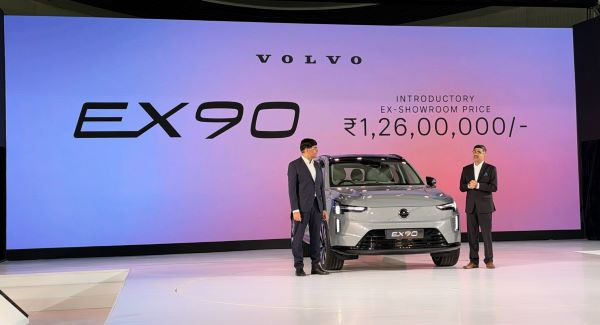
Can a luxury SUV become smarter, safer and more capable long after it leaves the showroom? Volvo Car India is betting on precisely that proposition with the launch of its all-electric flagship, the EX90, at an introductory ex-showroom price of ₹1.26 crore. Positioned as the Swedish marque’s first software-defined vehicle (SDV) in India, the six-seat luxury SUV combines electric performance, connected technology and an extensive suite of safety systems to signal a new phase in the company’s premium mobility strategy.
Built on Volvo’s SPA2 platform, the EX90 brings together Scandinavian design, a twin-motor electric powertrain, a claimed driving range of up to 625 km under the WLTP cycle and software capabilities designed to evolve through over-the-air (OTA) updates. Bookings are open, customer experiences and drives are scheduled to begin in November 2026, and deliveries are expected to commence in January 2027.
The introductory offer, applicable to bookings made until December 31, 2026, includes an 11-kW wallbox charger and a three-year service package. Volvo Cars dealerships are also offering a 65% buyback option after three years, subject to the applicable terms and conditions.
Speaking at the 90-90 show in Delhi, Jyoti Malhotra, Managing Director, Volvo Car India, said:
“The launch of the EX90 is a major milestone in Volvo Car India’s commitment towards a more electric, software-defined future. This flagship SUV also brings a new era of mobility with its unparalleled comfort, technology and superb range. We feel that it is the perfect luxurious family SUV that brings you peace of mind, keeps safety at the forefront and gives you the best experience of Swedish luxury.”
Software that can evolve after delivery
At the heart of the EX90 is a computing architecture designed to make the vehicle more than a conventional electric SUV. Powered by the NVIDIA DRIVE platform and Qualcomm Snapdragon 8155 cockpit technology, it uses a central computing system capable of processing approximately 254–280 trillion operations per second, according to the supplied specifications.
The cabin features a 14.5-inch central touchscreen with an integrated Google ecosystem, including Google Maps, alongside wireless Apple CarPlay and continuous OTA software updates. The platform is designed to support the evolution of vehicle functions and connected experiences through software upgrades, although the availability of individual features may depend on market specifications and future updates.
The EX90 also supports bi-directional charging, enabling energy-sharing applications where supported by the vehicle configuration and compatible charging infrastructure.
Electric power with flagship performance
The SUV draws power from a high-voltage 106-kWh lithium-ion battery and a twin-motor electric drivetrain producing 335 kW, or 456 hp, and 670 Nm of torque. Volvo quotes a 0–100 km/h acceleration time of 5.5 seconds.
Its projected WLTP range is up to 625 km, while the supplied specifications cite an ICAT-rated range of up to 725 km. These figures are based on different testing cycles and should not be treated as directly comparable. Actual driving range will vary with road conditions, speed, temperature, driving style, vehicle load and use of climate-control systems.
For buyers considering a switch from conventional luxury SUVs to electric mobility, the combination of long-distance range claims, home charging support and a bundled service package will be central to assessing the ownership proposition.
Safety engineered around the occupants
Safety remains a defining part of Volvo’s brand positioning. The EX90 deploys a sensor suite comprising five cameras, five radars and 12 ultrasonic sensors, supported by a 360-degree camera with a 3D view.
Its assistance technologies include Pilot Assist, adaptive cruise control, occupant-sensing technology and collision-avoidance systems intended to help protect occupants and other road users, including pedestrians.
The sensor-rich architecture is designed to provide the vehicle with a more comprehensive understanding of its surroundings. However, these systems are driver-assistance technologies, not a substitute for attentive driving, and their operation is subject to system limitations and road conditions.
Scandinavian craftsmanship meets a six-seat layout
Inside, the EX90 pairs minimalist Scandinavian styling with premium materials and family-oriented practicality. Highlights include back-lit wood décor, ventilated Nappa leather seats in Dawn, four-zone climate control and a panoramic electrochromic sunroof.
The six-seat configuration uses captain’s chairs, with easier access to the third row and power-folding rear seats to help accommodate changing passenger and luggage requirements.
An elaborate 25-speaker Bowers & Wilkins high-fidelity audio system, rated at 1,610 watts, adds Dolby Atmos and Abbey Road Studio modes to the cabin experience. The arrangement is intended to make the EX90 as much a technology-rich lounge on wheels as a long-distance family vehicle.
Measuring 5,037 mm in length, 2,113 mm in width including mirrors and 1,744 mm in height, the SUV has a kerb-weight range of 2,504–2,712 kg, according to the supplied specifications.
Six colours, one electric flagship
The EX90 will be available in six exterior shades: Denim Blue, Sand Dune, Mulberry Red, Crystal White, Onyx Black and Vapour Grey.
The launch also brings a glimpse of Volvo’s next potential electric offering for India: the ES90 luxury sedan, which the company has officially teased. Further details on its Indian launch timeline and specifications have not been provided in the supplied announcement.
With the EX90, Volvo is placing its emphasis on a convergence of electrification, software, safety and premium family comfort. The larger question for India’s luxury-electric market is whether buyers will value a vehicle not only for its range and performance at purchase, but also for its capacity to acquire new capabilities through software over time.