- From Matwad to the salt-laden sands of Dandi, a march becomes a moral compass
- Inclusivity over distance, truth over power—Gandhian values find new footsteps
- A timeless message for today’s youth: courage, conscience and collective action
NE DEFENCE BUREAU
AHMEDABAD, JAN 19
Nearly a century after Mahatma Gandhi’s Salt March shook the conscience of an empire, a group of modern walkers retraced that sacred path—not to recreate history, but to reawaken its relevance. Day 15 of the Dandi March reenactment, covering the final stretch from Matwad to Dandi on January 17, was not an ending. It was a widening of purpose.
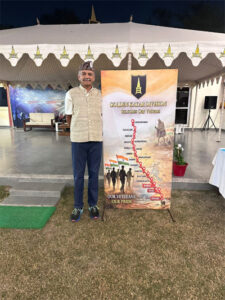
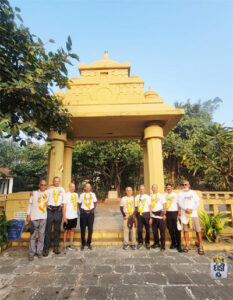
On the last day, the original nine core walkers were joined by five veterans, affectionately dubbed the “B-Complex group”—late entrants who brought fresh energy, new ideas and an unmistakable lift in spirit. As Dandi drew closer, the march seemed to grow larger in meaning, echoing Gandhiji’s belief that movements must expand hearts, not close ranks.
Inclusivity Was the Destination
The final leg was intentionally kept short so that many could walk together. By morning, the road became a living tapestry—sarpanches, NCC cadets, police personnel, villagers, children, men and women—some flying into Surat just to walk the last five kilometres. Distance did not matter; presence did. Though the road was modern tarmac, the spirit unmistakably belonged to 1930.
The walkers paused at the Prarthana Sthal, beneath the banyan tree where Gandhiji prayed on the night of April 5, 1930, on the eve of breaking the salt law. Inscribed there, in Gujarati, were words that continue to guide civilizations:
“God is Truth and Truth is God.”
Nearly a hundred years later, the stillness of the place felt intact—as if time itself had bowed in reverence.
Where History Breathes
The National Salt Satyagraha Memorial, spread across 14 acres, unfolded like a living archive. Twenty-four granite murals, crafted in panch dhatu (five metals), narrate the many dimensions of the original march. For the walkers—especially the core nine who had walked through all 24 villages—the resonance was deeply personal.
The most stirring moment came during the symbolic making of salt. It felt as though an invisible umbilical cord—or a modern USB cable—had connected the walkers of today with those of 1930, transferring resolve, intent and courage across generations. Humbling. Satisfying. Introspective. A perfect culmination of 425 kilometres on foot.

History’s irony was not lost. After the original salt-making, British authorities tried to destroy the site by sending hundreds of horses to churn the mud, rendering extraction impossible. Yet an unnamed Indian outwitted them—digging a small pit, covering it with leaves and thorns, forcing the horses away. That untouched patch became the exact spot where Gandhiji collected salt and boiled it, preserved today at Saifee Villa.
A Statue That Spoke to the Future
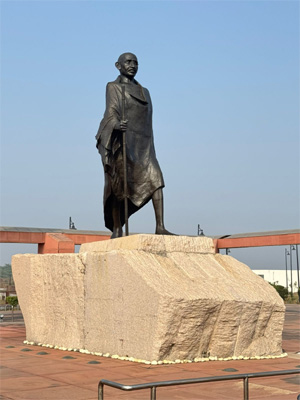
Beside a towering statue of Gandhiji, the group posed for a photograph. This was not the familiar image of a frail man leaning on a stick. This Gandhiji strode forward—upright, muscular, eyes lifted, purposeful. The same Mahatma, seen through the lens of a confident, resurgent nation—a powerful metaphor for Viksit Bharat 2047.

As the walk ended, an unexpected emptiness crept in. After days governed by rhythm and resolve, there was suddenly nowhere left to walk. Then the black sands of Dandi appeared. One walker stepped forward, knelt, and bowed his forehead to the ground. Politics, narratives and ideologies dissolved. This was hallowed land. Tears flowed freely—a convergence of effort, fatigue, achievement and quiet pride.
A handful of sand slipped through fingers, its texture memorised, a small portion carried home.
Learning, Living, Remembering
Guided by Kalubhai, a sociology scholar, the group explored the memorial in depth—Saifee Villa, the movement’s nationwide impact, and a man-made lake symbolising sustainability. The complex itself is net-zero, powered by solar “trees” whose stainless-steel leaves generate energy.

Nation-building is not a sprint—it is a march.-NE photo
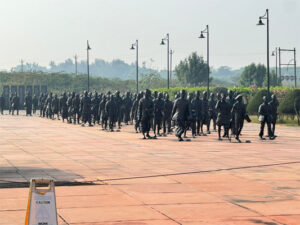
Among the most evocative installations was a line of 78 life-size bronze statues, walkers frozen mid-stride and led by Gandhiji—allowing visitors to walk among the marchers of 1930. Dandi walkers amongst Dandi walkers, separated by 95 years.
NCC cadets performed a graceful yoga display, a reminder that discipline, balance and service remain timeless.
The return drive from Dandi to Ahmedabad felt like walking the path in reverse—an experience once captured by scholar Dr Harmony Siganporia in her book Walking from Dandi – In Search of Vikas, which vividly brings the journey to life.
A warm send-off awaited in Ahmedabad. A slideshow traced the march; T-shirts, badges and mementoes were shared with supporters. Then came a surprise: a thoughtfully chosen memento—a medallion embossed with Gandhiji, a book, and a stainless-steel bookmark bearing his walking silhouette. A memory crafted to last a lifetime.
Late into the night, conversations flowed. Flights beckoned. Life resumed its pace.
Yet the echoes of Dandi lingered.
Message for Today’s Youth
The march was a reminder that Gandhian ideals are not relics—they are tools. In an age of speed and spectacle, truth, non-violence, courage and collective action remain the most powerful instruments of change. Gandhiji taught that ordinary people, walking together with conviction, can challenge injustice and reshape destiny.
For today’s youth, Dandi’s lesson is clear:
Stand for what is right. Walk the hard road. Let purpose outrun convenience.
Nation-building is not a sprint—it is a march.