- Gujarat’s high burden of sickle cell disease and thalassemia makes early Bone Marrow Transplant evaluation critical
- Apollo Hospitals Ahmedabad delivers world-class BMT at 10–30% lower cost, backed by strong Gujarat government transplant support
- Survival rates now comparable with leading global centres as India emerges as a cellular therapy destination
- AI-powered precision care, early screening and donor matching redefine cancer and blood disorder outcomes
R MANICKAVASAGAM
AHMEDABAD, FEB 20
Gujarat continues to face a significant burden of inherited blood disorders, particularly sickle cell disease and thalassemia, placing thousands of families under lifelong medical and financial strain.
According to data tabled in Parliament, over 77.34 lakh individuals have been screened for sickle cell disease in Gujarat, with more than 28,000 confirmed cases. Nationally, over 33 lakh individuals have been screened for thalassemia, with thousands diagnosed as major cases or carriers.
For many families, management often means lifelong blood transfusions, iron chelation therapy and repeated hospital visits. However, experts stress that Bone Marrow Transplant (BMT) — also known as haematopoietic stem cell transplant — is today a curative option for thalassemia major, severe sickle cell disease, several leukemias, lymphomas and bone marrow failure syndromes.
“We are curing diseases once considered fatal”
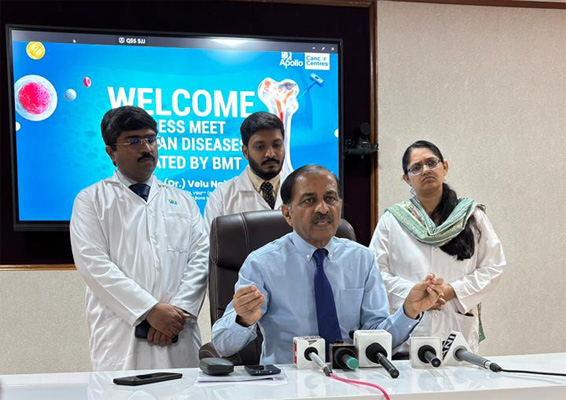
Lt. Gen. Dr Velu Nair (Retd), Haemato-Oncologist at Apollo Hospitals, said: “Bone Marrow Transplant has transformed the outlook for patients with serious blood disorders. We are today curing diseases that were once considered fatal. For many children and young adults with thalassemia major, severe sickle cell disease, leukemias or marrow failure syndromes, transplant offers long-term disease control or cure.”
He further added: “Gujarat government has been very generous in supporting all kinds of transplants, including BMT. Apollo Hospitals offers world-class BMT at 10–30 per cent less cost than many other centres. In keeping with the times, the hospital also deploys AI across departments to ensure best treatment planning and early recovery.”
How revolutionary is BMT today?
According to Dr Nair the transformation over the last decade has been dramatic:
- Advanced donor matching techniques
- Safer conditioning regimens
- Improved infection control
- Better ICU and supportive care
- Integration of AI for treatment precision
Survival rates in specialised centres are now comparable with leading global hospitals, particularly when patients are referred early.
India is also emerging as a destination for advanced cellular therapies, including CAR-T cell therapy for relapsed or refractory leukemias and lymphomas.
“CAR-T therapy represents a major step forward in precision immunotherapy. It is changing outcomes for patients who previously had limited options,” Dr Nair said.
Youngest and most critical cases: Hope across age groups
- Baby A, a 16-month-old from Gandhinagar with Inherited Bone Marrow Failure Syndrome, underwent a matched related donor transplant in January 2026 and is recovering well.
- Master R, 11, from Botad with transfusion-dependent thalassemia major, underwent haploidentical transplant in 2024 and is stable on follow-up.
- Ms S, 30, treated for Hodgkin’s Lymphoma with autologous stem cell transplant in 2019, remains cancer-free for over six years.
- Mr M, 20, with relapsed Acute Myeloid Leukemia (FLT3 positive), underwent transplant in 2024 and is in remission.
- Mr A, 53, diagnosed with AML (intermediate risk), underwent haploidentical transplant in 2022 and remains disease-free.
- Mrs V, 73, with relapsed Diffuse Large B-Cell Lymphoma, received CAR-T cell therapy in 2025 and is in remission.
- Child P, 6, with rare Shwachman-Diamond Syndrome, successfully underwent a third transplant after prior graft failures and is recovering with restored blood counts.
These cases demonstrate that BMT and cellular therapy are no longer age-restricted miracles but structured, evidence-based curative interventions.
- Following Press Council of India advisory, patient names have been changed to protect privacy.
Is India becoming a global BMT destination?
Experts believe India is rapidly emerging as a competitive global hub due to:
- Skilled haemato-oncologists
- Advanced transplant units
- Lower procedural costs
- Government support schemes
- Expanding donor registries
Apollo Hospitals’ “Zero to Hero” campaign aims to raise awareness about early detection and timely transplant evaluation, significantly improving survival outcomes.
Why early referral matters
Doctors emphasise that early screening, genetic counselling and timely transplant consultation can:
- Reduce lifelong transfusion dependence
- Prevent organ damage
- Improve survival probability
- Lower long-term costs
With Gujarat facing a measurable burden of genetic blood disorders, expanding awareness about BMT is critical.
“Early referral is the difference between lifelong management and potential cure,” Dr Nair stressed.