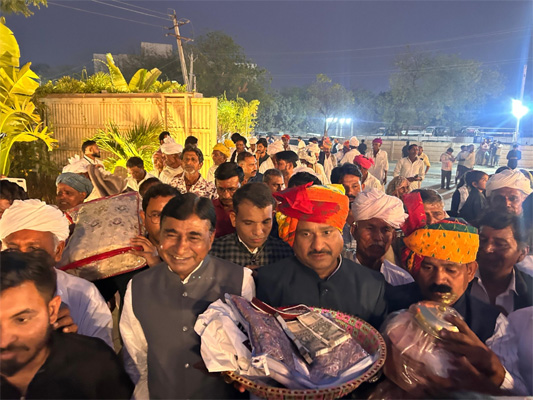

- Over 2,000 members from 45+ villages gather at Lapkaman to honour philanthropist Bababhai Bharwad’s daughter
42 Thakor and Jagirdar Darbar groups unite in an unprecedented social gesture in North Gujarat
Collective ‘Mameru’ celebrates gratitude for crores donated towards girls’ education and rural upliftment
Leaders across parties hail the event as a living example of social harmony beyond caste lines
NE NEWS SERVICE
AHMEDABAD, FEB 22
In an extraordinary demonstration of solidarity and gratitude, more than 2,000 members of the Kshatriya Thakor community from over 45 villages of Patan district converged at Lapkaman in Ahmedabad to perform a historic “collective Mameru” on the wedding of the daughter of philanthropist and former Ghatlodia corporator Bababhai Kanjibhai Bharwad.
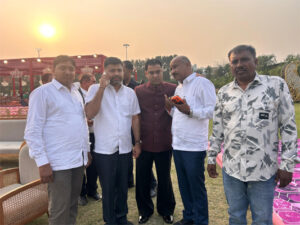
Unity Beyond Caste Lines: 42 community groups stand together in North Gujarat’s landmark event. – NE photo
Held at Kasumbal Ness on Friday evening between 4 pm and 6 pm, the ceremony transcended conventional social boundaries. For perhaps the first time in North Gujarat’s socio-cultural history, 42 groups of the Thakor community along with members of the Jagirdar Darbar community jointly organised a community-level ‘Mameru’ — a cherished Gujarati wedding tradition symbolising maternal blessings and familial support.
Gratitude in Action
Bababhai Bharwad, widely respected for channeling crores from his personal resources into girls’ education and welfare initiatives in Patan Panthak and beyond, has funded the distribution of educational tablets, bicycles and scholarships to students from economically weaker sections.
Addressing the gathering, Bababhai Bharwad said, “I have always believed that education is the strongest foundation for social transformation. Whatever I have done was my duty towards society. Today, the love shown by the Thakor community is not for me alone — it is for the cause of education.”
He added, “This ‘Mameru’ is not a ritual; it is a message that when we invest in our daughters’ future, society stands united.”
A Rare Social Milestone
Community leaders described the event as unprecedented in scale and spirit.
Bharatsinh Solanki said, “When communities come together like this, it sends a powerful message across Gujarat — unity is our real strength. This is not just a family function; it is a social milestone.”
Radhanpur MLA Lovingji Thakor remarked, “We often speak about social harmony. Today, we have demonstrated it. The Thakor community has shown that gratitude must be expressed collectively.”
Amaratji Thakor noted, “Bababhai’s contribution to girls’ education in Patan and surrounding regions has changed hundreds of lives. This collective Mameru is our way of saying that society remembers and respects selfless service.”
Former MLA Baldevji Thakor observed, “Political differences may exist, but social unity stands above all. This event has strengthened the social fabric of North Gujarat.”
Patan District BJP President Bharatbhai Arya said, “When 45 villages gather under one roof in discipline and devotion, it proves that Gujarat’s grassroots unity is alive and thriving.”
Former MLA Lakhabhai Bharwad added, “This gesture reflects a larger truth — service to society ultimately returns as collective blessings.”
Community representatives, including Nandaji Thakor, Navghanji Thakor, Vinaysinh Jhala of Sadaram Samiti, Mangaji Thakor, Dr. Manoj Thakor, Moghji Thakor and Vasanji echoed the sentiment that the event should become a model for future inter-community cooperation.
Discipline, Dignity and Determination
Nearly 2,000 attendees participated in an orderly and dignified manner, adhering to social protocols and traditions. Observers described it as a rare coming together that carried both cultural and subtle political significance in North Gujarat’s evolving social landscape.
The ceremony at Kasumbal Ness was marked not by grandeur alone, but by symbolism — that a daughter’s wedding can become a platform to reaffirm collective responsibility, gratitude and unity.
As Gujarat continues to champion education, women’s empowerment and inclusive growth, this unprecedented collective ‘Mameru’ may well be remembered as a turning point — where tradition met transformation, and solidarity found a ceremonial expression.