- Gujarat Journalists Union rallies behind Lokshahi Samarthan weekly editor Jayeshbhai Vyas, demands withdrawal of notice and apology from Visnagar city president
- GJU delegation submits memorandum to Visnagar Prant Officer as journalists from Kadi, Visnagar, Vadnagar and Mehsana join peaceful protest
- Prant Officer Vikaskumar D. Ratada assures journalists: ‘I will try my best to resolve their grievances’
- Union says reporting political and social developments is a journalist’s professional duty and cannot be silenced through pressure or intimidation
- Gandhian protest route chosen to defend press freedom; GJU warns of intensified democratic agitation if notice is not withdrawn
NE NEWS SERVICE
VISNAGAR, JULY 21
When a journalist receives a defamation notice for bringing a political or social issue into the public domain, the question is larger than the notice itself: is the law being used to seek legitimate redress—or can the threat of legal action become a chilling message to the entire newsroom?
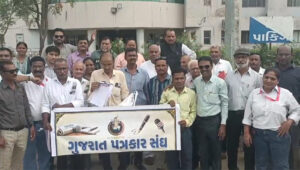
Taking a firm stand for press freedom, the Gujarat Journalists Union (GJU) on Tuesday rallied behind Jayeshbhai Vyas, editor of Lokshahi Samarthan, a Gujarati weekly, and demanded the withdrawal of a defamation notice issued by Visnagar city president Khushalbhai Patel.
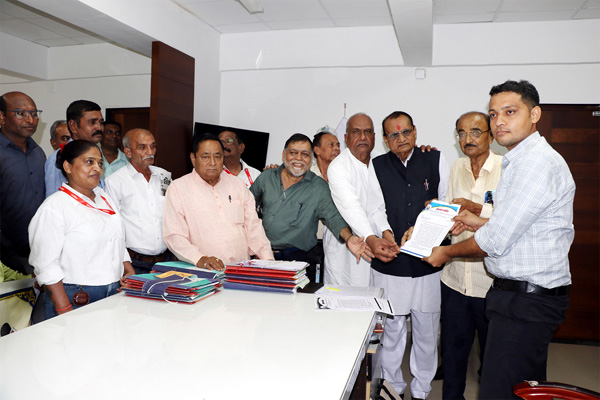
A GJU delegation led by its President B. R. Prajapati submitted a memorandum to the Visnagar Prant Officer at around 11.30 a.m. Journalists from Kadi, Visnagar, Vadnagar and Mehsana participated in the programme in large numbers.
The Union demanded that the notice be withdrawn and that the Visnagar city president apologise to the journalists.
Prant Officer hears GJU plea, assures efforts to resolve grievances
Vikaskumar D. Ratada, Prant Officer and Sub-Divisional Magistrate, Visnagar, sympathetically heard the GJU delegation’s plea and assured the journalists: “I will try my best to resolve the grievances of the journalists by taking up the issue with the authorities concerned.”
The assurance added an important administrative dimension to the peaceful protest, with the GJU urging the authorities to ensure that the grievance of the journalist and the larger issue of press freedom receive due consideration.
‘Reporting public affairs is a journalist’s duty—not defamation’
The Gujarat Journalists Union said journalists have a professional responsibility to bring political and social developments taking place in society before the public.
The Union maintained that this responsibility cannot be obstructed by fear, pressure or intimidation.
According to the GJU, Jayeshbhai Vyas had discharged his journalistic duty, and his reporting should be viewed as deserving appreciation rather than being treated as defamation.
The Union urged Khushalbhai Patel to understand the importance of an independent press, withdraw the notice and apologise to the journalist community.
Supreme Court: journalistic freedom lies at the core of free expression
The GJU’s stand draws strength from the constitutional protection of freedom of speech and expression under Article 19(1)(a).
In Arnab Manoranjan Goswami v. State of Maharashtra (2020), the Supreme Court observed that “the exercise of journalistic freedom lies at the core of speech and expression protected by Article 19(1)(a)” and warned that threats of reprisal can have a stifling effect on that freedom. The Court also underlined the importance of journalists being able to inform society and citizens being able to know about affairs of governance.
The Supreme Court has, however, also made the legal balance clear: freedom of the press is not a licence to defame, while factually correct publication in the public interest receives protection under the law.
The principle emerging from the judicial framework is therefore clear: journalism must be responsible, fair and fact-based, but legitimate criticism and public-interest reporting cannot be silenced merely because they are uncomfortable or invite scrutiny.
PCI norms: freedom with responsibility, criticism with verification
The broader framework of the Press Council of India’s Norms of Journalistic Conduct also seeks to preserve press freedom while maintaining high standards of journalism.
The norms emphasise the need for accuracy, verification, fairness and responsibility in reporting. They also recognise the importance of allowing bona fide criticism and public-interest journalism, subject to the law and the duty to avoid false or malicious publication.
The Press Council of India is an autonomous quasi-judicial body established to preserve the freedom of the press and maintain and improve press standards. Its framework also provides mechanisms for complaints concerning the press and matters involving press freedom and journalistic standards.
The democratic balance is therefore two-sided: a journalist must verify before publishing, but a public authority or public figure cannot expect immunity from bona fide scrutiny merely because a report is critical.
Gandhian path chosen, but agitation may intensify
The Gujarat Journalists Union said it had chosen the Gandhian path of peaceful protest to defend the freedom of the press.
However, the Union warned that if the defamation notice is not withdrawn and an apology is not tendered to the journalists, the agitation will be intensified through further democratic and Gandhian means.
The GJU said the issue was not limited to one journalist or one publication but concerned the larger rights and professional freedom of the entire journalistic fraternity.
Memorandum sent to top State officials
For information and necessary action, copies of the memorandum were also sent to:
- Gujarat Chief Minister Bhupendra Patel
- Deputy Chief Minister
- Rushikesh Patel, Gujarat Minister and Visnagar MLA
- Mehsana District Superintendent of Police
- Visnagar Police Inspector
The GJU urged the authorities to ensure justice in the interest of journalists and uphold the freedom of the press.
The delegation included Gujarat Journalists Union President B. R. Prajapati, Vice-President Jagdish Brahmbhatt, Dr Nikhil Shah, Jayeshbhai Vyas, General Secretary Natwarlal Bhatt, Joint Secretary Vinay Pandya, Treasurer Nilesh Vora, Executive Members Anil Verma and Paresh Mehta, Office Secretary Jagdish Meva, besides a large number of GJU members and journalists.
The Visnagar episode now raises a fundamental democratic question: can a journalist be expected to report only what is comfortable to those in power—or must the right to question, scrutinise and inform the public remain at the heart of journalism?