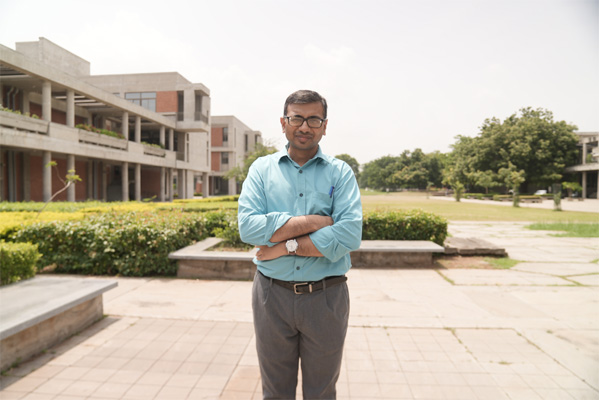
- IIT Gandhinagar’s Dr Mithun Radhakrishna to be honoured with National Award to Teachers 2026 by President Droupadi Murmu
- His classroom philosophy: Ask better questions, challenge assumptions and discover what you can do independently
- From explaining concepts to friends as a BTech student to nurturing independent researchers at IITGN
- Innovative teaching blends computation, experiments, research and real-world problems across disciplines
- In the age of AI, educator says the teacher’s greatest role is to build judgement, curiosity, integrity and scientific temperament
NE EDUCATION BUREAU
GANDHINAGAR, SEPT 4
The finest teachers do not merely fill young minds with answers—they leave them restless enough to keep asking questions. At a time when Artificial Intelligence can produce an answer to almost any question in seconds, Dr Mithun Radhakrishna, Associate Professor of Chemical Engineering at the Indian Institute of Technology Gandhinagar (IITGN), has received a national honour for championing precisely what technology cannot replace: curiosity, critical thinking, judgement and the courage to discover independently.
Dr Radhakrishna will receive the National Award to Teachers 2026 from President Droupadi Murmu on Teachers’ Day, September 5. He is among 21 teachers and faculty members from higher education institutions across India selected for the prestigious national recognition.
The award recognises exceptional contributions to teaching-learning, outreach, research, innovation and other areas of academic excellence, and marks a proud moment for IIT Gandhinagar.
But behind the national honour is a teaching philosophy that goes far beyond the conventional classroom.
The real lesson begins when the answer is not given
For Dr Radhakrishna, the most valuable outcome of education is not whether a student remembers an equation years later, but whether that student learns to think differently about a problem.
“The most meaningful part is not necessarily that they remember a particular equation or topic. It is when they say that something they learned changed the way they think about a problem. That, to me, is a much deeper outcome of education,” he said.
His philosophy has been shaped by teachers who influenced him at different stages of his own academic journey—from his high school teachers at Sadvidya School in Mysore, Karnataka, who made learning engaging and meaningful, to his PhD adviser Professor Sanat Kumar at Columbia University, whose approach to thinking and problem-solving left a lasting impression.
Yet his strongest early realisation that teaching was something he truly enjoyed came during his BTech years.
Before examinations, he would study with friends, discuss concepts and spend considerable time helping them resolve their doubts. Watching someone move from confusion to understanding made him realise that explaining ideas was not merely something he could do—it was something he loved doing.
That instinct ultimately helped shape his academic journey.
From a student’s doubt to a professor’s calling
As an undergraduate, Dr Radhakrishna recalls thinking that if he wanted to teach at an IIT, pursuing a PhD would be necessary. An opportunity to work with Professor Anil Kumar at IIT Bombay through a JNCASR fellowship then opened another door—the excitement of asking research questions for which the answers were not already known.
That combination of teaching and discovery eventually made academia a natural choice.
“Academia therefore became a very natural choice because it is one of the few professions where I could combine both things I enjoyed deeply—teaching and research. It also gives you the intellectual freedom to explore new ideas, move across disciplines, and think about questions simply because they are interesting or important. That freedom to teach, learn, question, and discover is what continues to make academia meaningful to me,” he said.
At IITGN, that philosophy has translated into a classroom that does not stop at textbooks or predetermined answers.
Alongside fundamental courses, he has introduced interdisciplinary offerings such as Molecular Simulations and Financial Modeling, while integrating computation, experiments, research papers and real-world problems into learning.
The objective is simple but profound: teach students not only how something works, but why it works—and what questions should be asked next.
The proudest achievement may not fit inside an award citation
The impact of a teacher, Dr Radhakrishna believes, is sometimes visible only years after the final class.
Former students have returned to tell him that a course or discussion inspired them to pursue research, explore a new field, take up computational work or coding, approach scientific problems differently or even rethink their career paths.
One milestone has been particularly fulfilling—seeing his first PhD student become a faculty member at IIT Kharagpur.
For a teacher, there could be few more powerful measures of mentorship than watching a student evolve from a learner into an independent researcher and, eventually, another teacher.
The smaller moments matter too: a difficult concept suddenly clicking for an entire class; an unexpected student question taking a lecture somewhere entirely unforeseen; or a discussion continuing long after the scheduled class has ended.
These are the moments, he says, when a classroom ceases to be a place where information is transmitted and becomes a place where teacher and students think together.
In the AI era, the teacher must become more human—not less
The arrival of AI has fundamentally changed the information equation. Students can now access explanations, calculations and vast bodies of knowledge almost instantaneously.
Dr Radhakrishna believes that makes the teacher’s role more important, not less.
“The teacher can no longer be primarily a transmitter of information because information is available instantly. Our role is increasingly to help students ask better questions, evaluate answers critically, connect ideas, develop judgement and discover what they are capable of doing independently,” he said.
That is perhaps the most contemporary dimension of his teaching philosophy.
When machines can increasingly generate answers, the premium shifts to knowing which questions are worth asking, whether an answer deserves to be trusted and what to do with the knowledge once it is obtained.
For Dr Radhakrishna, independent thinking also carries a moral dimension.
He wants students to leave IITGN with more than disciplinary knowledge—with the ability to question assumptions, reason logically, cultivate scientific temperament and act with integrity and responsibility.
The IIT Gandhinagar Honour Code reinforces these values.
“I would be happiest if they remember me not simply as someone who taught them a subject, but as someone who encouraged them to think independently, remain intellectually curious, and conduct themselves with integrity,” he said.
A national honour—and another beginning
Dr Radhakrishna’s reaction to the national recognition was characteristically grounded in the people who shaped his journey.
“My first reaction was a mixture of surprise, gratitude and happiness. Teaching is something I have always taken very personally, so receiving a national recognition for it is extremely meaningful. More than anything, it made me think of the students and teachers who have shaped my own journey,” he said.
The award, therefore, is not being treated as a full stop.
He plans to explore ways of integrating AI into education without compromising independent thinking, while continuing his research in computational molecular science and mentoring students pursuing original research questions.
And perhaps that is the most fitting tribute to a teacher par excellence: the national award may recognise what he has taught, but his students will ultimately testify to what he taught them to become.