- Next-Gen Engineering: International symposium explores the convergence of Artificial Intelligence and Computational Fluid Dynamics
- From Theory to Impact: Global experts decode how AI is reshaping complex simulations and safety-critical systems
- Learning Across Borders: IITGN hosts researchers, students and policymakers for interdisciplinary collaboration
- India’s Tech Imperative: Call for indigenous, reliable and user-friendly AI–CFD solutions
NE EDUCATION BUREAU
GANDHINAGAR, JAN 13
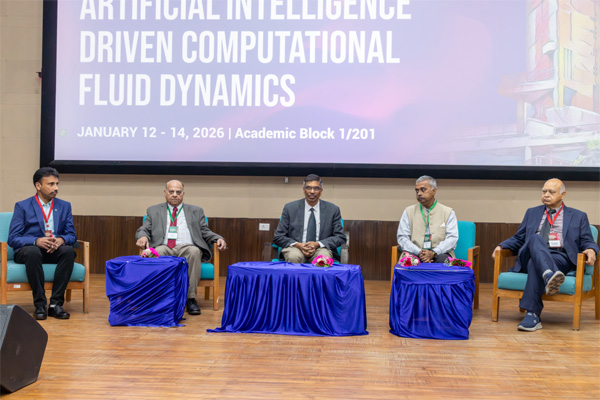
The Indian Institute of Technology Gandhinagar (IITGN) on Monday inaugurated a three-day International Symposium on Artificial Intelligence–Driven Computational Fluid Dynamics (AI–CFD), being held from January 12 to 14, 2026. The symposium brings together leading researchers, industry experts and young scholars to explore how artificial intelligence can revolutionise computational fluid dynamics and address some of the most complex challenges in science and engineering.
The inaugural ceremony commenced with the lighting of the lamp, followed by a welcome address by Prof. Vinod Narayanan, Conference Chair, IIT Gandhinagar. The symposium was formally inaugurated by Prof. Rajat Moona, Director, IIT Gandhinagar, with Prof. Debanik Roy from the Bhabha Atomic Research Centre (BARC), Mumbai, gracing the occasion as Guest of Honour.
AI as a Game-Changer in Engineering
Delivering the inaugural address, Prof. Rajat Moona highlighted the transformative role of artificial intelligence in modern engineering.
“Artificial Intelligence is a sophisticated, high-end statistical system capable of addressing computationally infeasible problems, and its integration with Computational Fluid Dynamics will transform the way complex engineering challenges are solved,” said Prof. Moona.
Recalling his doctoral research days, he reflected on the limitations of early computational models.
“Even a small weather simulation at that time could take 24 hours of uninterrupted computation, and managing power and data availability was a major challenge. Traditional methods alone could not keep pace with such complex simulations, which is why high-performance computing and AI have become indispensable tools for engineers and researchers,” he noted.
Prof. Moona also underlined AI’s broader impact on engineering and society, welcoming delegates and expressing confidence that the symposium would catalyse new ideas and applications in CFD.
Safety-Critical Research and Indigenous Solutions
As Guest of Honour, Prof. Debanik Roy, Bhabha Atomic Research Centre, Mumbai, praised the strong participation of students and early-career researchers.
“I always prioritize meeting students and young researchers, and I am pleased to see their active participation in this symposium,” he said.
Highlighting AI’s growing relevance in safety-critical domains, Prof. Roy added:
“While AI was not mature a decade ago, today we can use it to make systems smarter and more reliable, for example in groundwater flow measurement and radioactive discharge safety.”
Encouraging innovation among young scientists, he observed: “Developing user-friendly, freely available software will allow more researchers to apply these tools. You do not always need to be a domain expert but should have intuition to use these tools for technological solutions.”
Looking ahead, Prof. Roy pointed to emerging challenges, stating:
“Navigation and operation in feature-deficient environments, such as underwater systems, is an important area for innovative collaboration.”
He further emphasised the national imperative:
“India must develop indigenous software for safety-critical activities, validated through experiments and clear presentation of results, to ensure impactful research.”
Collaboration at the Core of AI–CFD
Prof. Akshai K. Runchal of ACRI CFD, India, underscored the accelerating role of AI in computational fluid dynamics.
“Traditional methods alone can no longer keep pace with complex simulations. AI provides tools to accelerate solutions, though it must be used responsibly,” he said.
Explaining AI’s unique advantage, he noted that it can seamlessly integrate theoretical models with real-world data, resulting in simulations that are significantly more accurate and efficient.
“There is no aspect of human industry or activity today where CFD does not play a role,” Prof. Runchal said, adding that AI can further enhance safety and efficiency across sectors.
Emphasising the symposium’s collaborative vision, he remarked:
“This symposium aims to connect leading researchers in India and internationally, encouraging joint programs, innovative research, and informing policymakers on technological solutions.”
A Global Platform for Future Research
Delivering the vote of thanks, Prof. Yogesh Jaluria, Rutgers University, USA, highlighted the value of sustained international engagement.
“Events like this not only foster knowledge sharing but also help build long-term connections between researchers and institutions across countries,” he said.
Over the next three days, the symposium will feature technical sessions, expert talks, panel discussions, poster presentations and networking opportunities. Key themes include AI and machine learning in CFD, multiphysics processes, particle-laden flows, physics-informed learning, and industrial applications spanning combustion, additive manufacturing and food processing.
By bridging artificial intelligence, physics and engineering practice, the AI–CFD symposium at IIT Gandhinagar aims to redefine the future trajectory of fluid dynamics research in India and beyond.