
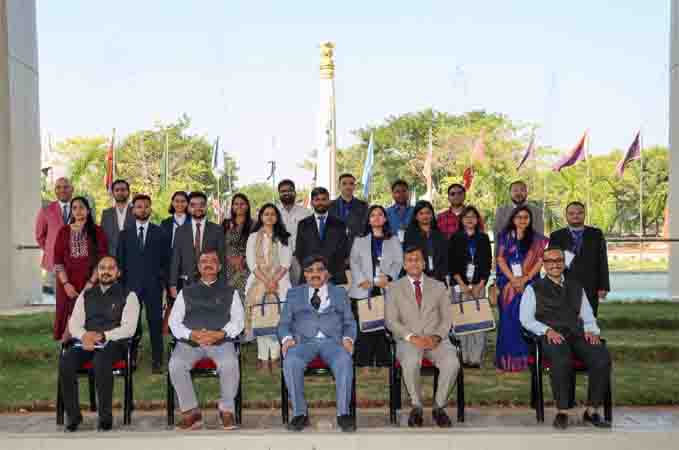

- GLOBAL LEGAL SHOWDOWN: More than 90 law students from 31 teams representing five countries converge at Rashtriya Raksha University, Gandhinagar
- A COMPELLING FICTIONAL DISPUTE: Three-day competition examines digital payments, suspected terror financing, cross-border remittances and the limits of State authority
- JUDICIAL WISDOM: Justice Kaushal Jayendra Thaker (Retd.) urges young advocates to value the quality of arguments, courtesy and professional decency
- INTERNATIONAL LAW UNDER SCRUTINY: ITLOS Judge and RRU Vice-Chancellor Bimal N. Patel stresses jurisdiction, admissibility and the legal basis of State claims
- SECURITY BEYOND BORDERS: Financial systems, energy supplies, digital networks and data emerge as critical dimensions of contemporary national security
NE EDUCATION BUREAU
GANDHINAGAR, NOV 20
When a digital payment network that millions depend on for everyday transactions and cross-border remittances is suspected of financing an armed group, where should the line be drawn between national security, sovereign authority and the rights of ordinary citizens? This challenging question lies at the heart of the Third RRU International Moot Court Competition, bringing together more than 90 aspiring legal professionals from five countries to debate some of the most consequential legal dilemmas confronting the modern world.
Rashtriya Raksha University (RRU) inaugurated the three-day international competition at its Lavad campus on Friday, with 31 teams representing India, Nepal, Uzbekistan, Ethiopia and the United Kingdom. Of these, 25 teams are from India, three from Nepal and one each from Uzbekistan, Ethiopia and the UK.
Jointly organised by RRU’s School of Criminal Law and Military Law (SCLML) and School of Integrated Coastal and Maritime Security Studies (SICMSS), the competition places participants in the role of legal representatives of two neighbouring States locked in a complex fictional dispute involving financial intelligence, suspicious transactions, international remittances and governmental intervention.
The problem requires the teams to examine which judicial forum can hear the dispute, the obligations undertaken by the States concerned, the admissibility of claims and the evidence necessary to substantiate their arguments.
The moot thus moves beyond conventional courtroom advocacy, confronting young lawyers with the increasingly blurred boundaries between financial security, technological innovation, international cooperation and State sovereignty.
Gandhian vision of law meets international perspectives
Welcoming the participants, adjudicators and distinguished guests, Manish Kumar Singh, Director, SICMSS, recalled Mahatma Gandhi’s understanding of the lawyer’s role in bringing divided parties together.
Drawing a parallel with the competition, he described the third edition as an important milestone, with institutions from South Asia, Central Asia, East Africa and Europe bringing diverse legal perspectives to the platform.
He also acknowledged the contribution of student ushers and organising teams in facilitating the participation of visiting delegations.
The discipline of international legal advocacy
In his inaugural address, Prof. (Dr.) Bimal N. Patel, Judge of the International Tribunal for the Law of the Sea (ITLOS) and Vice-Chancellor of RRU, urged participants to establish the legal authority underpinning every submission.
He drew attention to three fundamental questions that can determine the outcome of an international legal dispute: What have the States consented to? Which issues fall within the jurisdiction of the court? And is the particular claim admissible?
He encouraged the students to study applicable treaties and statutes meticulously and demonstrate how specific legal provisions support the conclusions they advance.
Emphasising the importance of preparation, he highlighted that excellence in international legal practice depends on an advocate’s ability to connect sound legal propositions with the facts placed before the bench.
Prof. (Dr.) Kalpesh H. Wandra, Pro Vice-Chancellor of RRU, highlighted the teamwork behind every successful oral submission, from researching legal authorities to refining arguments through repeated practice.
He encouraged participants to recognise the contributions of their teammates, interact with students from other universities and use the competition as an opportunity to develop lasting professional relationships.
He also acknowledged the adjudicators for mentoring young advocates and the student volunteers for extending a warm welcome to visiting teams.
National security in an increasingly digital world
Joining the inaugural session virtually, CA Deepak Garg, Vice-President, National Stock Exchange of India Limited, examined how technological and economic transformations have expanded the very definition of security.
He pointed out that contemporary security concerns extend well beyond territorial protection to encompass financial systems, energy supplies, digital networks and data.
Calling for a balance between sovereign authority and international cooperation, he posed a significant question relevant to the competition: can international law evolve quickly enough to regulate emerging technologies and the new forms of power they create?
Jigna Ashar, Associate Vice-President, Bombay Stock Exchange, also joined the inaugural session virtually.
Justice Thaker’s message: Win with arguments, succeed with character
Delivering the address as Chief Guest, Hon’ble Dr. Justice Kaushal Jayendra Thaker (Retd.), former Judge of the High Courts of Allahabad and Gujarat, offered the participants lessons extending beyond the courtroom.
He encouraged the young advocates to concentrate on the quality of their arguments and courtroom appearances, while underscoring the importance of benevolence, courtesy and professional decency.
His message was particularly relevant to aspiring legal professionals: remain courteous even in failure and maintain dignity and decency irrespective of the circumstances life presents.
He also urged participants to interact with peers trained in different legal traditions, appreciate the collective effort behind every oral submission and acknowledge the teammates whose research and preparation contribute to courtroom performance.
Wishing all the teams success, he encouraged them to approach the competition with confidence and enjoy the opportunity to learn and compete together.
The inaugural session concluded with a vote of thanks by Dr. Dharmesh D. Prajapati, Registrar, RRU, who acknowledged the Chief Guest, university leadership, invited speakers, adjudicators, organising teams of SCLML and SICMSS, and student volunteers.
The competition offers a valuable international platform for young legal minds to test their advocacy skills against questions that are no longer confined to academic debate. As digital finance, emerging technologies and national security become increasingly interconnected, the challenge for the next generation of lawyers will be to ensure that the exercise of State power remains firmly anchored in th2e rule of law.