
- Multinational Exercise Sahayata Setu 2026 culminates in a spectacular multi-agency disaster-response demonstration at Jamnagar
- CDS General N S Raja Subramani positions India as a dependable first responder across the Indian Ocean Region and Indo-Pacific
- Three Services, Coast Guard, NDRF, SDRF, civil authorities and international partners showcase integrated rescue, evacuation and relief capabilities
- QUAD HADR Working Group meeting reinforces regional cooperation, interoperability and collective preparedness
- Fighter aircraft, transport platforms, helicopters, drones and specialised rescue equipment demonstrate technology-driven disaster management
R MANICKAVASAGAM
JAMNAGAR, NOV 19
Disasters may know no borders, but India’s humanitarian response must transcend them.
That was the powerful message from Chief of Defence Staff (CDS) General N S Raja Subramani as India’s military forces, disaster-management agencies and international partners demonstrated their collective ability to respond to large-scale emergencies at Jamnagar. Calling for a coordinated ‘whole-of-nation’ approach, the CDS underscored India’s growing responsibility as a dependable first responder in the Indian Ocean Region (IOR) and the wider Indo-Pacific.
The three-day multinational Humanitarian Assistance and Disaster Relief (HADR) Exercise ‘Sahayata Setu 2026’, conducted at Air Force Station Jamnagar from November 17 to 19 under the aegis of Headquarters Integrated Defence Staff (HQ IDS) and Headquarters South Western Air Command (HQ SWAC), culminated on Thursday with a spectacular Multi-Agency Capability Demonstration (MACD).
The exercise brought together the Indian Army, Navy and Air Force, Indian Coast Guard, national disaster-management agencies, civil administrations and representatives from 24 Friendly Foreign Countries (FFCs), turning Jamnagar into a live demonstration ground for coordinated humanitarian response across land, air and maritime domains.
CDS: Disaster response cannot be the job of one agency
Addressing the media on the concluding day, General Raja Subramani emphasised that humanitarian assistance and disaster relief are an expression of India’s commitment to human security, both within the country and across its neighbourhood.
“In today’s disaster-prone world, effective response is not the ability of one agency alone. It requires a coordinated whole-of-nation approach,” he said.
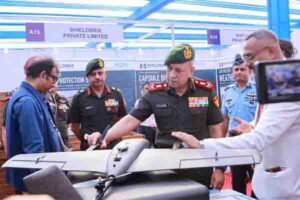
The CDS stressed that preparedness must be collective and response coordinated, involving the government, defence forces, NDRF, other agencies and citizens. He described Sahayata Setu as an important step towards translating this vision into operational capability.
“Disasters do not recognise geographical boundaries. Our response hence needs to transcend them,” he said, highlighting the importance of collective preparedness.
He also pointed to the importance of translating coordination into timely action, identifying interoperability, clearly defined responsibilities and effective use of technology as essential elements of successful disaster management.
India’s humanitarian reach: From Neighbourhood First to MAHASAGAR
Placing the exercise in India’s wider strategic and humanitarian context, the CDS said the country’s HADR approach is guided by the Neighbourhood First policy and the vision of MAHASAGAR – Mutual and Holistic Advancement for Security and Growth Across Regions.
He highlighted India’s emergence as a dependable first responder in the Indian Ocean Region and the Indo-Pacific, citing Operation Dost in Türkiye and Operation Brahma in Myanmar as examples of the country’s ability to mobilise and deliver assistance across international boundaries.
The exercise also drew lessons from Operation Amistad and Operation Sagar Bandhu, among other humanitarian initiatives, during its knowledge-sharing and professional deliberations.
The underlying message was clear: India’s disaster-relief capabilities are increasingly integral to regional cooperation, human security and international humanitarian partnerships.
From cyclone reconnaissance to life-saving rescues
The MACD simulated a severe cyclonic storm, widespread flooding, damaged infrastructure, stranded civilians and maritime emergencies, showcasing the complete chain of disaster response – from aerial reconnaissance and situation assessment to search and rescue, evacuation, medical assistance and restoration of connectivity.
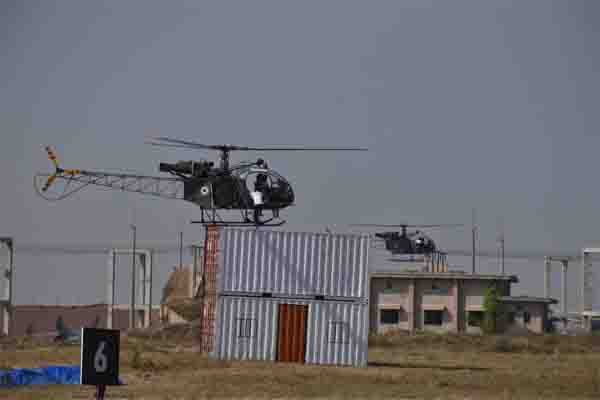
The Indian Air Force deployed Jaguar aircraft, C-130J Super Hercules transport aircraft, Mi-17 helicopters and remotely piloted aircraft, including quadcopters, to demonstrate aerial surveillance and rapid-response capabilities.
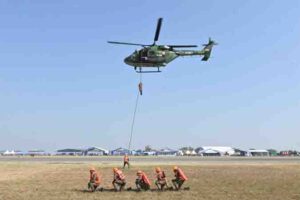
Advanced Light Helicopters (ALH), Army helicopters and other aerial platforms complemented the operations. Personnel of the IAF’s Combat Free Fall Rapid Response Force also demonstrated an aerial insertion from an AN-32 aircraft.
Army rescue and medical teams were deployed into affected areas, while Garud Commandos demonstrated emergency-response capabilities.
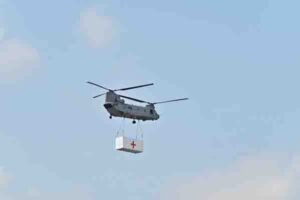
One of the striking demonstrations involved an Mi-17 V5 helicopter using a Bambi Bucket to douse a simulated fire. Firefighting robots added a technological dimension to the response. Another Mi-17 helicopter demonstrated the airlifting of an Army vehicle, while a Chinook heavy-lift helicopter showcased its ability to transport critical infrastructure components, including bridge sections, to disaster-hit locations.
These demonstrations illustrated how military aviation can support firefighting, rescue operations, emergency mobility and the restoration of essential connectivity when conventional infrastructure is damaged.
Land, sea and air: One integrated rescue network
The exercise extended beyond aerial operations to demonstrate how multiple agencies can work together when disasters simultaneously affect land and maritime areas.
Rescue teams from the Army, NDRF and SDRF showcased the extraction of people trapped beneath debris through specialised cutting and lifting equipment, rescue robots and trained search dogs. Helicopter-based evacuation of people stranded on rooftops was also demonstrated.
The maritime component featured the Indian Navy and Coast Guard conducting search-and-rescue operations for people stranded at sea, including fishermen caught in cyclone-like conditions.
The Navy’s Dornier aircraft and other platforms demonstrated the role of aerial surveillance and maritime rescue coordination in locating and assisting people in distress.
The relief and evacuation phase also highlighted the contribution of transport aircraft, including the C-295 and C-17, in moving personnel, vehicles, medical evacuees and essential equipment. The demonstration showcased the transportation of medical supplies, including blood, to field hospitals, underlining the importance of uninterrupted logistics during emergencies.
24 nations, one humanitarian purpose
The international dimension gave Sahayata Setu 2026 added significance. Representatives from 24 Friendly Foreign Countries associated with the Indian Ocean Rim Association (IORA), BIMSTEC and the QUAD participated in the exercise.
The participating countries included Australia, Bangladesh, Comoros, Indonesia, Kenya, Madagascar, Malaysia, Maldives, Mauritius, Mozambique, Oman, Seychelles, Singapore, Somalia, South Africa, Sri Lanka, Tanzania, Thailand, the United Arab Emirates, Yemen, Japan, the United States, Myanmar and Nepal.
A QUAD HADR Working Group meeting was also held, reaffirming the shared commitment to synchronising disaster-response efforts, strengthening regional capacity and promoting cooperation among partner nations.
The exercise began with a brainstorming seminar and expert deliberations involving representatives from the Ministry of External Affairs, the three Services, NDRF, disaster-management agencies and the Defence Research and Development Organisation (DRDO).
Discussions focused on India’s growing global HADR footprint, technology-enabled disaster management, joint capability development, enhanced situational awareness and operational interoperability.
A Table Top Exercise provided a collaborative platform for decision-making and response planning, while static displays offered participants technical familiarisation with equipment and capabilities. The final MACD translated these discussions into a practical demonstration of inter-agency coordination.
Technology, training and teamwork: The bigger takeaway
Beyond the impressive display of military platforms and rescue equipment, the exercise sought to familiarise participants with national and state disaster-management structures, clarify agency responsibilities and validate procedures for coordinated response.
The presence of DRDO officials and the display of specialised technologies added another dimension to the exercise, highlighting the role of indigenous research, innovation and technological solutions in strengthening disaster preparedness.
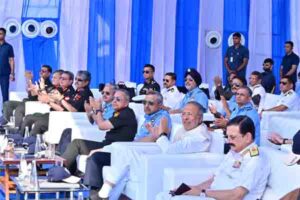
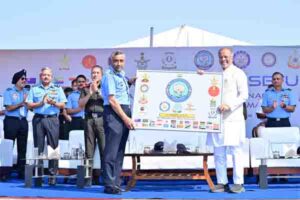
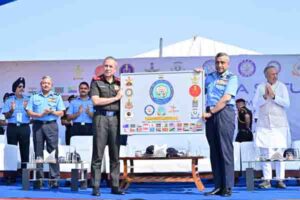
Senior military and civil dignitaries attended the concluding demonstration, including Chief of Defence Staff General N S Raja Subramani, Chief of Air Staff Air Chief Marshal Ashutosh Dixit, Gujarat Forest and Environment Minister Arjun Modhwadia, the General Officer Commanding-in-Chief, Southern Command, the Flag Officer Commanding-in-Chief, Western Naval Command, and the Air Officer Commanding-in-Chief, South Western Air Command.
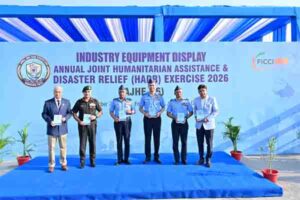
Air Chief Marshal Ashutosh Dixit also released a FICCI booklet during the event.
The successful culmination of Sahayata Setu 2026 reinforced a fundamental lesson: the effectiveness of disaster response depends not merely on the strength of individual agencies, but on their ability to operate as one coordinated system when lives are at stake.
For India and its regional partners, the exercise was a demonstration of humanitarian preparedness, international solidarity and the resolve to ensure that assistance reaches those in distress swiftly, irrespective of geographical boundaries.
AHMEDABAD–JAMNAGAR AIR LOGISTICS: Air logistics from Ahmedabad to Jamnagar for media coverage of the exercise was provided by the Indian Air Force in coordination with Defence PRO, Gujarat.