NE HEALTH BUREAU
CHENNAI, SEP 19
For a family, it can begin with something deceptively small. A mother forgets a familiar name. A father repeatedly asks the same question. A grandparent who once managed every household detail suddenly struggles with an everyday task. What first appears to be ordinary ageing can sometimes signal something more serious.
And when memory begins to fade, the challenge is not faced by the senior alone. The entire family enters a new and often unfamiliar world of caregiving.
- A two-day Chennai programme puts the spotlight on a silent healthcare challenge affecting millions of India’s seniors
- Athulya Senior Care, Madras Medical College and Athulya Academy join forces to strengthen dementia-care skills
- 60 healthcare professionals undergo expert-led learning spanning medicine, nursing, neurology and mental health
- Focus shifts from treating memory loss alone to understanding behaviour, communication, emotions and everyday life
- LASI-DAD study estimates 7.4% of Indians aged 60-plus—around 8.8 million people—are living with dementia
With India’s ageing population making dementia an increasingly important public-health concern, Chennai has brought the spotlight onto a question that will matter to millions of families: Are healthcare professionals sufficiently prepared to care for seniors whose needs extend far beyond memory loss?
From memory loss to a whole-person approach
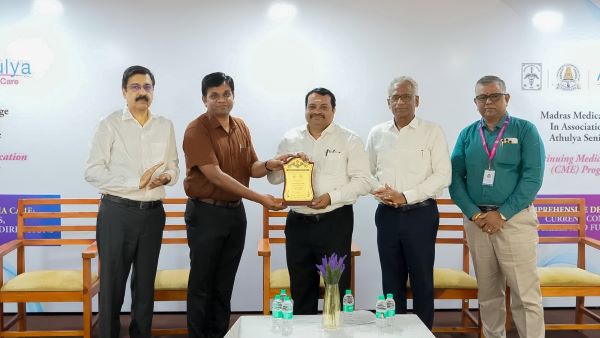
Seeking to strengthen the answer, Athulya Senior Care, in collaboration with Madras Medical College (MMC) and Athulya Academy, organised a two-day academic programme titled “Comprehensive Dementia Care: Current Concepts, Clinical Skills and Future Directions” on September 18 and 19 at Athulya Senior Care, Maduravoyal, Chennai.
The programme brought together healthcare professionals, nursing students and faculty for a combination of academic sessions and practical learning focused on dementia and geriatric care.
The underlying message was clear: dementia care cannot stop at memory.
It can involve changes in behaviour, communication, emotional wellbeing, mobility, daily activities and relationships—making a multidisciplinary approach essential.
8.8 million lives behind one alarming number
The scale of the challenge is significant.
A national LASI-DAD study estimated that 7.4% of Indians aged 60 and above—around 8.8 million people—are living with dementia.
Each statistic represents a senior, a family and a caregiving journey.
As life expectancy rises and India’s elderly population grows, the demand for healthcare professionals trained specifically in geriatric and dementia care is expected to become increasingly important.
The Chennai programme sought to address precisely this gap by connecting academic knowledge with clinical realities.
“Dementia care requires a multidisciplinary approach”
The programme was inaugurated on Saturday by Prof. Dr. R. Shankar Shanmugam, Principal, Madras Medical College (MMC), Chennai and Registrar, Tamil Nadu Nurses & Midwives Council, who attended as Chief Guest.
Speaking on the collaboration, Mr. Srinivasan G, Founder & CEO, Athulya Senior Care, said,
“Dementia care requires a multidisciplinary approach and well-trained professionals who understand the clinical and emotional needs of seniors. Through this programme, we aim to strengthen knowledge and practical skills while encouraging greater focus on specialised geriatric and dementia care.”
The programme brought together expertise from geriatric medicine, neurology, nursing and dementia care, creating a platform for professionals to examine dementia from multiple clinical and caregiving perspectives.
It is not just about forgetting
For families, one of the most important lessons in dementia care is recognising that the condition can affect much more than memory.
Dr. Nivedha Pathmanathan, Psychiatrist, Athulya Senior Care, said,
“Dementia affects much more than memory, often impacting behaviour, communication and everyday life. Strengthening awareness among healthcare professionals can support early recognition, timely intervention and more personalized, compassionate care for seniors and their families.”
Early recognition can help families seek appropriate medical assessment and understand what may be happening to their loved one, while healthcare professionals can play a crucial role in guiding families through the next stages of care.
60 professionals, one common mission
The two-day programme included expert-led sessions and practical learning covering key aspects of dementia care, with perspectives from medical, nursing and mental-health professionals.
Sixty healthcare professionals participated, providing an opportunity for knowledge exchange and discussion on the evolving requirements of dementia and geriatric care.
The programme also aimed to strengthen the bridge between academic education and frontline caregiving, particularly for nursing students, faculty and healthcare professionals who are likely to encounter an ageing population more frequently in their careers.
The future of dementia care is also about dignity
For a senior living with dementia, good care is not simply about medicines, clinical monitoring or managing symptoms.
It is also about preserving dignity, familiarity, communication, emotional security and quality of life.
For families, that can mean having healthcare professionals who understand not only the disease but also the person living with it.
The collaboration between Athulya Senior Care, Madras Medical College and Athulya Academy seeks to strengthen that human-centred approach by bringing academic learning, clinical expertise and practical caregiving together.
As India grows older, dementia care is likely to move increasingly from the margins of healthcare into the centre of family life.
And when memory fades, the quality of care, the preparedness of caregivers and the compassion of the healthcare system can make all the difference.