NE WOMEN EMPOWERMENT BUREAU
MUMBAI, SEPT 2
What happens when a woman says “no” inside a marriage—and the law does not treat that “no” in the same way it would outside marriage? That uncomfortable question has been stitched into four kilometres of fabric in Mumbai, transforming one of India’s most enduring symbols of womanhood into an extraordinary public demand for equality, dignity and consent.
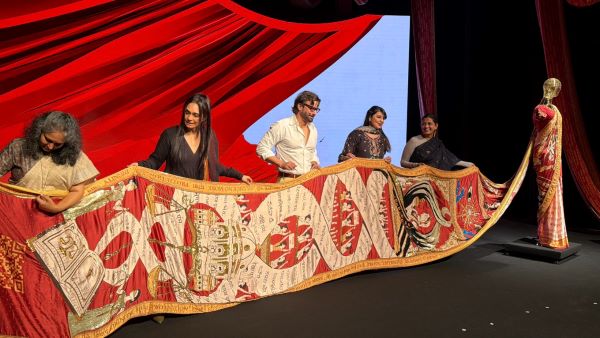
The Infinite Saree, unveiled at Mumbai’s Royal Opera House, has been conceived by Red Dot Foundation, a UN-accredited nonprofit working on gender-based violence, as a living petition calling for the removal of the marital-rape exception from Indian law. Designed by fashion designer Nivedita Saboo, the four-kilometre saree carries signatures and messages demanding legal reform. The campaign draws inspiration from the ancient story of Draupadi, whose endlessly extending saree has long been associated with protection of a woman’s dignity.
- Red Dot Foundation’s ‘Infinite Saree’ turns India’s iconic garment into a living petition demanding removal of the marital-rape exception
- Four-kilometre campaign installation carries signatures, stories and a fundamental question: Does marriage ever take away a woman’s right to consent?
- Campaign calls for legal recognition of marital rape while matter remains before Supreme Court
- From Mumbai’s Royal Opera House to the global creative stage, ‘Infinite Saree’ transforms cultural symbolism into advocacy for dignity and bodily autonomy
- NFHS-5 data highlights the continuing consent gap, with 18% of women reporting they cannot refuse sex with their husbands
- Campaign’s message: marriage may create a relationship, but it cannot erase the right to safety, dignity and bodily autonomy
The symbolism is deliberate: a garment traditionally associated with womanhood and dignity has been turned into a public canvas for a woman’s right to bodily autonomy.
The question behind the fabric
At the heart of the campaign is a proposition that its organisers say should not depend upon marital status: consent is a human right, not a marital privilege.
Supreet K. Singh, filmmaker and Co-founder & CEO of Red Dot Foundation, said:
“Every signature on the Infinite Saree is a thread of courage and every fold a testament to a woman’s right to choose and refuse to be silenced. It carries the voices of those who believe consent is a human right, not a marital privilege.”
Calling for urgent legal reform, she added:
“The right to say no does not end at marriage, and the law must finally recognise marital rape as rape—without exceptions, conditions, or delay—upholding consent as central to marriage and affirming married women’s constitutional rights to safety, dignity, and bodily autonomy.”
The campaign’s call comes against the backdrop of a continuing legal debate over the marital-rape exception.
Under the Bharatiya Nyaya Sanhita, 2023 (BNS), which replaced the Indian Penal Code, Exception 2 to Section 63 provides that sexual intercourse or sexual acts by a man with his wife, where the wife is not under 18, do not constitute rape under that provision.
Thus, while Indian law has removed the exception for wives below 18, the exception for adult wives remains.
When marriage meets the question of consent
The campaign brings into public view a difficult intersection of marriage, consent, criminal law and constitutional rights.
NFHS-5 findings have added urgency to the conversation. According to reporting based on the 2019-21 survey, 18% of women in India said they were unable to refuse sexual intercourse with their husbands when they did not want it.
The data does not, by itself, establish the incidence of marital rape. But it does illuminate the continuing challenge around women’s ability to exercise sexual consent within marriage.
For the Infinite Saree campaign, that distinction is central: the issue is not about attacking marriage as an institution, but about asking whether marriage should diminish a woman’s legal protection against non-consensual sexual acts.
‘Culture can challenge culture’
Designer Nivedita Saboo said:
“The Infinite Saree uses culture to challenge and create reform in culture.”
Explaining the significance of the creation, she said:
“It honours one of India’s oldest symbols of womanhood, while turning it into a movement for equality and reform. It is proof that India’s traditions can also be the foundation for its progress. With the Infinite Saree, India’s oldest and most iconic garment becomes its newest symbol of justice and change.”
That cultural framing has helped the campaign move beyond conventional advocacy. Rather than presenting legal reform solely through legal terminology, the initiative uses fashion, mythology, art, public participation and storytelling to bring an otherwise deeply private issue into a wider civic conversation.
Survivors ask society not to look away
For survivors and advocates, the campaign is also about breaking the silence surrounding violence within intimate relationships.
Zaaria Patni, survivor and advocate, said:
“When lawmakers, activists, survivors, and citizens stand together, we do more than start a conversation. We create the pressure that makes change inevitable. Marital rape must no longer hide behind the guise of marriage.”
Her message puts the focus on solidarity—not merely between survivors and activists, but across lawmakers, citizens and institutions.
The campaign has also received support from actor and campaign ambassador Rahul Bhat, who said: “Most of us grow up believing that home is the safest place for all. But for many women, it isn’t.”
He added: “Every woman deserves dignity, respect, and the basic right to feel safe, especially in her own home. This isn’t just a legal issue. It’s a human one.”
Bhat said he had signed the petition seeking removal of the marital-rape exception and urged others to do the same.
A legal debate that refuses to disappear
The Supreme Court is considering challenges relating to the marital-rape exception. The issue reached the national legal spotlight after the Delhi High Court delivered a split verdict in 2022, leaving the question unresolved and paving the way for consideration by the Supreme Court.
The debate has also entered Parliament. The campaign material refers to Dr Shashi Tharoor’s private member’s Bill seeking removal of the exception, framing it as an issue of equality, dignity and bodily autonomy.
The issue is therefore no longer confined to courts or women’s-rights organisations. It has become part of a larger national conversation about the meaning of consent within marriage and the extent of criminal-law protection available to married women.
From Mumbai to the world stage
The Infinite Saree has since acquired recognition well beyond its original advocacy setting. The campaign won a Silver Lion in Health & Wellness at Cannes Lions 2026 and received 14 honours at the Clio Health Awards, including the inaugural Women’s Health Grand Clio.
Its journey also took it to the Kala Ghoda Arts Festival, where the four-kilometre installation was displayed at Elphinstone College, placing the conversation about consent and marital rape within a major public cultural setting.
That journey gives the campaign an unusual trajectory: from an ancient symbol of dignity, to a modern work of art, to a citizen petition, to an international award-winning advocacy campaign.
The saree asks what the law must answer
The Infinite Saree’s power lies not simply in its extraordinary length, but in what that length represents.
One signature is a voice. Thousands of signatures become a demand. Four kilometres of fabric become a question that cannot easily be folded away.
The question is ultimately larger than the saree itself: Can a woman’s right to bodily autonomy begin, continue and remain intact—even after she says “I do”?
For Red Dot Foundation and the campaign’s supporters, the answer is unequivocal: marriage should never be understood as blanket consent.
The Infinite Saree now carries that message into public spaces, cultural conversations and the continuing legal debate—asking India to confront an issue that many women experience in silence, while insisting that dignity, safety and consent must remain rights, not privileges conditional upon marital status.