
- IEEE ICPCCI 2026 brings researchers, industry and academia together to examine the technologies shaping intelligent infrastructure
- IN-SPACe Director Dr Rajeev Jyoti highlights emerging opportunities for Indian innovators in space technology
- 76 research papers, 10 technical sessions and 300-plus participants put AI, chips, drones, cybersecurity and smart grids under the spotlight
- Conference explores how power, control and communication technologies can converge to build the infrastructure of tomorrow
NE SCIENCE & TECHNOLOGY BUREAU
AHMEDABAD, OCT 8
What happens when the technologies that power a city, connect a nation, drive an electric vehicle and take a spacecraft beyond Earth begin speaking the same language? That question lies at the heart of the IEEE International Conference on Power, Control and Communication Infrastructure (IEEE ICPCCI 2026), which opened at the Institute of Infrastructure, Technology, Research and Management (IITRAM), Ahmedabad, on Thursday.
The two-day conference, being held on October 8 and 9, brings together researchers, academics, industry professionals, students and government-sector participants to explore a technological landscape in which power systems, artificial intelligence, control engineering and communication infrastructure are no longer isolated domains.
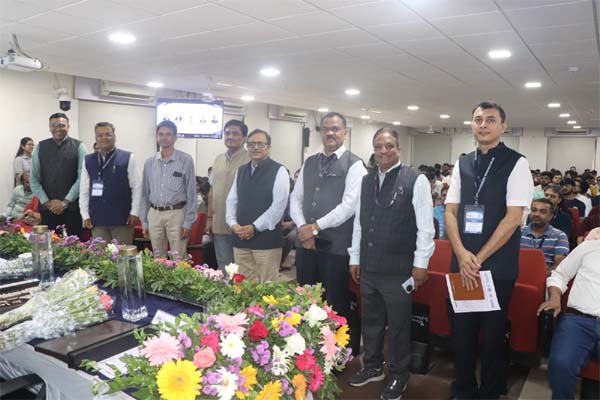
The second edition of IEEE ICPCCI 2026 began with a traditional lamp-lighting ceremony, followed by a plenary address by Dr Rajeev Jyoti, Director, IN-SPACe, who attended as Chief Guest and focused on the opportunities opening up for Indian innovators in space technology.
The conference assumes significance against the backdrop of rapid technological convergence. From AI-enabled systems and semiconductor chips to high-altitude drones, electric mobility, smart grids and space applications, the discussions seek to examine not merely what technology can achieve, but how different technologies can work together to solve increasingly complex infrastructure challenges.
Welcoming delegates, Prof. Pramod Kumar Jain, Director General, IITRAM, underlined the institute’s commitment to cutting-edge research and technological advancement.
The event also featured Milind Mahajan and Sanjeev Kulshresth from SAC-ISRO, along with Prof. Maniklal Das of DAU, representing the IEEE Gujarat Section, as Guests of Honor.
Dr Abhishek Rawat, Conference Chair, outlined the technical programme, while Dr Priyesh Chauhan, Conference Chair and Head, Electrical and Computer Science Department, IITRAM, delivered the vote of thanks.
From Space to Silicon
The plenary sessions reflected the extraordinary breadth of the technology ecosystem now emerging around electrical and computer science engineering.
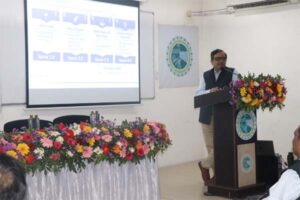
Dr Rajeev Jyoti spoke on the current and future opportunities for Indian innovators in space technology, placing the rapidly expanding space sector within reach of researchers and technology entrepreneurs.
The conversation then moved from outer space to the microscopic world of semiconductor technology. Dr Jignesh Patoliya, Senior Design Verification Engineer, eInfochips Pvt. Ltd, discussed the importance of chips in advancing artificial intelligence, highlighting the foundational role of semiconductor technology in the AI revolution.
Prof Abhishek of IIT Kanpur addressed the importance and challenges involved in designing heavy-lift drones, particularly for operations at high altitudes.
Together, the sessions presented a striking picture of modern engineering: the future of infrastructure may depend as much on algorithms, chips, sensors and communication networks as on conventional physical systems.
76 Papers, 10 Technical Sessions
The conference will feature 76 research papers across 10 technical sessions during the two-day programme, with participation expected from more than 300 students, faculty members, industry professionals and government-sector representatives.
The technical programme spans a wide spectrum, including Artificial Intelligence, healthcare technology, cybersecurity, communication systems, antenna technology, intelligent computing, electric vehicle technology, intelligent infrastructure, control systems, microgrids, smart grids, and power and energy systems.
The diversity of subjects is itself a reflection of the central challenge confronting today’s technology community: building systems that are not only smarter, but also interconnected, resilient and capable of operating across multiple technological domains.
The Bigger Question
For Ahmedabad, the conference also underscores the growing importance of academic institutions as meeting grounds where research, industry and emerging technologies can intersect.
The larger question emerging from the discussions is no longer simply which technology will dominate the future. It is how power, computing, communication, AI, mobility and space technologies can be designed to work together without creating new vulnerabilities or widening the gap between technological capability and social need.
That convergence—and the human and infrastructure challenges it brings with it—could well define the next chapter of India’s technology journey.