- From Sundials to Sorting Games, Learning Steps Out of Textbooks
- Recycled Tyres, Indian Knowledge Systems and Computational Thinking Spark Curiosity
- IIT Gandhinagar–AMC Initiative Reimagines STEM as Playful Discovery
- 60,000+ Children Across 453 Municipal Schools to Learn by Doing
NE EDUTAINMENT BUREAU
GANDHINAGAR, JAN 30
In a heartening blend of play, curiosity and science, the Center for Creative Learning (CCL), IIT Gandhinagar, in collaboration with the Ahmedabad Municipal Corporation (AMC), has redefined “building-as-learning-aid” by transforming municipal school spaces into interactive classrooms—where children learn by moving, observing, questioning and creating.
Designed to ignite early interest in science, mathematics and computational thinking, the year-long initiative introduces students to complex concepts through hands-on, child-friendly installations rooted in Indian knowledge systems and modern STEM ideas.
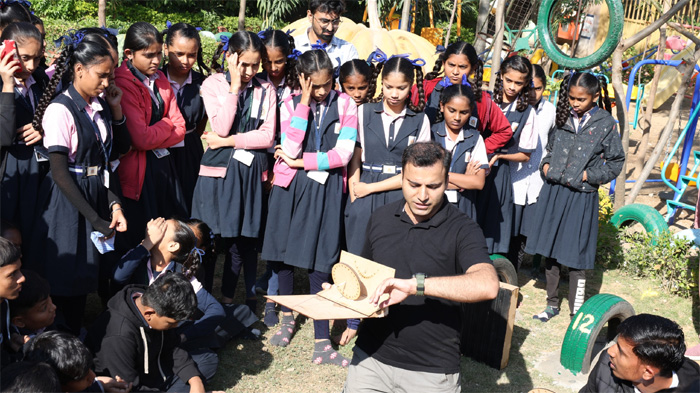
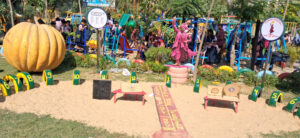
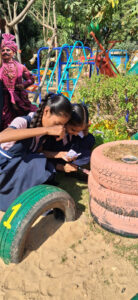
One of the most captivating highlights is a giant sundial installed at Anupam Primary School No. 2, Thaltej. Crafted innovatively from a recycled tyre, the sundial features 12 colourful tiles representing the months of the year. By simply standing on the tiles and watching their own shadows, children learn how time is measured—turning the playground into a living science lab.
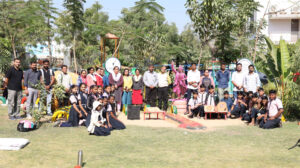
The installation became a celebration of collective learning, with students, teachers and the principal actively participating. Beyond the outdoor exhibit, children created paper sundials, explored the geometry of time, and discovered the timeless contributions of Indian mathematicians such as Aryabhata, Brahmagupta and Varahamihira—bringing heritage and science together seamlessly.
“The focus is on active engagement,” said Chirag Joshi, Principal, Anupam Primary School No. 2. “Students and teachers jointly painted the recycled tyre used for the sundial. It made learning participatory, joyful and memorable.”
A similar spirit of experiential learning unfolded at a municipal school in Asarva, where students were introduced to computational thinking through a lively, physical activity. Children entered a network randomly and exited in a sorted sequence, mirroring how computers organise data—making abstract algorithms tangible and fun.
Adding to the playful learning environment, logic-based puzzles designed by students themselves have been painted within school premises. These puzzles change every week, encouraging algorithmic thinking through outdoor play rather than rote learning.
Commending the initiative, Lagdhir Desai, Administrative Officer, AMC, said, “The work done by the Center for Creative Learning, IIT Gandhinagar, has made STEM education engaging at the grassroots. This programme nurtures out-of-the-box thinking and is being extended to all 453 AMC schools.”
The initiative forms part of a comprehensive year-long project through which CCL, IIT Gandhinagar, will reach over 60,000 middle-school students across 453 municipal schools. The programme includes hands-on workshops in every school, weekly online STEM sessions, specially designed learning kits, and exposure visits to the IIT Gandhinagar campus.
By turning school buildings into learning tools and play into pedagogy, the IIT Gandhinagar–AMC collaboration is crafting a powerful model of joyful, inclusive and future-ready education—one where curiosity leads the curriculum and every child becomes an explorer.
Student Voices: Learning Through Wonder & Play
“I never knew I could tell time by just standing in the sun. When my shadow moved, it felt like science was talking to me,” said a Class 6 student at Anupam Primary School No. 2, Thaltej.
“We painted the tyre together and then used it to learn months and time. It doesn’t feel like studying—it feels like a game,” shared a Class 5 student, smiling as she pointed to the sundial tiles.
“When we stood in random order and came out sorted, I understood how computers think. I want to learn more about coding now,” said a student participant from the Asarva municipal school.
“The puzzles on the walls make us think even during recess. Every week we wait to see what the new challenge will be,” remarked a middle-school student, highlighting how learning continues beyond the classroom.