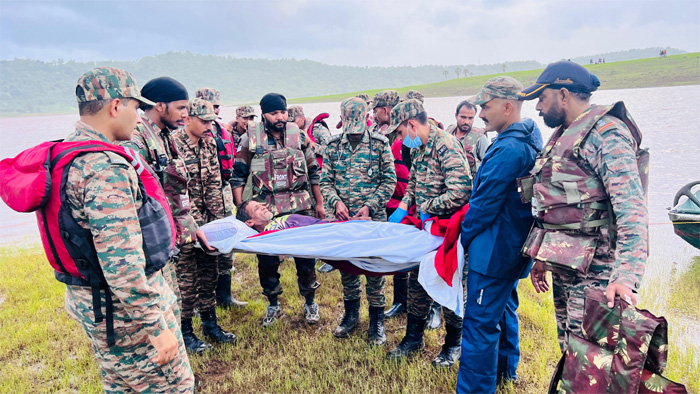
- Army’s seven HADR columns, engineers and medical teams evacuate 355 stranded civilians across Gujarat and Dadra & Nagar Haveli
- Coast Guard rescues 170 people in 11 operations, including pregnant woman, patient with respiratory distress and person with severe chest pain
- 82 civilians rescued after being trapped for over 40 hours at Rajoda’s Amazon Godown; helicopters airlift 33 from Navsari’s Mendar village
- NDRF, SDRF, Army, Coast Guard, police, local divers and civil administration mount massive multi-agency response as 40,500 people are evacuated
- Rescuers battle raging currents, flooded buildings, disrupted roads and relentless rain to deliver food, water, medical aid and hope
- A salute to the daredevil men and women in uniform whose humanitarian mission has become Gujarat’s lifeline in its hour of distress
NE NEWS SERVICE
AHMEDABAD, JULY 25
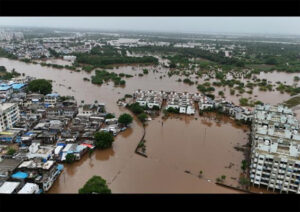
When roads disappeared beneath floodwaters, buildings became islands and raging currents cut off entire communities, Gujarat witnessed a different kind of rising tide — the courage, compassion and daredevilry of India’s uniformed forces.
From Army soldiers wading into inundated habitations and engineers opening rescue routes to Coast Guard helicopters braving hazardous weather to pluck stranded civilians from isolated villages, the flood-relief mission across Gujarat, Daman and Dadra & Nagar Haveli has become a powerful story of humanitarian assistance at a scale where every rescued life is a victory.
The Indian Army, Indian Coast Guard, NDRF, SDRF, police, local divers and civil administration have mounted a massive, round-the-clock response as incessant rainfall triggered severe flooding and widespread disruption across South Gujarat, Ahmedabad and adjoining areas.
As of Saturday, about 40,500 people had been evacuated to safer locations, with 17 teams of the Army and NDRF and 32 SDRF teams engaged in rescue and relief operations across the State, according to official updates reported by Akashvani.
Army columns become lifelines in the flood zone
Responding swiftly to the unfolding crisis, the Indian Army, under the aegis of Southern Command, commenced Humanitarian Assistance and Disaster Relief operations on the evening of July 23.
Seven Relief and Rescue Columns, including specialised Engineer and Medical teams, have been deployed across the affected areas.
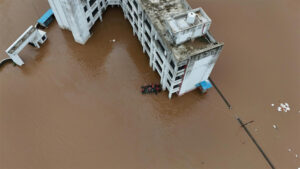
Two columns are operating in Navsari, one in the Valsad–Vapi region, three in Ahmedabad — covering Ahmedabad city, Ahmedabad Rural and the Ahmedabad–Rajkot Highway — and one in Silvassa in Dadra & Nagar Haveli.
Additional columns remain on standby at key locations including Vadodara, Ahmedabad and Jamnagar, ready to move at short notice as the situation evolves.
Since the beginning of operations, Army teams have rescued 355 stranded civilians, often under extremely challenging conditions. They have evacuated people trapped for prolonged periods in flooded buildings and isolated habitations, while medical teams provided immediate healthcare and relief teams distributed food, drinking water and essential supplies.
The operations are being conducted in close coordination with the NDRF, SDRF, police, civil administration and other agencies.
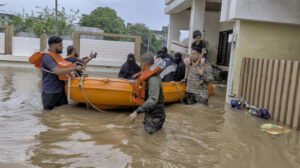
40 hours trapped — 82 lives brought back from Rajoda
One of the most dramatic rescue operations unfolded at Rajoda village in Ahmedabad, where teams of the Army’s Golden Katar Division worked continuously from 8.30 pm on Friday.
By Saturday, 82 civilians who had been trapped for more than 40 hours in the Amazon Godown and adjoining buildings had been safely evacuated.
The rescue unfolded under extremely difficult conditions, with the Army teams continuing to work to reach the remaining stranded civilians.
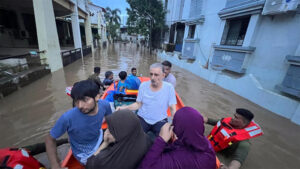
Medical assistance was provided to those requiring care, while food, water and other essentials were delivered to affected people.
In another operation, an Army team rushed to Gallop Industrial Park near Meladi Mata Temple in Sari-Matoda to rescue a large number of stranded workers.
The Army’s message from the flood zone has been simple and powerful: no stranded civilian will be abandoned while rescue operations remain possible.
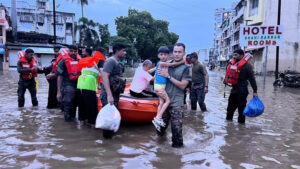
Coast Guard’s 11 missions: 170 rescued across land and water
The Indian Coast Guard has emerged as another formidable force in Gujarat’s flood-relief campaign.
Working in close coordination with the civil administration, Coast Guard personnel rescued 170 stranded persons through 11 operations across Daman, Dadra & Nagar Haveli and South Gujarat since midnight on July 22.
The operations began during the night of July 22–23 with the rescue of five persons from Khanvel, Silvassa, followed by the evacuation of three fishermen trapped along the flooded riverbank at Kadaiya.
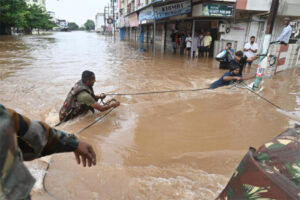
Through flooded buildings, isolated habitations and treacherous currents, the Army’s HADR teams pressed ahead — because every stranded civilian was a life worth reaching. – Courtesy: PIB
In one of the largest missions, 60 persons stranded in the flood-hit Welspun Industrial Area were safely evacuated during the night of July 23–24 after road connectivity was completely disrupted.
The Coast Guard subsequently rescued seven persons from a bus stranded near Aero Fibre Pvt. Ltd., evacuated 10 persons from Dongri, rescued four persons by helicopter from the Valsad–Pardi area and evacuated eight persons overnight from the Reliance Industries area.
In a particularly sensitive operation at Avadh Society, the Coast Guard rescued 10 persons, including a nine-month pregnant woman and a woman suffering from respiratory distress, ensuring their timely access to medical care.
Helicopters against the storm: 33 airlifted from Mendar
On July 24, two Indian Coast Guard helicopters successfully airlifted 33 stranded persons from Mendar village in Navsari district.
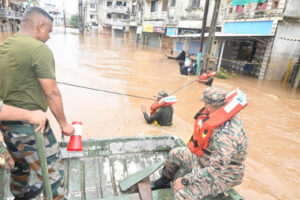
Battling incessant rain and inundated terrain, the Indian Army’s seven HADR columns continue their mission: rescue, relief and reassurance across Gujarat. – Courtesy: PIB
Among those rescued was a person experiencing severe chest pain, who was provided urgent medical assistance.
The operation demonstrated the extraordinary risks undertaken by Coast Guard aircrews and rescue teams as they operated amid relentless rain, swift currents and hazardous conditions.
Yet the mission continued.
The Coast Guard’s motto, ‘Vayam Rakshamah’ — We Protect, was transformed into action across flooded villages, industrial areas, roads and isolated habitations.
The scale and range of the Coast Guard operations — from rescuing fishermen and industrial workers to airlifting vulnerable civilians and providing urgent medical assistance — reflected a response that went far beyond conventional coastal duties.
NDRF, SDRF and local teams form one massive rescue chain
The flood response has also seen an extraordinary convergence of national, state and local capabilities.
NDRF and SDRF teams, Army personnel, Coast Guard crews, police, local divers, fire and emergency services and district administrations have been operating in close coordination.
In Navsari, joint teams of the NDRF, SDRF, Indian Army and local divers evacuated more than 14,000 residents from flood-affected areas, according to Akashvani’s report.
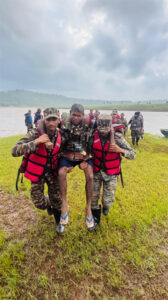
The coordinated response has been crucial in a situation where different emergencies unfolded simultaneously — people trapped inside buildings, workers stranded in industrial areas, villages cut off by floodwaters, patients needing medical attention and roads rendered unusable.
The combined strength of the agencies has allowed rescue operations to continue across multiple fronts.
A deluge of historic intensity — and a response of extraordinary courage
The rescue mission unfolded against the backdrop of an exceptionally intense rainfall episode.
Umbergaon in Valsad recorded 1,064 mm of rainfall in 24 hours ending 8.30 am on July 23, according to the India Meteorological Department, making it one of the highest 24-hour rainfall totals recorded in India.
The extreme weather triggered severe flooding across South Gujarat and forced the evacuation of tens of thousands of people. More than 38,000 people had already been shifted to safer locations in the early phase of the crisis, according to Akashvani.
The response has therefore been not merely a rescue operation, but a vast humanitarian undertaking.
Food and drinking water have been supplied to stranded residents. Medical teams have treated those requiring assistance. Vulnerable people have been prioritised. Helicopters have been deployed where roads have vanished. Soldiers and rescuers have entered areas that ordinary vehicles and conventional response systems could not reach.
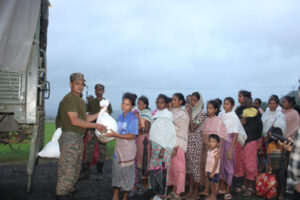
A salute to the guardians who went where the flood dared to go
In every disaster, numbers tell only part of the story.
Behind the figure of 355 Army rescues are families reunited, elderly people brought to safety and civilians pulled from buildings surrounded by water.
Behind the 170 Coast Guard rescues are fishermen, industrial workers, women, children, a pregnant woman and patients whose access to medical care could have been cut off by the flood.
Behind the helicopter airlifts are pilots and rescue crews who flew into weather conditions in which even reaching the stranded was a formidable challenge.
And behind every operation is a soldier, sailor, aircrew member, engineer, medic, police officer, diver or disaster-response professional who placed duty before danger.
Gujarat’s floodwaters may have overwhelmed roads, bridges and communications — but they did not overwhelm the human spirit. The men and women of the Indian Army, Indian Coast Guard, NDRF, SDRF and the wider rescue machinery stood between helplessness and hope.
To these daredevil rescuers — who entered the flood so that others could come out of it — Gujarat salutes you.