
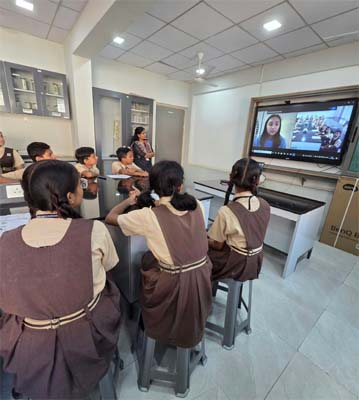

- Avoid3 founder Aashna Shah connects global climate risks with Ahmedabad’s urban heat and water security
- Virtual Climate Masterclass at J.L. High School turns a global emergency into a local wake-up call
- Students explore how rising temperatures could intensify droughts, extreme rainfall and flash floods
- Sponge-city designs and early-warning networks spotlighted as tools for climate resilience
- Youth leadership, water conservation and renewable energy take centre stage in cross-border dialogue
NE EDUTAINMENT BUREAU
AHMEDABAD, OCT 15
Across continents, a generation is discovering that climate change respects neither national borders nor the boundaries of a classroom. For Ahmedabad, the warning could be written on the banks of its own lifeline—the Sabarmati River—where a warming world could intensify the extremes of water scarcity and sudden flooding. That stark local connection gave a virtual climate masterclass at J.L. High School a powerful message: the climate crisis is not a distant forecast; it is a challenge that today’s students will inherit and help shape.
Leading this cross-border conversation was Aashna Shah, a high school student at The Pingry School in New Jersey, United States, and founder of Avoid3, a global climate initiative. Connecting virtually with students in Ahmedabad, Shah brought the science and stakes of global warming closer to home, urging young people to see climate action not merely as an environmental concern but as a question of public safety, urban resilience and intergenerational responsibility.
The session moved beyond abstract temperature projections to examine what unchecked warming could mean for cities such as Ahmedabad. More intense heat, pressure on water resources and the risk of extreme rainfall could place growing demands on urban infrastructure and disaster preparedness. The Sabarmati, central to the city’s identity and development, became a compelling lens through which students could consider the consequences of a changing climate.
From a global temperature target to Ahmedabad’s doorstep
Avoid3 was founded around the concern that the world could face a temperature rise of 3°C under high-warming trajectories. Shah used this risk to help students understand why the choices made today—by governments, businesses and communities—matter for the climate conditions they may face in adulthood.
The discussion connected global warming with local vulnerabilities, including Ahmedabad’s intense summer heat, its dependence on water systems and the challenges posed by extreme monsoon rainfall. The message was not that any single climate outcome is inevitable, but that rising temperatures can increase risks and make preparedness more urgent.
By bringing the issue into the students’ immediate surroundings, Shah turned climate change from a distant global headline into a question about the future liveability of their own city.
Floods are not just disasters; they are lessons in preparedness
The masterclass also drew attention to the devastating consequences of extreme flooding, including the deadly floods in Nepal cited during the session. Such events underline the importance of understanding local risks, investing in resilient infrastructure and ensuring communities receive timely warnings.
Among the approaches discussed were sponge-city designs, which use green spaces, permeable surfaces and water-sensitive urban planning to absorb and manage rainfall, and early-warning networks that can give residents and authorities more time to prepare for dangerous weather.
For a rapidly urbanising city such as Ahmedabad, the broader lesson is that climate resilience must extend beyond emergency response. Urban planning, drainage, protection of vulnerable communities and public awareness all have a role in reducing the impact of extreme events.
A generation united by heat, smoke and uncertainty
Shah also shared insights from her own climate advocacy, including engagement with the Citizens’ Climate Lobby and her examination of the role corporate systems can play in environmental outcomes. Her experience helped connect the concerns of students in India with those confronting young people in the United States.
From extreme urban heat in Ahmedabad to wildfire smoke affecting communities in parts of California, the examples illustrated how climate-related threats can take different forms while creating a shared challenge across borders.
The exchange also reinforced the importance of examining policy choices and institutional accountability alongside individual behaviour. While personal action matters, lasting progress depends on coordinated efforts by governments, industries, communities and citizens.
Turning climate anxiety into climate action
The discussion widened to include water conservation, renewable energy and the role of young people in shaping public attitudes and policy. Students were encouraged to look beyond concern about the future and consider practical ways to contribute to solutions in their schools, homes and communities.
For Ahmedabad, such action can begin with responsible water use, energy conservation, greener neighbourhoods and greater awareness of heat and flood risks. At the same time, sustained investment in resilient infrastructure and credible climate policies remains essential.
The masterclass’s central message was one of urgency without helplessness. Climate change presents formidable challenges, but informed citizens and engaged young people can help build the public demand and community participation needed to address them.
As the virtual classroom connected New Jersey with Ahmedabad, the distance between the two places seemed less significant than the future they share. For the students of J.L. High School, the Sabarmati was more than a familiar river in a climate lesson: it became a reminder that protecting a city begins with understanding the forces reshaping its environment—and acting before the next warning becomes a disaster.