- A year-long cultural uprising finds its crescendo on World Mother Language Day
- Artists gift their voices freely to resurrect forgotten literary treasures
- A grassroots literary movement reconnects youth with identity, pride, and linguistic roots
- From poetry to performance, Ahmedabad witnesses a renaissance of Gujarati consciousness
NE LITERARY BUREAU
AHMEDABAD, FEB 19
In an age when languages quietly erode under the pressure of globalization, a musical-literary movement in Ahmedabad is rewriting the fate of Gujarati—not through nostalgia alone, but through living, breathing performance.
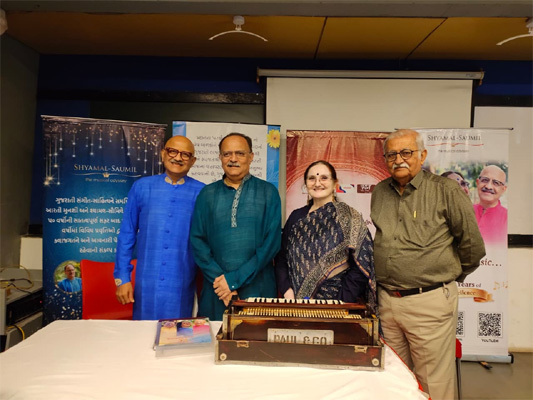
The monthly cultural series Man ni Mojnishi, conceived and hosted by Pradan Charitable Trust – Kaladham and led by acclaimed artist trio Shyamal Munshi, Saumil Munshi, and Aarti Munshi, will mark its first anniversary on Saturday -February 21, aligning with the globally observed International Mother Language Day, a day proclaimed by UNESCO to safeguard linguistic diversity.
Hosted at the iconic Gujarati Sahitya Parishad Hall—offered free of cost to encourage cultural preservation—the 12th edition symbolizes not merely continuity, but cultural resistance and revival.
Language as Emotion, Not Just Expression
Unlike conventional literary gatherings, Man ni Mojnishi is designed as an emotional archive in motion. Every month, poems and compositions of legendary Gujarati literary figures—from Narmad to Umashankar Joshi and Jhaverchand Meghani—are brought alive through immersive musical renditions and recitations.
“Gujarati is not merely spoken—it is felt,” said Aarti Munshi, her voice carrying both conviction and urgency.
“Through Man ni Mojnishi, we are not performing songs; we are reviving memories, identities, and emotions that belong to every Gujarati soul.”
For Shyamal Munshi, the initiative represents a moral and cultural responsibility.
“If language fades, a civilization loses its inner voice. This series is our humble attempt to ensure Gujarati continues to breathe, sing, and inspire future generations.”
Echoing this sentiment, Saumil Munshi emphasized the transformative power of performance.
“When young people hear poetry in melody, it stops being history—it becomes personal. That emotional connection is the foundation of cultural continuity.”
Art Without Commerce: A Rare Cultural Offering
In a remarkable act of artistic commitment, all participating artists perform without remuneration, turning Man ni Mojnishi into a rare example of art driven purely by purpose.
Malav Bhai, trustee of the organizing trust, underlined the philosophy behind the effort.
“This is not an event—it is a cultural mission. Every artist here contributes selflessly because preserving language is preserving civilization itself.”
Strengthening this mission, Prudent Financial Services has extended CSR support to sustain the initiative into its second year.
A spokesperson from Prudent Financial Services said: “Supporting Man ni Mojnishi aligns with our belief that financial growth must go hand-in-hand with cultural stewardship. Language is the ultimate inheritance.”
A Cultural Awakening for a Globalized Generation
At its heart, Man ni Mojnishi is a quiet yet powerful rebellion against cultural amnesia. As digital distractions fragment attention spans, the series creates a sacred space where words regain their power, rhythm, and meaning.
The leadership of Gujarati Sahitya Parishad, which provided the venue free of charge, described the initiative as a cultural necessity.
“Institutions must serve as custodians of heritage. When artists and organizations unite like this, language does not merely survive—it thrives.”
By making entry free and inviting all—from seasoned poets to curious youth—the event transforms literary appreciation from an elite pursuit into a shared community experience.
A Movement That Transcends Performance
What began as a monthly gathering has evolved into a cultural renaissance—one that reminds Gujaratis that their language is not a relic of the past, but a living force shaping identity and imagination.
As the first anniversary approaches, Man ni Mojnishi stands as proof that when artists lend their voices to language, they do more than perform—they protect, preserve, and pass forward an entire civilization.