NE DEFENCE BUREAU
CHENNAI, SEPT 26
A military pilot masters the art of flying; a flying instructor masters the art of creating pilots. That transformation took centre stage at Air Force Station Tambaram as 54 pilots from India’s Defence Forces and three friendly foreign countries graduated as Qualified Flying Instructors, ready to pass their flying skills, discipline and professional confidence to the next generation of military aviators.
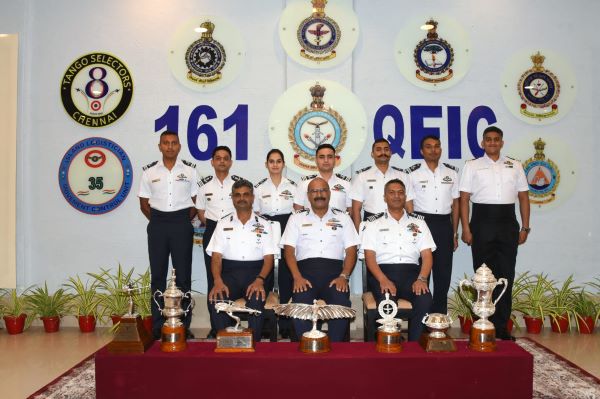
The graduation ceremony of the No-161 batch of the Qualified Flying Instructors’ Course (QFIC) at the Flying Instructors’ School (FIS), Air Force Station Tambaram, on September 25 marked the culmination of 24 weeks of rigorous training designed to turn experienced pilots into instructors capable of moulding combat-ready and professionally confident aviators.
- 24 weeks of relentless training transform operational pilots into instructors who will shape future military aviators
- 42 IAF, seven Navy, three Army and two Coast Guard pilots among graduates
- Three friendly foreign-country pilots complete the prestigious Qualified Flying Instructors’ Course
- 200+ hours of ground training and 10 phases of flying test precision, pedagogy and professional mastery
Air Marshal George Thomas, Air Officer Commanding-in-Chief, Western Air Command, was the Reviewing Officer for the graduation ceremony.
A tri-services cockpit of excellence
The graduating batch reflected the increasingly joint character of India’s military aviation ecosystem.
Of the Indian graduates, 42 were from the Indian Air Force, seven from the Indian Navy, three from the Indian Army and two from the Indian Coast Guard. Three pilots from friendly foreign countries also successfully completed the demanding course.
The course commenced on April 13, 2026, and comprised 10 phases of flying training and more than 200 hours of ground training, testing the pilots across flying skills, instructional methodology, ground subjects and aerobatics.
On successful completion, the graduates were awarded the coveted qualification of ‘Qualified Flying Instructor’, marking their transition from pilots who fly missions to instructors who will shape those who fly them.
Where flying skill meets teaching mastery
The FIS course goes beyond cockpit proficiency. Its deeper purpose is to equip pilots with the ability to observe, analyse, correct and develop another pilot’s performance—a responsibility that can ultimately influence operational safety and combat effectiveness.
The distinction holders were recognised with a series of prestigious trophies.
Squadron Leader Bopanna AA won the Majithia Trophy for standing first in the Overall Order of Merit, while Squadron Leader Shivkumar Bhatkare received the Arjan Singh Trophy for Best in Fixed Wing Flying.
Squadron Leader Saumya Sharma secured the Arjan Singh Trophy for Best in Rotary Wing Flying, while Squadron Leader Bijo Anton won the Nirmal Jeet Singh Sekhon Trophy for standing first in Aerobatics.
The Dilbagh Trophy for standing first in Instructional Technique went to Lieutenant Commander Parth Deshpande, while Squadron Leader Amol Garg received the Subroto Mukherjee Trophy for standing first in Ground Subjects.
Squadron Leader Avani Chaturvedi secured the Mehar Singh Trophy for standing second in the Overall Order of Merit.
“Pass out confident and professional pilots”
Addressing the graduating instructors, the Reviewing Officer congratulated the graduates and trophy winners and exhorted them to ensure that the trainees they subsequently train pass out as confident and professional pilots, fully prepared in all respects for service in the Indian Air Force.
The message underscored the critical multiplier role of a flying instructor: every instructor trained today can influence the skills, judgement, confidence and professional standards of scores of pilots tomorrow.
From pilots to force multipliers
The graduation at Tambaram thus marked more than the completion of another training course. It represented the creation of a new cadre of instructors who will carry forward the traditions of military flying while preparing future pilots to operate with precision, confidence and professional discipline.
From fixed-wing aircraft to rotary-wing operations, from aerobatics to instructional technique, the No-161 QFIC batch demonstrated the breadth of expertise required to build a modern military aviation force.
The wings may belong to 54 graduating pilots today—but the real impact of their training will be measured by the thousands of hours flown by the pilots they go on to teach.