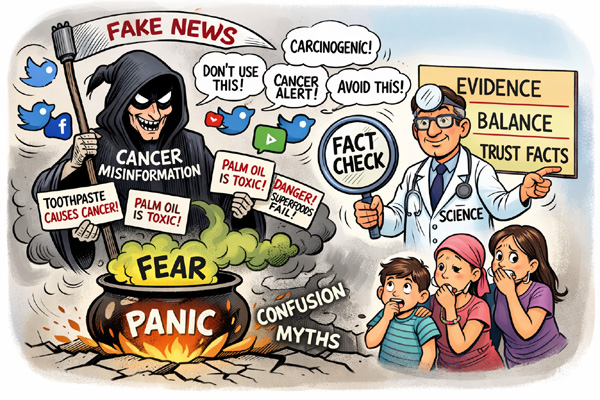
- How misinformation turns everyday products into imagined cancer threats
- Why ‘carcinogenic’ does not always mean dangerous in real life
- Food myths that distract from real cancer risk factors
- When wellness claims become quietly harmful
- Choosing science over scare stories this World Cancer Day
DR AMAN RASTOGI

Every World Cancer Day, oncologists reiterate a familiar but vital message—prevention, early detection and evidence-based treatment save lives. Increasingly, however, another challenge has entered the cancer conversation: the rapid spread of misinformation, where everyday foods, ingredients and consumer products are casually branded as “carcinogenic” without credible scientific evidence.
Earlier this year, a viral social media message claimed that toothpastes containing sodium lauryl sulfate (SLS)—an ingredient commonly derived from palm oil—cause cancer. The claim spread rapidly, triggering unnecessary alarm before it was eventually fact-checked and debunked by a handful of responsible media outlets.
There is no credible human evidence linking SLS to cancer, and the ingredient is approved for use by major regulatory agencies worldwide. Yet, even as the claim was corrected, the damage was done. Cancer is a word that evokes deep fear, and when fear is used irresponsibly, it travels far faster than facts.
When misinformation becomes the real public health risk
Palm oil has become a frequent casualty in the misinformation ecosystem. Despite repeated scientific clarification, it continues to be targeted by unsubstantiated cancer claims, often amplified through selective data, misinterpreted research, lobbying by competing oil interests and emotionally charged narratives.
Scientific concerns around palm oil largely relate to high-temperature processing contaminants, not palm oil consumption itself. Crucially, human cancer risk has not been conclusively demonstrated. Like all fats, palm oil should be consumed in moderation as part of a balanced diet. Balance is a nutritional principle, not a marker of carcinogenicity.
Reducing cancer risk to a single ingredient oversimplifies a complex disease and diverts attention from well-established risk factors such as tobacco use, alcohol consumption, obesity, physical inactivity and excessive sun exposure.
What ‘carcinogenic’ actually means—and what it doesn’t
Much confusion stems from misunderstanding the term “carcinogenic.” A carcinogen is something that can cause cancer under specific conditions, depending on dose, duration and biological context. Importantly, hazard classification is not the same as real-world risk.
Organisations such as the World Health Organization’s International Agency for Research on Cancer (IARC) classify substances based on potential hazard, not everyday exposure. This explains why substances as varied as aloe vera (whole leaf extract), bracken fern and mobile phone radiation may appear in similar categories—despite posing vastly different levels of actual risk in daily life.
Food myths that refuse to die
Food-related cancer myths are particularly persistent. In reality, very few foods are proven to increase cancer risk. Strong evidence exists for processed meat, while red meat is classified as probably carcinogenic, both linked to bowel cancer. Alcohol is firmly established as increasing the risk of at least seven cancers, including breast and bowel cancer.
Beyond these, most dietary cancer claims fail scientific scrutiny. The human body tightly regulates its internal chemical balance, and no single food can override these systems.
Equally misleading is the belief in so-called “anti-cancer superfoods.” Green tea, tomatoes, berries, alkaline diets, supplements and multivitamins are often promoted as cancer-preventive. Yet, large population studies have found no clear protective effect. Some beliefs can even be dangerous—apricot kernels, for example, contain amygdalin, which can cause cyanide poisoning.
A healthy diet reduces cancer risk not through miracle foods, but by supporting metabolic health, maintaining a healthy weight and ensuring nutritional balance.
From sunscreen scares to scientific reality
Beyond food, everyday consumer products are frequently accused of causing cancer without evidence. Recent misinformation around sunscreen illustrates this risk vividly. Benzene, a known carcinogen, is not an ingredient in sunscreens. While rare contamination has been detected in a small number of products at very low levels, regulatory systems exist to identify and recall unsafe batches.
The proven carcinogenic risk of ultraviolet radiation far outweighs the theoretical risk posed by trace contamination—reinforcing the importance of sunscreen use rather than avoidance.
Why evidence—not emotion—must guide cancer prevention
Health misinformation does more than confuse. It fuels anxiety, undermines trust in medical science and distracts from genuine research. Ironically, compounds such as tocotrienols found in palm oil are actively being studied for their biological activity against cancer. Emerging evidence suggests they may influence cancer-related cellular pathways and selectively affect cancer cells—highlighting why research-driven understanding must replace fear-based conclusions.
On this World Cancer Day, cancer prevention must be reframed as a commitment to evidence, proportion and perspective. It is not about eliminating every chemical or ingredient from modern life, but about understanding risk through credible human data. Science does not deny uncertainty—but it firmly rejects exaggeration.
If we truly wish to reduce the burden of cancer, our most powerful tools remain trust in evidence-based medicine, responsible communication and informed public dialogue.
FACT CHECK | MYTH vs TRUTH: Cancer & Everyday Products
MYTH 1: Toothpaste ingredients like sodium lauryl sulfate (SLS) cause cancer
TRUTH:
There is no credible human evidence linking sodium lauryl sulfate (SLS) to cancer. SLS is approved for use by major regulatory agencies worldwide. Claims circulating on social media have been fact-checked and debunked. Fear spread faster than facts in this case.
MYTH 2: Palm oil consumption causes cancer
TRUTH:
There is no conclusive human evidence that palm oil consumption causes cancer. Scientific concerns relate to high-temperature processing contaminants, not palm oil itself. Like all fats, palm oil should be consumed in moderation as part of a balanced diet. Balance—not elimination—is key to health.
MYTH 3: If something is labelled ‘carcinogenic’, it is dangerous in everyday life
TRUTH:
A carcinogen is defined by potential hazard, not real-world risk. Cancer risk depends on dose, duration and biological context. International agencies classify substances based on hazard, not everyday exposure—leading to misunderstandings among the public.
MYTH 4: Most foods significantly increase cancer risk
TRUTH:
Strong evidence exists only for processed meat and alcohol, which are linked to increased cancer risk. Red meat is classified as probably carcinogenic. Beyond these, most food-related cancer claims do not withstand scientific scrutiny.
MYTH 5: ‘Anti-cancer superfoods’ can prevent cancer
TRUTH:
There is no proven anti-cancer superfood. Claims around green tea, berries, tomatoes, alkaline diets and supplements lack conclusive evidence. Some can even be harmful—apricot kernels, for example, may cause cyanide poisoning.
MYTH 6: Sunscreens cause cancer due to benzene
TRUTH:
Benzene is not an ingredient in sunscreens. Rare contamination has been detected in a few products at trace levels, which regulatory systems monitor and recall. The proven cancer risk from UV radiation far outweighs any theoretical contamination risk—making sunscreen use essential.
MYTH 7: Eliminating one ingredient can significantly reduce cancer risk
TRUTH:
Cancer is a complex, multifactorial disease. The biggest proven risk factors remain tobacco, alcohol, obesity, physical inactivity and excessive sun exposure. Focusing on single ingredients distracts from meaningful prevention.
THE TAKEAWAY
Cancer prevention is built on evidence—not emotion.
Trust credible science, understand risk in context, and be wary of fear-based health claims that oversimplify a complex disease.
The author of this article is Consultant – Surgical Oncology, Max Hospital, Shalimar Bagh, Delhi