
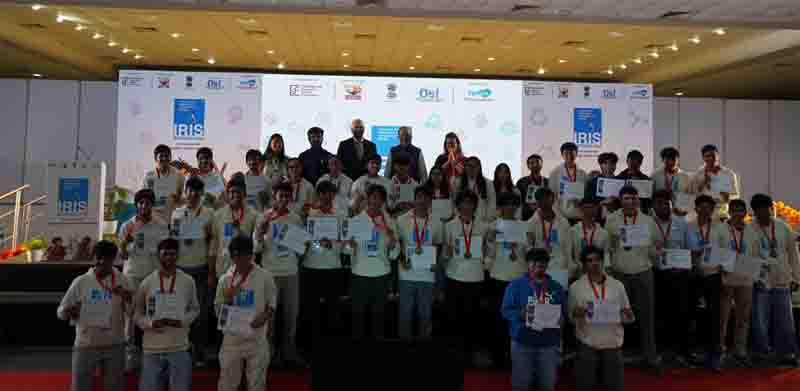
- 144 students from 30 States and Union Territories showcase research projects at Gujarat Science City
- Fair draws over 3,000 registrations of interest and more than 1,000 project submissions
- Scientific Review Committee evaluates entries to identify 20 projects for international representation
- Deputy Chief Minister Harsh Sanghavi and Science & Technology Minister Arjun Modhwadia honour young researchers
NE EDUCATION BUREAU
AHMEDABAD, NOV 25
India’s next generation of scientific thinkers has put its research credentials on display, demonstrating how curiosity, creativity and a problem-solving mindset can translate into innovations with global potential. The IRIS National Fair 2026 concluded at Gujarat Science City, Ahmedabad, on Tuesday, bringing together 144 promising young researchers from 30 States and Union Territories.
The valedictory ceremony was attended by Gujarat Deputy Chief Minister Harsh Sanghavi and Science & Technology Minister Arjun Modhwadia, who recognised the students’ research efforts and encouraged them to pursue scientific inquiry with confidence and perseverance.
The fair attracted more than 3,000 registrations of interest and received over 1,000 research project submissions. Following a rigorous evaluation by the Scientific Review Committee (SRC), 144 students earned places at the national-level showcase, reflecting the growing enthusiasm among school students for scientific research and innovation.
Twenty projects to take India’s research talent to the global stage
A major highlight of the fair is the selection of 20 outstanding research projects for international representation. The selected young researchers will get an opportunity to represent India at the Regeneron International Science and Engineering Fair (ISEF) 2027 in Los Angeles, USA, one of the world’s largest pre-college science and engineering competitions.
The IRIS initiative, or Initiative for Research and Innovation in STEM, seeks to identify, nurture and recognise original scientific research among school students. It provides a national platform for young minds to take their ideas beyond classroom learning and present research-based solutions before scientists, academicians and domain experts.
According to the Department of Science and Technology’s description of the initiative, IRIS has been nurturing scientific talent among Indian school students since 2006, with a pathway for outstanding projects to reach the international ISEF platform.
Sanghavi: Consistent effort matters more than awards
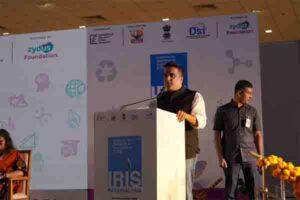
Addressing the young researchers, Sanghavi urged them not to measure their scientific journey merely by awards and accolades. Emphasising the importance of perseverance, he said:
“The competition is not about winning or losing. Congratulations to those who have been selected at the global level, but double congratulations to those who have not been selected, because they still have immense opportunities to conduct further research and move ahead.”
Highlighting the challenge of excessive screen time among children, he observed that the projects demonstrated how digital engagement could be channelled towards meaningful and productive pursuits.
“Merely dreaming will not be enough; one must work consistently to turn those dreams into reality,” he said, encouraging students to remain committed to their ideas.
Modhwadia highlights India’s expanding innovation landscape
Science & Technology Minister Arjun Modhwadia said the students’ efforts to identify problems in their surroundings and develop practical solutions represented an important transition from passive learning to active problem-solving.
Referring to India’s expanding research, innovation and start-up ecosystem, he cited the country’s indigenous vaccine development during the Covid-19 pandemic and advances in the semiconductor sector as examples of emerging opportunities.
“Six of the country’s 12 semiconductor plants are being established in Gujarat. Young Indians are increasingly equipped to take a leading role globally in areas such as space technology, biotechnology, electronics and artificial intelligence,” he said.
He also drew attention to a Class V student’s project exploring ways to transform children’s screen time into productive learning, underscoring that meaningful scientific inquiry can begin at an early age.
Stressing that scientific progress depends on experimentation and sustained curiosity, Modhwadia encouraged students who did not receive awards to continue developing their ideas. He also acknowledged the contributions of parents and mentors in nurturing young researchers.
The three-day national fair, held from November 22 to 24 at Vigyan Bhavan, Gujarat Science City, was organised by Exemplar Education Linkers Foundation, with Zydus Lifesciences Limited as its supporting partner.
The larger significance of the IRIS platform lies in its ability to make research an integral part of school education. By encouraging students to question, experiment, investigate and develop solutions, it helps cultivate a scientific temperament that extends far beyond competitive examinations and conventional classroom learning.
For the 20 projects heading towards the international arena, Ahmedabad marks not an end to a competition, but the beginning of a much larger scientific journey.