NE RAILWAY BUREAU
NEW DELHI, SEPT 1
Indian Railways is simultaneously attacking three of its biggest operational challenges—freight congestion, train safety and ageing signalling infrastructure—with a combined ₹675-crore investment push covering West Bengal-Jharkhand freight corridors, Uttar Pradesh and Bihar.
- 11-km Adra–Joychandipahar bypass to unlock freight capacity and eliminate bottlenecks
- Kavach 4.0 to cover remaining 712 Rkm of Moradabad Division at ₹170 crore
- Electronic Interlocking coming to 21 Samastipur stations under ₹233-crore modernisation plan
- Projects target congestion, collision risks and ageing signalling infrastructure across key rail corridors
- Energy, mineral and cement traffic to gain from capacity expansion while indigenous safety technology gets wider footprint
In a significant infrastructure thrust, the Railway Ministry has approved ₹272 crore for an 11-km bypass between Adra end and Joychandipahar in South Eastern Railway, ₹170 crore for Kavach Version 4.0 across the remaining 712 Route Kilometres of Moradabad Division in Northern Railway, and ₹233 crore for Electronic Interlocking at 21 stations of Samastipur Division in East Central Railway.
Taken together, the three approvals underline a broader strategy to create more railway capacity, remove operational conflicts and bring advanced indigenous safety and signalling technologies deeper into the network.
Adra bypass to take freight traffic off the congestion track
The 11-km Adra–Joychandipahar–Sanka bypass, estimated to cost ₹272 crore, is designed to provide dedicated path segregation and a bi-directional connection to the upcoming third line.
The project is expected to facilitate the projected movement of 6.065 freight rakes a day and cater to rising industrial traffic. It will be particularly important for freight requirements linked to SAIL’s 23.40 MTPA iron ore demand and BCCL’s projection of 45 rakes per day.
The bypass is aimed at removing existing operational bottlenecks and reducing surface-crossing detentions on the Adra–Joychandipahar section. With the existing network operating at around 71% utilisation, freight movement has been affected by conflicts arising from surface crossings.
The project is expected to facilitate additional traffic of 8.88 MTPA after completion. The current line capacity of the Joychandipahar–Adra section is 47.50%, which is projected to rise to 56.45% by 2028-29.
A freight artery for the Energy, Mineral and Cement Corridor
The bypass forms part of the Energy, Mineral and Cement Corridor identified by Indian Railways and is expected to provide the additional capacity required to absorb future industrial traffic.
By separating freight paths and easing crossing-related conflicts, the project is expected to improve the reliability and efficiency of freight operations while allowing higher throughput on a strategically important industrial corridor.
The move is significant for a region where iron ore, coal and other industrial commodities generate sustained rail demand. The additional capacity is expected to help freight growth translate into more efficient utilisation of the railway network rather than additional congestion.
Kavach 4.0 spreads across the remaining 712 Rkm of Moradabad
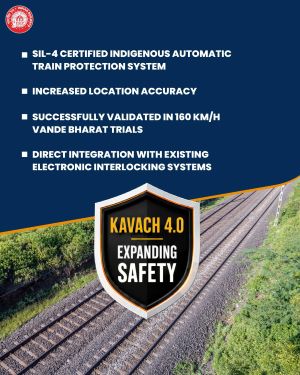
Safety modernisation received another major push with Indian Railways approving ₹170 crore for deployment of Kavach Version 4.0 on the remaining 712 Route Kilometres of Moradabad Division.
The indigenous Automatic Train Protection (ATP) system is designed to provide an additional layer of protection during train operations.
Kavach helps prevent Signal Passing at Danger (SPAD), automatically applies brakes when required to avert unsafe situations, controls train speed under critical conditions and significantly reduces the risk of collisions.
The approval for the remaining sections of Moradabad Division marks another step in Indian Railways’ continuing expansion of Kavach coverage and its transition towards more advanced train protection and signalling systems.
21 Samastipur stations to get computer-based signalling
At Samastipur Division of East Central Railway, Indian Railways has approved ₹233 crore for Electronic Interlocking (EI) at 21 stations, replacing existing Panel Interlocking systems.
The computer-based technology will strengthen signalling infrastructure at the identified stations and facilitate the implementation of Kavach, thereby creating an important technological foundation for enhanced railway safety.
Electronic Interlocking offers higher reliability, faster fault diagnosis, easier maintenance and greater operational flexibility compared with ageing signalling arrangements.
The Samastipur project therefore goes beyond simply replacing signalling equipment. It forms part of the larger transition towards a digitally enabled railway network in which modern interlocking systems and automatic train protection technologies work together to improve both safety and operational efficiency.
Three investments, one larger railway transformation
The three approvals collectively illustrate how Indian Railways is approaching modernisation from different but interconnected fronts.
The Adra bypass creates physical capacity for freight, the Kavach 4.0 deployment strengthens protection against operational safety risks, and Electronic Interlocking provides the modern signalling backbone needed for safer and more efficient train movement.
The combined ₹675-crore investment therefore represents more than three individual projects. It reflects an effort to build a railway system capable of carrying more freight, moving trains more safely and managing increasingly complex traffic through modern technology.
With industrial freight demand rising and railway operations becoming increasingly technology-driven, the message from these approvals is clear: the next phase of railway expansion is not merely about laying more tracks—it is about making every kilometre safer, smarter and more productive.