R ARIVANANTHAM
CHENNAI, DEC 29
In a major step to significantly enhance the combat capability and operational preparedness of the Indian armed forces, the Defence Acquisition Council (DAC), chaired by Defence Minister Rajnath Singh, on Monday accorded Acceptance of Necessity (AoN) for a range of capital acquisition proposals worth ₹79,000 crore for the Indian Army, Indian Navy and Indian Air Force.
The Defence Acquisition Council (DAC) meeting held today accorded Acceptance of Necessity (AoN) for various proposals of the three Services amounting to a total of about Rs 79,000 crore.
The MoD under the leadership of PM Shri @narendramodi is working tirelessly to strengthen…
— Rajnath Singh (@rajnathsingh) December 29, 2025
The approvals cover procurement of radars, radios, loitering munitions, guided rockets, unmanned systems, simulators and precision strike equipment, reflecting a decisive push to modernise capabilities across the land, maritime and aerial domains, while reinforcing the government’s emphasis on Atmanirbhar Bharat in defence.
- Loitering munitions, Pinaka rockets and counter-drone systems to power Army’s battlefield dominance
- Navy cleared for HALE drones, secure radios and harbour support vessels
- IAF to induct Astra Mk-II missiles, Tejas simulators and precision strike kits
- Rajnath Singh stresses readiness, indigenisation and future warfare preparedness
Addressing the significance of the decisions, Rajnath Singh said, “These approvals reflect our unwavering commitment to enhancing the operational preparedness of the armed forces and equipping them with state-of-the-art, future-ready capabilities. The focus remains on indigenisation, timely induction of critical systems and strengthening India’s ability to respond effectively to emerging security challenges.”
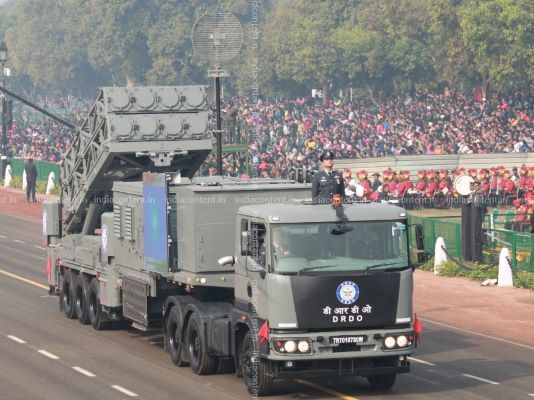
For the Indian Army, AoN was accorded for loitering munition systems for Artillery Regiments, Low-Level Light Weight Radars, Long-Range Guided Rocket Ammunition for the Pinaka Multiple Launch Rocket System (MRLS), and the Integrated Drone Detection & Interdiction System (IDD&IS) Mk-II.
Loitering munitions will enable precision engagement of tactical targets, while the Low-Level Light Weight Radars will improve detection and tracking of small, low-flying unmanned aerial systems. The Long-Range Guided Rockets will significantly enhance the range and accuracy of the Pinaka MRLS, enabling effective strikes against high-value targets, the defence ministry said.
On counter-drone capability, the ministry stated, “Integrated Drone Detection & Interdiction System Mk-II with enhanced range will protect the vital assets of the Indian Army in Tactical Battle Area and Hinterland.”
For the Indian Navy, the DAC cleared procurement of Bollard Pull (BP) Tugs, High Frequency Software Defined Radio (HF SDR) Manpack, and leasing of High Altitude Long Range (HALE) Remotely Piloted Aircraft Systems (RPAS).
The BP Tugs will assist naval ships and submarines in berthing, unberthing and manoeuvring in confined waters and harbours. The HF SDR Manpack will enhance secure long-range communications during boarding and landing operations, while the HALE RPAS will provide persistent Intelligence, Surveillance and Reconnaissance (ISR) and strengthen Maritime Domain Awareness across the Indian Ocean Region.
For the Indian Air Force, AoN was accorded for the Automatic Take-off Landing Recording System, Astra Mk-II Beyond Visual Range missiles, Full Mission Simulator for the Light Combat Aircraft Tejas, and SPICE-1000 Long Range Guidance Kits.
The ministry noted that the Automatic Take-off Landing Recording System will bridge critical gaps in the aerospace safety ecosystem by enabling high-definition, all-weather recording of take-offs and landings. The Astra Mk-II missiles, with enhanced range, will substantially boost the IAF’s ability to neutralise adversary aircraft from extended stand-off distances.
Highlighting training and strike capability, the ministry said, “Full Mission Simulator for Light Combat Aircraft Tejas will augment pilots’ training in a cost-effective and safe manner, while SPICE-1000 will enhance long-range precision strike capability of the Indian Air Force.”
The approvals reaffirm the government’s intent to accelerate military modernisation, strengthen deterrence and deepen indigenous defence manufacturing, ensuring the armed forces remain prepared for the evolving nature of warfare.