R ARIVANANTHAM
CHENNAI, JULY 21
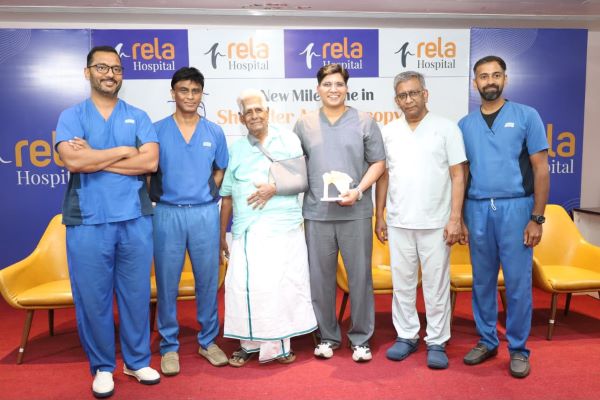
A 97-year-old patient has become the face of a new possibility in elderly healthcare after Rela Hospital successfully restored his shoulder function through what it describes as India’s first fully awake keyhole surgery using a biodegradable balloon spacer—demonstrating that even advanced age and serious cardiac concerns need not automatically close the door on life-improving surgical treatment.
- A 97-year-old with a massive, irreparable rotator cuff tear regains shoulder function after a minimally invasive procedure performed under a regional nerve block
- Biodegradable InSpace™ balloon spacer restores smooth, pain-free movement and gradually dissolves without leaving behind any permanent implant
- Advanced age and a frail heart rule out general anaesthesia, prompting doctors to perform the entire surgery while the nonagenarian remained fully awake
- Patient walks out of hospital within two days after early arm support and physiotherapy
- Medical milestone showcases personalised, age-appropriate and tissue-sparing care for elderly patients with complex shoulder disorders
The nanogenarian, who had suffered a massive and irreparable rotator cuff tear in his left shoulder after a fall at home, had been living with persistent pain and an almost unusable arm for nearly a month. With conventional tendon repair not feasible and general anaesthesia considered risky because of his age and underlying cardiac condition, doctors adopted a minimally invasive alternative.
The patient remained fully awake throughout the surgery, which was performed under an interscalene nerve block. A biodegradable balloon spacer was inserted through tiny keyhole incisions to restore the natural spacing and gliding mechanism of the shoulder joint.
The result was striking: following a routine post-operative stay in the general ward, early arm support and physiotherapy, the 97-year-old walked out of the hospital within two days.
A balloon, not a permanent implant, gives the shoulder a new lease of movement
The procedure was performed using the InSpace™ biodegradable subacromial balloon spacer, a minimally invasive dissolvable device specifically designed for massive irreparable rotator cuff tears.
During the arthroscopic procedure, the deflated balloon is introduced through tiny incisions into the space beneath the shoulder bone and gently inflated with sterile saline. Acting as a smooth cushion, it helps keep the ball of the shoulder centred within its socket and restores the joint’s natural spacing.
This reduces painful bone-on-bone friction and allows the patient to lift and move the arm more comfortably.
The balloon gradually and harmlessly dissolves over several months as the shoulder adapts to a more balanced and comfortable movement pattern. No permanent implant, screw or anchor is left behind.
‘Fully awake at 97’: the anaesthesia challenge doctors overcame
Dr Ashok S. Gavaskar, Clinical Lead, Orthopaedics and Head of Joint Replacement Services, Rela Hospital, said the patient’s condition presented an exceptional surgical challenge.
“In this patient, the rotator cuff tear was massive. A large portion of the tendon had torn away from the bone. Because the tear was extensive and the weakened tissues had retracted, a conventional tendon repair was not feasible. Managing such a massive tear in a 97-year-old patient is both uncommon and challenging.”
He added that shoulder arthroscopy is generally performed under general anaesthesia, but the patient’s age and underlying cardiac condition made that approach potentially risky.
“We therefore carried out the entire procedure with the patient fully awake under an interscalene nerve block, a targeted regional anaesthetic technique that completely numbs the shoulder while keeping the patient comfortable and conscious throughout the surgery. This enabled us to avoid the risks associated with general anaesthesia in a nonagenarian and facilitate a faster and safer recovery.”
One in five adults above 40 may have some degree of rotator cuff tear
Dr Prakash Ayyadurai, Consultant – Orthopaedics, Arthroscopy & Sports Medicine, Rela Hospital, who headed the surgical team, said rotator cuff tears are among the most common shoulder disorders and become increasingly prevalent with age.
“Rotator cuff tears are among the most common shoulder disorders and become increasingly prevalent with advancing age. They represent a significant and growing healthcare burden in India’s ageing population.”
According to him, studies from India suggest that approximately one in five adults over the age of 40 has some degree of rotator cuff tear, with prevalence rising sharply with every advancing decade. Full-thickness tears are seen in nearly 10-11% of this population.
“Age remains the single most important risk factor, as the tendons naturally weaken and undergo degenerative changes over time. Against this background of age-related wear and tear, even a seemingly minor fall can be sufficient to cause a major tear. Other factors that increase the risk include diabetes, hypertension, smoking and a lifetime of repetitive overhead activities,” he added.
‘A dead arm is not something elderly patients simply have to live with’
Prof Mohammed Rela, Chairman, Rela Hospital, described the procedure as a notable achievement in personalised, age-appropriate surgical care.
“Performing this procedure while the patient remained fully awake at the age of 97 is a notable achievement. It exemplifies personalised, age-appropriate surgical care.”
He said the case reflected the modern, tissue-sparing direction of shoulder surgery, where an irreparable rotator cuff tear can be treated with a biodegradable balloon spacer instead of major open reconstruction or joint replacement.
“Importantly, this case demonstrates that persistent shoulder pain and a ‘dead arm’ are not conditions that elderly patients simply have to live with.”
Prof Rela said advanced age and underlying cardiac concerns need not necessarily become barriers to effective treatment when the appropriate minimally invasive technique is matched to the right patient.
“Modern keyhole surgical techniques, combined with tailored anaesthetic approaches, now enable even patients in their 90s to undergo surgery safely and benefit significantly. We encourage patients not to delay seeking specialist advice. An early and honest assessment can help determine the most appropriate treatment options and what can realistically be achieved.”