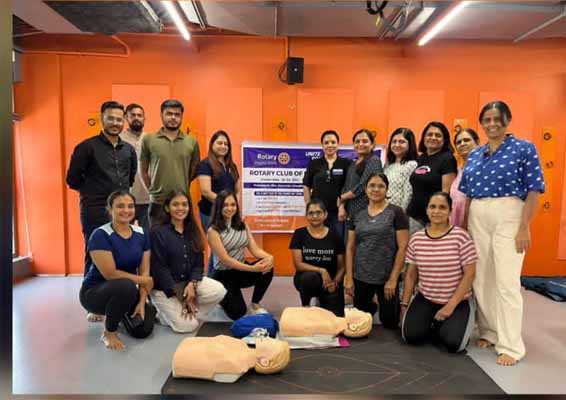
- The session was conducted by Dr. Komal Shah, Anesthesiologist at Sir T. Hospital, Bhavnagar
NE HEALTH BUREAU
BHAVNAGAR, JULY 24
Rotary Club of Bhavnagar Vibrant recently organized a hands-on CPR (Cardiopulmonary Resuscitation) training session for gym trainers at Kunas Gym to promote health awareness and emergency preparedness.
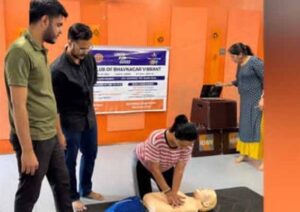
The session was conducted by Dr. Komal Shah, Anesthesiologist at Sir T. Hospital, Bhavnagar. She was accompanied by her interns Kevin and Swaraj, who assisted in guiding the participants through practical demonstrations.
During the session, trainers were taught how to respond effectively during sudden cardiac emergencies — including how to perform chest compressions.
Trainers from Kunas Gym actively participated in the training, showing great enthusiasm. The session was graced by Club President Rtn. Namrita Chadha, Secretary Rtn. Sunita Shah, and several Rotary Club members who also took part.
President Namrita Chadha thanked Dr. Komal Shah and her team for sharing their expertise and emphasized Rotary’s commitment to spreading life-saving knowledge within the community.
This initiative marks another impactful step towards building a healthier and safer Bhavnagar.
How to perform CPR
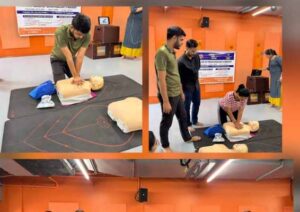
Check the scene for safety, form an initial impression and use personal protective equipment (PPE)
If the person appears unresponsive, Check for responsiveness, breathing, life-threatening bleeding or other life-threatening conditions using shout-tap-shout
If the person does not respond and is not breathing or only gasping, CALL 9-1-1 and get equipment, or tell someone to do so
Kneel beside the person. Place the person on their back on a firm, flat surface
The American Red Cross CPR guidelines recommend 100 to 120 chest compressions per minute, 30 at a time. Remember these five points:
- Hand position: Two hands centered on the chest
- Body position: Shoulders directly over hands; elbows locked
- Compression depth: At least 2 inches
- Rate of compressions: 100 to 120 per minute
- Allow chest to return to normal position after each compression
Give 2 breaths
- Open the airway to a past-neutral position using the head-tilt/chin-lift technique
- Pinch the nose shut, take a normal breath, and make complete seal over the person’s mouth with your mouth.
- Ensure each breath lasts about 1 second and makes the chest rise; allow air to exit before giving the next breath
Note: If the 1st breath does not cause the chest to rise, retilt the head and ensure a proper seal before giving the 2nd breath If the 2nd breath does not make the chest rise, an object may be blocking the airway
Continue giving sets of 30 chest compressions and 2 breaths. Use an AED as soon as one is available! Minimize interruptions to chest compressions to less than 10 seconds.