- Three-day contest brings together 24 teams from five countries to debate international law & rising global threats
- Judges, diplomats, scholars and practitioners dissect cyber warfare, displacement, non-compliance with ICJ rulings & space security
- Keynotes highlight Global South representation, state responsibility, corporate claims & new-age geopolitical challenges
- Army Institute of Law wins the title; RRU–NSAB launches Investment Arbitration Database to boost advanced research
NE EDUCATION BUREAU
GANDHINAGAR, NOV 17
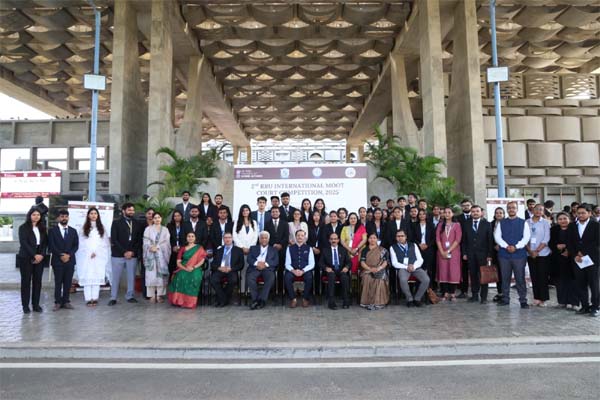
The Rashtriya Raksha University (RRU), an Institution of National Importance under the Ministry of Home Affairs, concluded the 2nd International Moot Court Competition (RIMC) 2025, held from November 14–16 on the theme “International Law and Global Security.” The event drew 24 teams from India, Nepal, Bangladesh, Ethiopia and Kenya, bringing together leading judges, scholars and legal practitioners to explore some of the most urgent challenges shaping the global legal order.
Inaugural Day: Law, Security and Global Responsibility
The event opened with the felicitation of dignitaries by Professor (Dr.) Bimal N. Patel, Vice Chancellor, followed by the formal inauguration by Justice Bela M. Trivedi, Former Judge, Supreme Court of India.
Reflecting on the rapidly evolving threat landscape, Justice Trivedi said: “Cyber warfare, terrorism, misinformation, climate displacement and transnational crimes are reshaping global security. International law remains indispensable for protecting global order.”
She also commended Professor Patel’s global roles, including his positions on the National Security Advisory Board, the UN International Law Commission, and his candidature for the International Tribunal for the Law of the Sea.
In his address, Professor Patel underscored the inseparability of law and security, stating:
“In today’s geopolitical turbulence, law and security must move forward together. Moot court problems mirror real-world disputes, and young professionals must approach them with precision, context and global awareness.”
Dr. Niharika Raizada, Director-in-Charge, School of Criminal Law and Military Law (SCLML), welcomed the delegates and emphasised the school’s mission:
“Our commitment is to nurture principled, research-driven and globally competent legal professionals who can navigate the demands of contemporary justice systems.”
The day concluded with preliminary rounds that set a strong academic tone for the competition.
Day Two: High-Intensity Rounds and Scholarly Interventions
Quarter-final and semi-final rounds showcased exceptional advocacy and analytical rigour.
The day featured two expert keynote lectures:
- Sanitya Kalika, international lawyer and Hering Scholar, University of Oxford, delivered a lecture on “Non-Compliance with the Judgment of an International Court.”
He underlined:
“Respect for international judgments is essential for safeguarding the credibility of global judicial institutions.” - Harsh Mahaseth, Associate Professor of Law, Jindal Global University, delivered a lecture on “Admissibility of Claims When a State Represents Corporations Before the ICJ.”
He noted: “State representation of corporations introduces complex layers of sovereignty and responsibility in international adjudication.”
The evening closed with a cultural celebration featuring the Gujarat Police Band, commemorating 150 years of Vande Mataram, earning admiration from participants—especially international delegates.
Final Day: Space Security, Global South Voices and Future Pathways
The concluding day brought together key dignitaries, including Professor (Dr.) Bimal N. Patel; Professor Chinnasamy Jayaraj, former Secretary-General, Indian Society of International Law; Udaya Kumar, Judicial Member, Karnataka State Administrative Tribunal; Smarak Swain, Director, FATF Cell, Ministry of Finance; Dr. Shikhar Ranjan, Director, AALCO; and Professor (Dr.) Mamata Biswal, GNLU.
Professor Jayaraj delivered a compelling lecture on “International Space Law and Global Security: Prohibition of Weapons, Particularly Nuclear Weapons, in Outer Space.”
He remarked: “Outer space must remain a domain of peace. The weaponisation of space would destabilise global security irreversibly.”
The grand finale saw the top teams argue with precision, composure and deep legal insight.
During the valedictory session, Professor Patel emphasised the moral dimension of legal careers, stating: “Those who work in international law hold the responsibility of shaping a peaceful, rules-based global order. Your work will influence nations, not just cases.”
Judicial Member Udaya Kumar praised RRU’s efforts and urged students to view the experience as a formative journey:
“Moot court participation is not merely competition—it cultivates discipline, analytical thinking, courtroom ethics and respect for the rule of law. International law today shapes domestic governance, administrative adjudication and state accountability. Stay globally aware and nationally committed.”
Dr. Shikhar Ranjan stressed the need for Global South representation in international adjudication:
“The Global South must have a stronger voice in international courts and tribunals. Young lawyers must aspire to global litigation and diplomacy roles.”
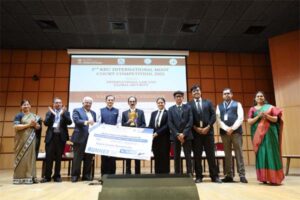
A major highlight of the day was the launch of the RRU–NSAB Investment Arbitration Database, marking a significant step in advancing specialised research in international law.
Winners, Opportunities and the Road Ahead
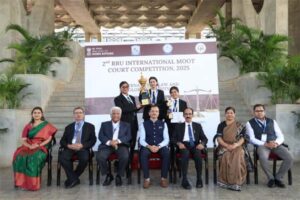
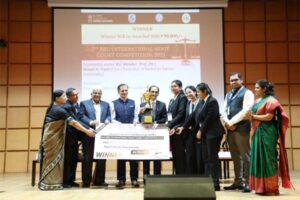
The Army Institute of Law, Mohali, emerged as the winner, followed by the United World School of Law, Karnavati University as runners-up. Winning teams secured internships at the RRU Centre for International Law, with exposure to research themes currently under consideration at the UN International Law Commission.
Delivering the closing remarks, V. Jayshree, Faculty Convener, announced the dates for the next edition:
“The 3rd RRU International Moot Court Competition will be held from 9–11 October 2026. We thank our leadership, faculty, staff and volunteers whose dedication made this event a resounding success.”
RRU continues to consolidate its standing as a global leader in national security, international law, policing and governance, with SCLML remaining at the forefront of justice education and research.