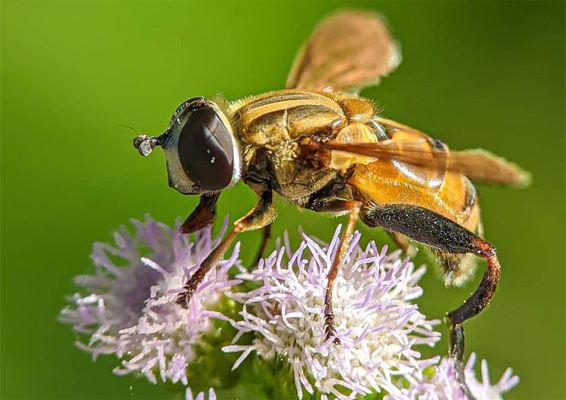
- Findings show mediterranean systems also at risk; temperate zones only relatively stable
- Researchers urge region-responsive conservation, reject one-size-fits-all frameworks
- Targeted strategies needed to protect bees, butterflies, biodiversity hotspots and global food security
NE ENVIRONMENT BUREAU
GANDHINAGAR, DEC 4
A landmark collaborative study by the Indian Institute of Technology Gandhinagar (IITGN) and Northeastern University, USA, has delivered a decisive message: universal conservation frameworks are inadequate in the face of climate change. Published in Communications Earth & Environment, the research reveals that pollination networks in tropical regions are the most vulnerable to rising temperatures, while Mediterranean systems also face significant threats.
Pollinators—bees, butterflies, beetles and more—form the backbone of global food production and natural ecosystems. Conservation programmes have long relied on broad international guidelines, but this study shows that such generalised strategies may fall short and, in some regions, may have “imperceptible benefit.”
Explaining the study’s approach, Dr Udit Bhatia, Associate Professor at IITGN’s Department of Civil Engineering and the study’s principal investigator, said, “Unlike most research that examines how climate change affects individual species, we have attempted to map entire ecological networks from diverse regions.”
The team examined eleven real ecological networks representing tropical, temperate and Mediterranean systems. By integrating these networks with climate projections from multiple Earth System Models, the researchers assessed future shifts in species growth, mortality, competition and mutualistic relationships over the next 75 years.
Their findings indicate that tropical plant-pollinator networks are the most at risk.
“Our results indicated that tropical networks, home to some of the world’s most biodiverse ecosystems, showed the greatest vulnerability,” said Ms Adrija Datta, first author and PhD scholar in IITGN’s Department of Earth Sciences. Simulations showed sharp reductions in pollinator populations, with many networks becoming unstable even under moderate warming. Because several tropical species already operate near their upper thermal limits, even small temperature increases can push them beyond survival thresholds.
Mediterranean ecosystems also revealed steep declines due to intense summer heat and extreme seasonal variability. Temperate ecosystems—common across Europe and North America—showed slower declines, thanks to broader temperature ranges and wider thermal safety margins. But the relative stability of temperate zones does not guarantee long-term protection.
As Mr Sarth Dubey, co-author and PhD scholar in IITGN’s Department of Computer Science and Engineering, warned, “Despite the ecosystem being relatively balanced, the inclusion of other pollinator threats, such as habitat loss, pesticide exposure, and timing mismatches between plants and pollinators, could accelerate decline.”
To assess whether focused conservation can help, the researchers evaluated strategies such as safeguarding one influential species versus supporting multiple highly connected species. In tropical networks, restoring multiple keystone species significantly improved stability and pollinator abundance—but these interventions made minimal difference in Mediterranean and temperate systems.
“Management works in the tropics because there are species whose presence and abundance hold the network together,” explained Ms Datta. “That kind of leverage does not exist everywhere.”
The study reinforces that conservation models must reflect regional ecological realities. As Mr Dubey emphasized,
“Climate adaptation policies are being negotiated worldwide, but ecological responses are not universal.”
The findings offer a scientific foundation to determine where immediate action is needed and where ecosystems may possess inherent resilience.
Looking ahead, the researchers plan to incorporate additional stressors—such as land-use change, chemical exposure and habitat fragmentation—to create integrated, high-accuracy risk models. According to Dr Bhatia, understanding how these combined pressures interact, especially in regions currently considered stable, will be crucial for long-term, evidence-based conservation planning.