
R ARIVANANTHAM
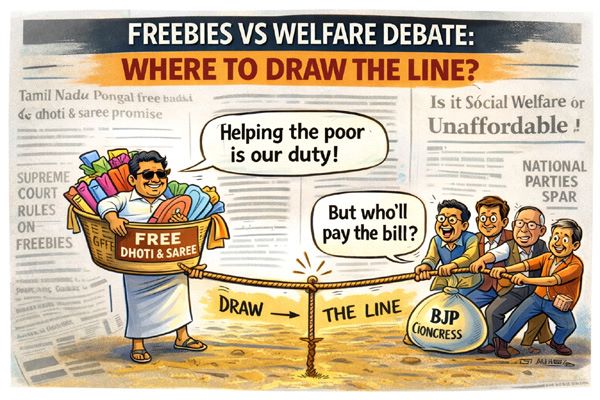
As Tamil Nadu prepares for Pongal 2026, the state government’s announcement of free dhotis (veshtis) and sarees for all ration card holders has reignited a nationwide debate on welfare versus freebies, fiscal prudence and constitutional accountability.
Handlooms and Textiles Minister R. Gandhi confirmed that the distribution would be completed by January 6, 2026, stating, “The targets for the veshtis and sarees produced for distribution to poor and needy people for the Pongal festival have been fully achieved. The production work was completed very quickly.”
According to official estimates, the scheme is expected to benefit over 2.15 crore ration card holders, including priority household beneficiaries, with an estimated exchequer burden exceeding ₹2,000 crore, covering procurement, logistics and distribution.
- Festive relief for crores of ration card holders
- ₹2,000+ crore exchequer cost raises sustainability questions
- National parties, economists and the apex court weigh in
- Welfare vs freebies debate intensifies ahead of 2026 Assembly polls
- Other states mirror similar schemes, deepening policy divide
Political Reactions: Support, Skepticism and Sharp Divides
The DMK government has defended the scheme as a continuation of Tamil Nadu’s long-standing social justice and welfare tradition, arguing that festive support for vulnerable households helps cushion inflationary pressures and boosts local textile production.
The AIADMK, while not opposing welfare per se, questioned the timing and targeting, asserting that “festive handouts should not substitute long-term income generation, jobs and price control mechanisms.”
The BJP, at both state and national levels, reiterated its stance that welfare must be outcome-oriented, cautioning that blanket freebies could strain state finances and reduce capital expenditure. Party leaders pointed to the need for skill development, entrepreneurship and infrastructure investment alongside social support.
The Congress adopted a nuanced position, supporting welfare for the poor but urging transparent budgeting and social audits, while Left parties welcomed the scheme as people-centric relief, particularly for informal sector workers.
TVK Chief Vijay: Welfare with Accountability
Tamilaga Vettri Kazhagam (TVK) chief Vijay has called for a balanced welfare model, stating that support schemes must uplift dignity, not create dependency. He has stressed that welfare spending should be corruption-free, transparent and measurable, warning that unchecked freebies must not divert funds from education, healthcare and youth employment.
TVK sources say the party supports targeted welfare with accountability, especially for women-headed households and daily-wage earners, while demanding clarity on funding sources and long-term fiscal impact.
Economists Speak: Relief Today, Risk Tomorrow
Economists remain divided. Some view festive welfare as a counter-cyclical social safety net, especially during periods of high food inflation. Others caution that revenue-heavy states like Tamil Nadu may absorb such costs today, but replication across states could widen fiscal deficits nationally.
Public finance experts warn that recurrent freebies without asset creation may crowd out spending on health, education and infrastructure, potentially affecting growth and credit ratings.
Similar Schemes Across States
Tamil Nadu is not alone. States such as Telangana, Andhra Pradesh, Karnataka, Rajasthan, Madhya Pradesh and West Bengal have rolled out free ration kits, cash transfers, power subsidies and festival grants in recent years. The growing competitive populism has made welfare politics a central electoral plank nationwide.
Supreme Court on Freebies vs Welfare
The Supreme Court of India has repeatedly drawn a distinction between legitimate welfare schemes and indiscriminate freebies, especially during election periods.
What the Court Has Said (In Principle):
- Welfare measures aimed at basic needs, dignity and social uplift are constitutionally valid.
- Unfunded or irrational freebies may distort voter choice, strain public finances and impact future generations.
- States must disclose the financial implications of such schemes and their impact on development spending.
- The Court has called for institutional mechanisms to evaluate welfare promises against fiscal sustainability, without encroaching on legislative powers.
Key Takeaway
The apex court has stopped short of banning freebies but insists on fiscal responsibility, transparency and informed democratic choice.
The Road Ahead
As Pongal cheer reaches crores of households, Tamil Nadu’s scheme underscores a larger national crossroads—how to balance compassion with caution, relief with reform, and electoral politics with economic discipline.
With the Supreme Court watching closely, economists divided and political parties sharpening positions, the debate over welfare versus freebies is set to intensify as India heads toward the next electoral cycle.
(Author of this article is Executive Editor, navjeevanexpress.com)