NE NEWS SERVICE
CHENNAI, DEC 31
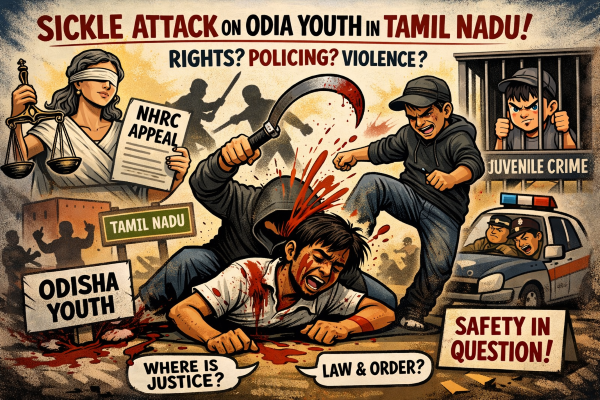
A shocking incident of violence near Tiruttani railway station in Tamil Nadu’s Tiruvallur district has triggered a formal appeal to the National Human Rights Commission (NHRC), seeking suo moto cognizance and a comprehensive inquiry. The incident, which occurred on December 27, 2025, involved a 20-year-old youth, Shri K. Suraj from Kalahandi district, Odisha, who was brutally attacked with sickles by four juveniles, reportedly for refusing to participate in a social media reel.
- Assault Caught on Camera: A Chilling Case of Viral Violence
- Police Action Swift, But Institutional Gaps Flagged
- Human Rights at Stake: Article 21 and Interstate Safety Concerns
- NHRC Urged to Act: Call for Suo Moto Cognizance and Reforms
According to the complaint, the assailants allegedly filmed the assault and uploaded it on Instagram, raising disturbing concerns about the glorification of violence, juvenile delinquency, and substance abuse. The victim sustained serious injuries to his head, face, hands and arm after being forced off a suburban EMU train and assaulted near abandoned railway quarters.
Tiruttani Town Police arrested all four juveniles on December 28, seizing weapons and mobile phones used in the crime. A case was registered under Section 109 of the Bharatiya Nyaya Sanhita (attempt to murder) and related provisions. Three juveniles were sent to a juvenile home in Chengalpattu, while one was released into parental custody, a move that has drawn scrutiny given the severity of the offence.
In a press briefing on December 30, North Zone IGP Shri Asra Garg stated that preliminary findings point to a personal dispute, not a region- or identity-based attack, and dismissed rumours of the victim’s death. However, the complaint notes lingering questions regarding substance abuse testing, adherence to NDPS and Juvenile Justice Act protocols, and the transparency of the investigation.
VIDEO | IG Asra Garg said, "Teenagers held for assaulting Odisha man in Tamil Nadu's Tiruvallur face attempt to murder charge."
(Full video available on PTI Videos – https://t.co/n147TvqRQz) pic.twitter.com/QqmkkgQx5n
— Press Trust of India (@PTI_News) December 30, 2025
The petition to the NHRC argues that the incident constitutes a potential violation of Article 21 — the Right to Life and Dignity, citing alleged lapses in victim protection, psychological counselling, family notification, and secure post-treatment handover. It also flags concerns over the victim’s mental trauma, fear of retaliation, and long-term rehabilitation.
Beyond the individual case, the incident raises broader constitutional questions about inter-state citizens’ right to free movement and equal protection under Articles 14, 19(1)(d), and 21. While police deny a regional motive, the complaint highlights apprehensions over underreported attacks on migrant and inter-state workers in industrial corridors.
The representation, submitted by A.N.S. Prasad, Spokesperson, Tamil Nadu BJP, urges the NHRC to invoke its powers under Section 12 of the Protection of Human Rights Act, 1993. Key demands include an independent inquiry into police conduct, hospital protocols, juvenile handling, and victim care, along with on-record interaction with the victim in Odisha.
The plea also seeks free legal aid, compensation, and systemic recommendations to curb juvenile drug abuse and misuse of social media platforms for violent content. The matter has drawn political attention, with Odisha Chief Minister Shri Mohan Charan Majhi condemning the attack and assuring support to the victim.
#WATCH | Bhubaneswar | On a man from Odisha assaulted by four juveniles in Tamil Nadu, Odisha Minister Ganesh Ram Singh Khuntia says, "I appeal to the Tamil Nadu government to take the strictest possible action against those who are doing this… One of our officers has gone… pic.twitter.com/Fs0e78Z5Ax
— ANI (@ANI) December 30, 2025
As the nation grapples with evolving forms of youth violence amplified by digital platforms, the case has emerged as a critical test of human rights safeguards, institutional accountability, and preventive governance.