
R ARIVANANTHAM
From Palladam to Patna: The Rise of Women-Centric Electoral Politics
The DMK’s women’s conference—Vellum Tamil Pengal (Winning Tamil Women)—held at Palladam near Coimbatore on December 29, marks more than a state-level outreach. It reflects a pan-Indian political churn, where women voters are no longer silent beneficiaries but active power brokers shaping electoral outcomes. Incidentally, Tamil Nadu has more woman voters than men
This was the second in a series of carefully choreographed mass conferences across six key districts in Tamil Nadu, following the youth-focused conclave in Thiruvannamalai. With barely 100 days left for the next Assembly election, the message from Palladam was unmistakable: the battle for Tamil Nadu will be won or lost through women.
This phenomenon is not confined to Tamil Nadu. From Bihar’s cash assistance to women heads of families, Andhra Pradesh’s Amma Vodi and women SHG empowerment model, West Bengal’s Lakshmir Bhandar, to Madhya Pradesh’s Ladli Behna Yojana, political parties across India—regional satraps and national players alike—have recalibrated strategies to place women voters at the centre of electoral arithmetic.
The Freebie Debate vs the Reality of Women’s Power
Critics often dismiss these initiatives as “freebies”, but for women voters—especially in rural and semi-urban India—they translate into mobility, dignity, financial agency and bargaining power within households.
In Tamil Nadu alone, women voters now outnumber men—3.14 crore women against 3.03 crore men (2024–25)—and consistently record higher turnout rates. Historically, this decisive vote bank was consolidated by Jayalalithaa, who positioned herself as the guardian of women’s safety and welfare from the 1990s. After her demise in 2016, women voters fragmented—shifting towards the DMK and Seeman’s NTK in successive elections.
The DMK’s current women-first pitch rests on tangible welfare architecture:
- Rs. 1,000 monthly assistance to women heads of families
- Free bus travel, saving an estimated Rs. 888 per month
- Morning breakfast scheme, easing the burden on working mothers
- Naan Mudhalvan skill programme, targeting employability of youth, especially young women
Beyond welfare, the party is invoking Dravidian social justice legacy, grassroots mobilisation, and door-to-door engagement to project itself as the protector of women’s rights. It is needless to say that TN model has been replicated by almost all regional parties as well national parties to comeback to power.
Superstars, Setbacks and Shifting Loyalties
The women-centric narrative is also reshaping the fortunes of celebrity politicians. The visible political decline of Ulaganayagan Kamal Haasan’s Makkal Needhi Maiam, once seen as an urban, reformist alternative, underscores a hard truth: women voters now seek delivery, not just discourse.
In contrast, Vijay’s entry into politics has emerged as a magnetic force, particularly among young women and first-time voters. With a likely three-cornered contest, political strategists believe Vijay could disrupt both DMK and AIADMK vote banks, especially in urban and semi-urban belts.
Nationally too, superstar-led politics—from the past of NTR and MGR to contemporary experiments—has shown that charisma alone cannot sustain women’s trust without institutional welfare and representation.
The recent Karur tragedy and the mass mobilisation that followed have further heightened political consciousness, pushing leaders—often dubbed Jana Nayagans—to position themselves as empathetic, accessible and responsive to women’s concerns.
The Chanakyan Question: Welfare Without Representation?
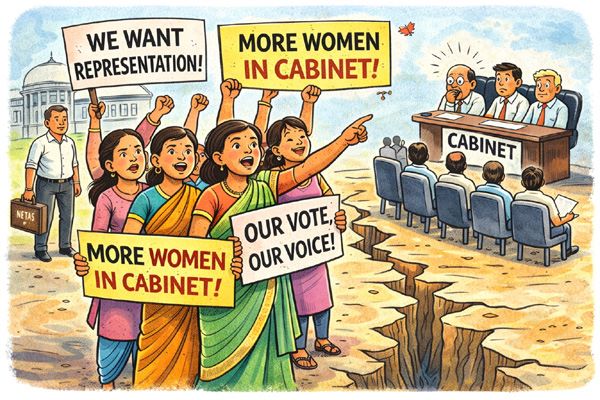
While political parties aggressively court women voters through welfare schemes, a crucial question remains unanswered: Are women receiving proportional representation in party structures and governments?
Across India, women-centric policies abound, but women MLAs, MPs, ministers and decision-makers remain underrepresented. The Women’s Reservation Bill promises structural correction, but its delayed implementation exposes the gap between political messaging and political power-sharing.
India’s modern-day Chanakyas—political strategists and election managers—clearly understand one reality: women voters can make or break governments. Yet, whether this understanding translates into real leadership opportunities for women, rather than symbolic outreach, will define the next phase of Indian democracy.
Awakening the Silent Majority
From Vellum Tamil Pengal to women-led electoral shifts across Bihar, Andhra Pradesh, Bengal and beyond, one truth stands tall: women voters are no longer a silent vote bank—they are the decisive force.
As elections approach, the real strength of women lies not just in accepting welfare, but in questioning representation, demanding accountability, and reshaping governance priorities. The next political wave in India may well be decided not in war rooms, but in how convincingly parties answer a simple question women voters are increasingly asking:
“Beyond welfare, where is our seat at the table of power?”