- Odisha consensus, Gujarat stakeholder meet and JIPMER model converge on Ayurveda’s global moment
- US healthcare crisis propels shift from intervention to prevention
- Dr Charles and Dr Lesle Elder map America’s integrative medicine framework
- Gujarat emerges as national pilot for quality, regulation and collaboration
- MBBS–BAMS integration flagged as education reform India cannot delay
- Policy makers, medical councils urged to rise above silos for patient-centric care
NE HEALTH BUREAU
AHMEDABAD, JAN 12
Building on the national momentum created at the recent Ayurveda deliberations in Odisha, the American Association of Physicians of Indian Origin (AAPI), in collaboration with Cadila Pharmaceuticals, convened “Vishwa Ayurved Samvad” in Ahmedabad—positioning Ayurveda not as an alternative ideology, but as a clinically relevant, evidence-oriented partner in modern medicine.
The forum came at a critical juncture, as healthcare spending in the United States approaches 18 per cent of GDP, largely due to chronic disease burdens and intervention-heavy treatment models. Speakers argued that integrative medicine is no longer optional, but essential for healthcare sustainability.
From Parallel Systems to Patient Outcomes
Participants stressed that Ayurveda’s strengths in prevention, lifestyle modulation and long-term disease management can complement modern diagnostics and acute care, leading to better patient outcomes and reduced system-wide costs.
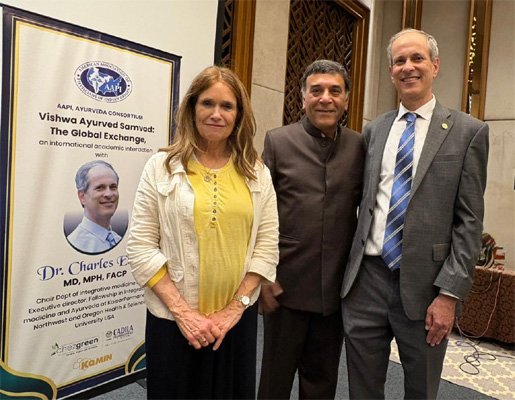
Dr. Charles Elder, global pioneer in integrative medicine and Executive Director, Fellowship in Integrative Medicine and Ayurveda at Maharshi International University (MIU), outlined the scientific and educational roadmap.
“We have learnt how Ayurveda can be integrated with modern medicine to achieve better outcomes for patients. Our mission is to transmit this knowledge in a structured and scientific manner, showing how Ayurveda and contemporary medicine can work together for the best results,” he said.
Highlighting the importance of physician education in the US, he added:
“In the United States, it is essential that licensed physicians are trained to understand authentic Ayurveda, and for that we need strong resources, collaborators and institutional support. We are encouraged by the growing interest and are close to finalising formal frameworks that will help take this work forward.”
Ayurveda in the US: From Curiosity to Clinical Confidence
Dr. Lesle Elder, a leading integrative medicine educator and long-time advocate of Ayurveda in the US, traced its steady institutional acceptance.
“Over the last two decades, we have seen Ayurveda move from being viewed as a cultural curiosity to a respected system of preventive and lifestyle medicine in the United States. When taught authentically and applied scientifically, Ayurveda enhances clinical decision-making and empowers patients to participate actively in their own healing,” she said.
She noted that Ayurveda’s growth mirrors the earlier mainstreaming of yoga, driven by patient demand and physician dissatisfaction with purely intervention-driven care.
Gujarat Stakeholder Meet: From Talk to Implementation
A significant outcome of Vishwa Ayurved Samvad was the announcement of a state-level multi-stakeholder working group in Gujarat, bringing together allopathic and Ayurvedic doctors, research scientists, regulators, academia and industry leaders.
The group will focus on:
- Quality assurance and contamination control
- Clinical validation and documentation
- Globally acceptable manufacturing standards
- Integrated treatment protocols
This Gujarat initiative is being positioned as a national pilot, with the potential to guide policy frameworks across India.
Patient First, Not System Supremacy
Dr. Amit Shah, Chairman of AAPI’s Ayurveda Consortium, said the dialogue must move beyond disciplinary turf wars.
“This is not a debate of Ayurveda versus allopathy. Our focus is patient well-being, irrespective of medical discipline. If something works and benefits the patient, it should be part of care,” he said.
He added: “Ayurveda’s strong preventive focus can significantly reduce healthcare costs over time. Integrated science has become a necessity, not a choice.”
Industry’s Role: Trust Begins with Quality
Dr. Manjul Joshipura, President of Cadila Pharmaceuticals, underlined the responsibility of industry in Ayurveda’s global journey.
“For Ayurveda to gain wider acceptance internationally, particularly in regulated markets like the US, ensuring quality and safety of medicines is critical. Industry, academia and medical professionals must work together to strengthen standards and build trust,” he said.
Policy Focus | MBBS–BAMS Integration: Why JIPMER must not remain an exception
What JIPMER Has Initiated
JIPMER, Puducherry, has introduced an integrated MBBS–BAMS undergraduate programme, enabling students to learn modern medicine and Ayurveda under one structured academic framework as part of the New Educational Policy..
Why Policymakers Must Act Now
- Fragmented education perpetuates mistrust between systems
- Integrated learning promotes clinical collaboration and rational referrals
- India can lead the world in evidence-based integrative healthcare
Why Medical Councils Must Recalibrate
- Move from protectionism to patient outcomes
- Frame clear accreditation and curriculum norms
- Encourage joint research, not parallel silos
Role of Private Medical Colleges
- Educate the majority of India’s doctors
- Essential for scaling integrative education nationally
- Aligns with NEP’s multidisciplinary vision
Experts at the forum stressed that without regulatory courage and institutional reform, India risks exporting Ayurveda as culture—but importing healthcare solutions at enormous cost.
Awakening Call: Beyond Tradition, Towards Transformation
The collective message from Odisha to Gujarat, from JIPMER to the US, was unequivocal:
Ayurveda’s future lies not in sentiment, but in science; not in isolation, but integration; not in politics, but patient welfare.