NE HEALTH BUREAU
CHENNAI, JAN 20
The Sri Ramachandra Institute of Higher Education and Research (SRIHER) on Monday celebrated the 20th anniversary of its Cochlear Implant Programme (CLIPS), marking two decades of restoring hearing, speech, and confidence among children with profound hearing impairment.

The milestone event underscored SRIHER’s pioneering role in cochlear implantation, a technology that directly stimulates the auditory nerve, enabling children with severe to profound hearing loss to perceive sound and develop age-appropriate speech and language skills.
- · Two Decades of the CLIPS Programme Restore Hearing, Speech and Confidence
- · Over 300 Children Benefit as Families Celebrate a Journey of Hope
- · First Cochlear Implant Recipient Returns as a Classical Dancer
- · Multidisciplinary Care, Early Intervention Drive Lasting Outcomes
A Celebration of Voices Once Lost to Silence
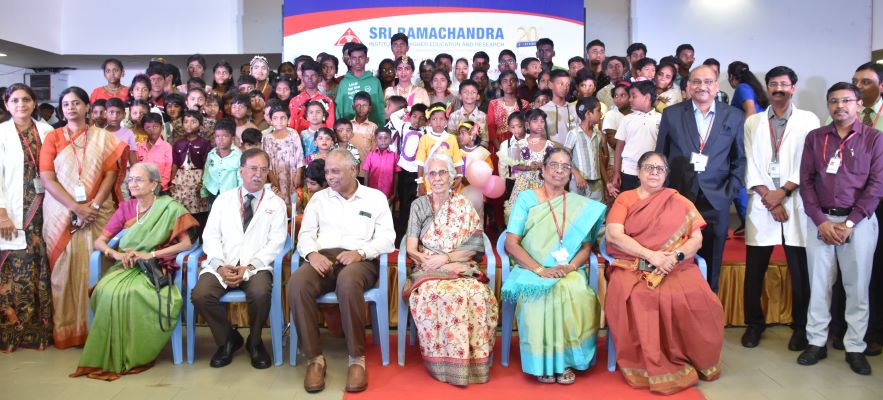
Nearly 180 cochlear implant recipients, accompanied by their parents, participated in the anniversary celebrations. The event turned into an emotional showcase of transformation, with children presenting cultural performances and personal testimonials that traced their journey from silence to sound.
A standout moment was the performance by Kalyani Karthik, currently pursuing a postgraduate degree, who underwent cochlear implantation at the age of three and is SRIHER’s first cochlear implant recipient. She captivated the audience with a classical Bharatanatyam performance, symbolising the life-changing impact of early auditory intervention.
Chief Guest Highlights Child-Centred Learning
The celebrations were inaugurated by Uma Shanker, President, Indian Montessori Centre, Bengaluru, who lauded the collective efforts of healthcare professionals involved in the programme.
She commended the commitment of ENT surgeons, audiologists, speech therapists, and social workers for delivering timely and appropriate interventions to children with hearing loss.
Emphasising the Montessori philosophy, she said it was essential to “guide children along their own learning paths rather than impose external views.” On the occasion, she also released a Cochlear Implant Parent Education Booklet, aimed at empowering families navigating the post-implant rehabilitation journey.
CLIPS: A Multidisciplinary Model of Care
Through the CLIPS programme, over 300 children have benefitted from cochlear implantation and comprehensive rehabilitation at SRIHER. The programme’s success has been driven by a strong multidisciplinary team comprising ENT surgeons, audiologists, speech and language therapists, anaesthesiologists, and rehabilitation specialists working in close coordination.
SRIHER continues to expand its impact through parent empowerment initiatives, cochlear implant camps, and awareness programmes, including the distribution of educational pamphlets and audio-visual materials to sensitise families about cochlear implantation and post-implant habilitation.
Leadership Presence Reflects Institutional Commitment
The anniversary event was attended by Vice Chancellor Dr. Uma Sekar, Pro Vice Chancellor Dr. Mahesh Vakamudi, Dean of the Medical College Dr. K. Balaji Singh, Medical Director Dr. R. B. Sudhagar Singh, Medical Superintendent Dr. P. Surendran, Head of the Department of ENT, Head & Neck Surgery Dr. S. Prasanna Kumar, Principal, Faculty of Audiology and Speech Language Pathology Dr. Prakash Boominathan, Special Officer Ms. Roopa Nagarajan, along with senior faculty members.
Their presence reaffirmed SRIHER’s long-standing commitment to inclusive healthcare, early intervention, and long-term rehabilitation for children with hearing impairment.
Here is a clean, reader-friendly MEDICAL EXPLAINER BOX, suitable for print, web, and magazine layouts, written in clear, non-technical language and aligned with health journalism standards:
MEDICAL EXPLAINER | What Is a Cochlear Implant?
Restoring Hearing When Conventional Hearing Aids Are Not Enough
A cochlear implant is an advanced electronic medical device designed for individuals with severe to profound sensorineural hearing loss. Unlike hearing aids, which amplify sound, cochlear implants bypass damaged parts of the inner ear and directly stimulate the auditory nerve, enabling the brain to perceive sound.
Who Needs a Cochlear Implant?
Cochlear implants are recommended for:
- Children born with severe or profound hearing loss
- Individuals who do not benefit adequately from hearing aids
- Children identified through newborn hearing screening
- Adults who have lost hearing due to illness, trauma, or aging
Early implantation, especially before the age of three, significantly improves speech, language development, and learning outcomes.
How Does a Cochlear Implant Work?
A cochlear implant has two main components:
- External processor: Worn behind the ear, it captures sound and converts it into digital signals
- Internal implant: Surgically placed under the skin, it sends electrical signals directly to the auditory nerve
The brain then interprets these signals as sound.
Is Cochlear Implant Surgery Safe?
Yes. Cochlear implant surgery is a well-established and safe procedure, typically lasting 2–3 hours. Most children are discharged within a few days. The surgery is followed by device activation and structured rehabilitation.
Why Is Post-Implant Therapy Important?
Cochlear implantation is not a one-time solution. Success depends heavily on:
- Auditory-verbal therapy
- Speech and language rehabilitation
- Parental involvement
- Regular device mapping and follow-up
With consistent therapy, many children can attend mainstream schools and communicate effectively.
What Are the Long-Term Benefits?
- Development of speech and language
- Improved social interaction and confidence
- Better academic outcomes
- Enhanced quality of life
Are Cochlear Implants Supported in India?
Yes. Cochlear implants are supported under various government and institutional programmes, including early intervention schemes. Multidisciplinary centres like SRIHER’s CLIPS programme provide comprehensive evaluation, surgery, and rehabilitation under one roof.
Key Takeaway
Cochlear implants do not cure deafness, but they open the door to sound, speech, and learning—especially when intervention happens early and rehabilitation is sustained.
Photo Captions
- Cochlear implant recipients performing cultural programmes during the 20th anniversary celebrations of SRIHER’s CLIPS programme in Chennai.
- Ms. Kalyani Karthik, SRIHER’s first cochlear implant recipient, performing Bharatanatyam at the anniversary event.
- Chief Guest Ms. Uma Shanker releasing the Cochlear Implant Parent Education Booklet at SRIHER.