- Defence Minister Says Indigenous Systems Boosted Combat Readiness in Real Operations
- DRDO Technologies Proven in Battle, Powering Aatmanirbhar Bharat Mission
- ‘Survival of the Fastest’ Doctrine to Define Future Warfare Preparedness
- Time-to-Induction Emerges as Key Performance Metric for Defence R&D
- Exports, Co-Development & Global Credibility Central to Viksit Bharat 2047 Vision
NE DEFENCE BUREAU
NEW DELHI, JAN 27
Operation Sindoor has demonstrated that indigenous defence systems are significantly strengthening India’s operational readiness, Defence Minister Shri Rajnath Singh said on Monday, underlining the decisive role played by the Defence Research and Development Organisation (DRDO) in the country’s journey towards self-reliance in defence.
Addressing DRDO’s Best Performing Scientists and Technical Personnel, who attended the 77th Republic Day Parade as Special Guests, Defence Minister said self-reliance has become a national mindset under the leadership of Prime Minister Shri Narendra Modi, with DRDO emerging as a central pillar in the rapid transformation of India’s defence sector.
“Operation Sindoor demonstrated that indigenous systems are strengthening India’s operational readiness,” said Defence Minister, noting that DRDO-developed technologies were effectively deployed on the battlefield, validating years of indigenous research and development.
‘Survival of the Fastest’ in Modern Warfare
Highlighting the pace of technological change, Defence Minister urged DRDO scientists to innovate faster, think boldly, and embrace calculated risks.
“Technology is changing rapidly. Any tech that is new today may become irrelevant in 4-5 years. Therefore, in today’s times, especially on the battlefield, we must move forward keeping in mind the theory of ‘survival of the fastest’ and not just ‘survival of the fittest’. The country that thinks, decides & deploys technology quickly stays ahead,” he said.
He encouraged DRDO to venture beyond domains where private industry has already built strong capabilities, suggesting the creation of a dedicated high-risk research wing to pursue breakthrough technologies that could deliver historic success.
Speed of Induction Is the New Benchmark
Stressing that time is now the most critical factor in defence preparedness,Defence Minister called for drastic reductions in delays across the innovation pipeline.
“Need to reduce time between research to prototype, prototype to testing & testing to deployment, timely induction should be the biggest parameter,” he asserted.
Pointing out that DRDO traditionally focuses on design and prototyping while industry handles production, he emphasised the need to bridge this gap through co-development models, involving industry partners from the earliest design stages—mirroring best international practices.
Collaboration Is Key to Aatmanirbhar Bharat
Calling for a shift from siloed innovation to an open, collaborative defence R&D ecosystem, Defence Minister urged DRDO to work closely with public sector undertakings, private industry, MSMEs, start-ups and academia.
“DRDO must collaborate with public & private sectors, MSMEs, start-ups and academia to realise Aatmanirbhar Bharat vision,” he said, citing the Light Combat Aircraft Tejas as a prime example of successful collaboration between DRDO and Hindustan Aeronautics Limited.
He added that government support will be truly meaningful only when DRDO moves away from a monopolistic R&D model and actively shares knowledge across the innovation ecosystem.
Exports: From National Capability to Global Influence
Highlighting the sharp rise in defence exports, Defence Minister noted that exports have grown from less than Rs 1,000 crore in 2014 to approximately Rs 24,000 crore today, driven by indigenous capability building.
“We have set a defence exports target of Rs 50,000 crore by 2029-30. DRDO should consider export markets right from the design stage of its systems, especially focusing on drones, radars, electronic warfare systems, and ammunition,” he said, adding that exports enable cost recovery, global credibility and stronger strategic partnerships.
Expressing confidence in DRDO’s future role, he said the organisation will be a key contributor to building Viksit Bharat by 2047.
Honouring Scientific Excellence
Describing scientists, engineers and technicians as DRDO’s greatest strength, Defence Minister stressed the importance of continuous learning, leadership opportunities and freedom to innovate, acknowledging that failures are an inherent part of research.
The event honoured outstanding contributors under the DRDO Award Scheme 2024, including:
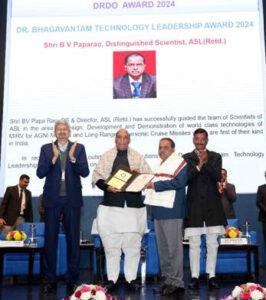
- Dr Bhagavantam Technology Leadership Award 2024 to Shri BV Paparao, Director, Advanced Systems Laboratory, Hyderabad, for leadership in developing Agni missile technologies and MIRV capability for long-range hypersonic cruise missiles.
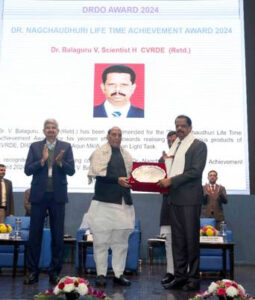
- Dr Nagchaudhuri Lifetime Achievement Award 2024 to Dr Balaguru V, Former Scientist, CVRDE, Chennai, for contributions to MBT Arjun MK-1 and India’s Light Tank ‘Zorawar’.
Three Best Scientific Excellence Awards and two Best Technical Excellence Awards were also presented.
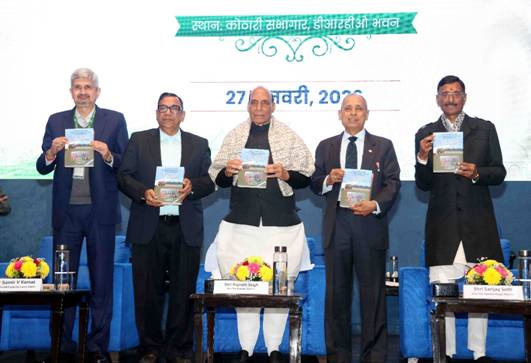
A book titled ‘The Unprecedented Success Story of the First Indigenous Supersonic Multi-Target Surface-to-Air Missile System – AKASH’ was released, chronicling the missile’s journey from conception to operational success and underscoring DRDO’s scientific excellence and Aatmanirbhar Bharat spirit.
MoS for Defence Sanjay Seth, Secretary (Defence R&D) and Chairman DRDO Dr Samir V Kamat, along with award-winning scientists and their families, were present at the function.