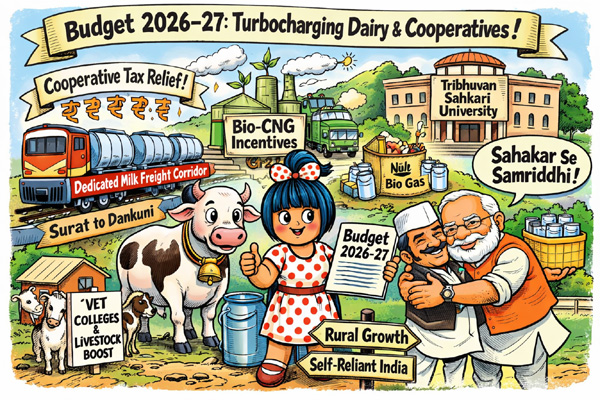
- Amul Welcomes Tax Reforms, Freight Corridor and Bio-Energy Push for ‘Sahakar se Samriddhi’
- Landmark Cooperative Tax Relief to Unlock Cash Flows and Farmer Surpluses
- Dedicated Freight Corridor to Strengthen National Milk Grid
- Bio-CNG Incentives Accelerate Circular Dairy Economy
- ₹300 Cr Tribhuvan Sahkari University Anchors Cooperative Capacity Building
- Exports, Veterinary Education and Livestock Infra Get Big Budget Thrust
NE BUSINESS BUREAU
ANAND, FEB 1
The Union Budget 2026–27 has delivered a decisive boost to India’s cooperative movement, dairy sector and rural economy, drawing a strong welcome from Amul. Through a combination of far-reaching cooperative taxation reforms, logistics infrastructure, clean energy incentives, education investments and export support, the Budget reinforces the Government’s vision of “Sahakar se Samriddhi”—prosperity through cooperation—while laying the foundation for a more resilient, farmer-centric and globally competitive dairy ecosystem.
Cooperative Tax Reforms: Fixing Structural Bottlenecks
The Union Budget 2026–27 introduces landmark taxation reforms aimed at strengthening the financial sustainability and operational efficiency of cooperative institutions.
Extension of income-tax deduction to cattle feed and cotton seed
The existing income-tax deduction available to primary cooperative societies supplying milk, oilseeds, fruits and vegetables has now been extended to include cattle feed and cotton seed produced by their members.
This reform is particularly significant for Gujarat’s dairy cooperative ecosystem, which collectively produces and markets nearly 10,000 metric tonnes of cattle feed daily, with an annual turnover of around ₹10,000 crore. The move is expected to substantially simplify accounting and tax compliance for 18,600 Village Cooperative Societies (VCSs) in Gujarat, while extending similar benefits to thousands of dairy cooperatives nationwide.
Inter-cooperative dividend deduction under the new tax regime
The Budget allows inter-cooperative society dividend income as a deductible expense, addressing the long-standing issue of double taxation within cooperative structures.
This reform is expected to provide immediate financial relief of approximately ₹80–100 crore annually to dairy cooperatives in Gujarat alone, improving surplus availability for higher farmer payments, infrastructure expansion and member services.
Three-year dividend exemption for national cooperative federations
A three-year exemption on dividend income has been announced for notified national cooperative federations on investments made up to January 31, 2026, subject to onward distribution to member cooperatives. Together, these measures significantly strengthen the financial backbone of dairy and agricultural cooperatives.
Milk on the Move: Dedicated Freight Corridor Boost
The announcement of a new Dedicated Freight Corridor (DFC) connecting Surat in the West to Dankuni in the East is expected to play a transformative role in dairy logistics.
The corridor will:
• Enable faster, time-bound movement of liquid milk
• Reduce logistics and transportation costs
• Minimise spoilage and transit losses
• Integrate regional milk sheds into a stronger national milk grid
Similar to the existing Gujarat–Delhi DFC, this corridor will substantially enhance the movement of perishable commodities, delivering major operational advantages to large, multi-state dairy cooperatives.
Bio-CNG Push: Turning Waste into Wealth
The Budget delivers major support to the circular dairy economy through clean energy incentives.
- Entire value of biogas excluded while calculating excise duty on biogas-blended CNG
• Duty exemptions for renewable energy and biogas equipment
• Policy support for achieving a 5% bio-CNG blend by 2028–29
These measures will promote dung-based bio-energy plants, generate additional income streams for milk producers, encourage clean energy adoption and strengthen sustainability across the dairy value chain.
₹300 Crore for Cooperative Education: Anand at the Centre
An allocation of ₹300 crore has been announced for cooperative education and capacity building, with a strong focus on:
- Professional management training
• Leadership development
• Digital and governance reforms
• Youth engagement in cooperatives
The establishment of Tribhuvan Sahkari University in Anand, Gujarat, marks a major milestone in building a future-ready, professionally managed and globally competitive cooperative movement through education, research and leadership development.
Exports, Animal Health and Rural Enterprise Get a Lift
₹450 crore for National Cooperative Exports Limited (NCEL)
The Budget provides ₹450 crore to NCEL to strengthen export capabilities of cooperative institutions, including dairy cooperatives, enabling farmer-owned entities to access global markets and enhance value realisation.
Veterinary education & animal husbandry infrastructure
Recognising livestock’s contribution of nearly 16% to farm income, the Budget introduces a loan-linked capital subsidy scheme to establish veterinary and para-veterinary colleges, hospitals, diagnostic labs and breeding infrastructure in the private sector.
The initiative aims to add over 20,000 veterinary professionals nationwide, addressing critical rural shortages, while facilitating collaboration with foreign institutions to improve education quality and global best practices.
Dairy & livestock entrepreneurship
The Budget also promotes modernisation and scaling of dairy enterprises, integrated value chains, Livestock FPOs and credit-linked subsidies to drive rural entrepreneurship and employment.
The Big Picture
With cooperative-friendly tax reforms, improved milk logistics, clean energy incentives, ₹300 crore investment in education, export support through NCEL and a major expansion of veterinary services, Union Budget 2026–27 delivers a comprehensive growth framework for India’s dairy and cooperative sector.
Together, these initiatives empower millions of dairy farmers, strengthen the national milk grid, enhance rural incomes and accelerate India’s journey towards a self-reliant, sustainable and globally competitive dairy economy.