- Cognitive and cyber domains take centrestage at Tri-Services warfare think-tank
- Manekshaw Centre hosts strategic deep-dive into information-age conflict
- Top commanders flag influence operations, AI and digital dominance as decisive
- FWC 3.0 readies officers for multi-domain wars of the future
NE DEFENCE BUREAU
NEW DELHI, FEB 4
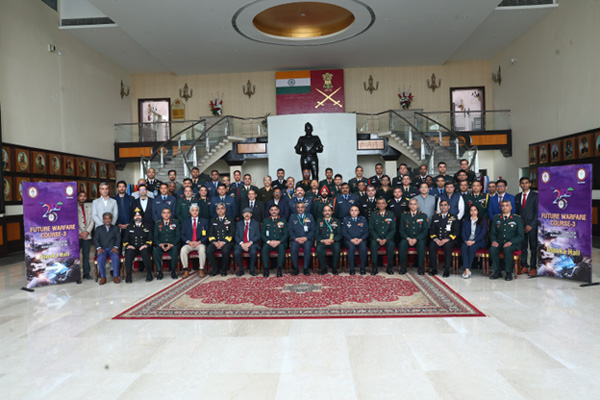
The Tri-Services Future Warfare Course 3.0 (FWC 3), underway at the Manekshaw Centre, New Delhi, has entered its most consequential phase with an intensive Cognitive and Cyber Warfare module, reflecting the rapidly evolving character of modern conflict.
Being conducted from February 2 to February 25, 2026, the third edition of the course is designed to equip senior military officers and strategic thinkers with a holistic understanding of cyber, information and cognitive warfare, domains that are increasingly shaping outcomes alongside conventional military power.
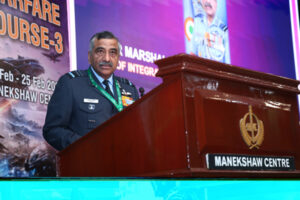
Addressing participants, Air Marshal Ashutosh Dixit, Chief of Integrated Staff to the Chairman Chiefs of Staff Committee (CISC), underscored the transformational shift underway in global warfare.
“Future conflicts will be increasingly shaped by cyber and cognitive dimensions, alongside conventional operations,” Air Marshal Dixit said.
He emphasised that military decision-making, operational planning and strategic advantage would now depend heavily on the ability to navigate complex information environments, counter adversarial influence campaigns and employ digital and cognitive tools effectively.
“India’s preparedness in these domains is central to maintaining credible deterrence and operational superiority,” he stressed.
The module brings together a diverse, multi-disciplinary cohort, including officers from the Army, Navy and Air Force, alongside DRDO scientists, academics and representatives from the defence and technology industry. This broad participation has enabled a dynamic exchange of perspectives on integrating cognitive and cyber capabilities across multi-domain operations.
Participants are examining how emerging technologies such as artificial intelligence, neural networks and automated intelligence systems can be leveraged to secure operational advantage, manage information superiority and outmanoeuvre adversaries in both physical and virtual battlespaces.
The presence of industry leaders and academic experts further reinforces the course’s emphasis on bridging operational requirements with technological innovation, offering participants real-world insights into cutting-edge developments relevant to national security.
By blending theoretical frameworks, operational scenarios and future-oriented strategic thinking, FWC 3 ensures officers are equipped to confront both conventional threats and non-traditional challenges, including cyber intrusions, misinformation campaigns and cognitive manipulation.
The course will continue with advanced modules on multi-domain operations, land, naval and air warfare, culminating in scenario-building exercises and operational problem-statement presentations. Its comprehensive structure aims to prepare India’s military leadership to anticipate emerging threats and craft actionable strategies, preserving India’s operational edge in an increasingly contested global security environment.