- Academia–Industry–Government Convergence Sets the Tone for Scalable AI Innovation
- Centre for AI-driven Innovations Unveils Six Strategic Verticals for National Impact
- Policy, Infrastructure and Ethical Governance Take Centre Stage
- Project Showcases Demonstrate Real-World AI Deployment Pathways
- IITGN Positions Itself as a Next-Gen AI Hub for Social Good and Strategic Systems
NE SCIENCE & TECHNOLOGY BUREAU
GANDHINAGAR, FEB 12
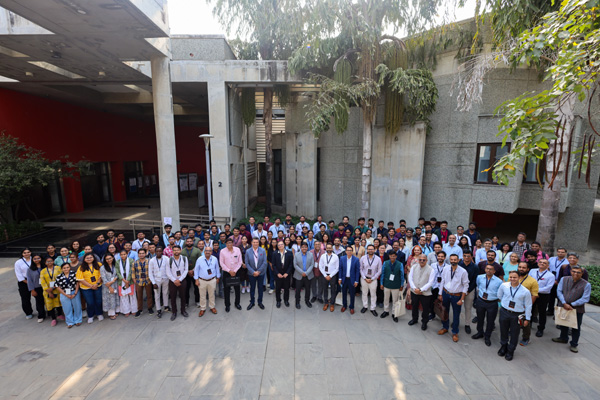
In a decisive stride toward shaping India’s AI future, the Indian Institute of Technology Gandhinagar (IITGN) hosted AI Day @ IITGN, a high-impact precursor to the India AI Impact Pre-Summit 2026. Supported by ANRF Pair, the Department of Computer Science and Engineering (CSE), and the Center for AI-driven Innovations, the event convened thought leaders from academia, industry, and government to chart pathways for responsible, scalable Artificial Intelligence deployment.
The day-long deliberations revolved around collaboration, governance frameworks, infrastructure readiness, and AI-driven societal transformation — reinforcing IITGN’s ambition to emerge as a national AI powerhouse.
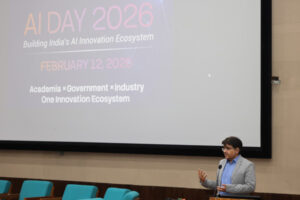
Addressing the gathering, Prof Vimal Mishra, Dean R&D, IITGN, underscored the inevitability of AI in contemporary life.
“Whatever we may feel about the pros and cons of AI, one thing is certain, we cannot neglect the impact AI is already having on our lives,” he said, noting how AI-powered systems are reshaping decision-making through science-backed and data-driven insights.
He stressed that leading technological institutions must transition from passive users of AI tools to active developers of foundational technologies.
Speaking about the Centre of Excellence in AI, Prof Mishra highlighted the imperative of ambition aligned with societal good. “The bigger opportunity lies in how AI can bring social good and how it can help in sustainability, disaster management, climate resilience, healthcare, and food security,” he observed. Calling this the “era of AI,” he urged the Centre to keep pace with global advancements and establish leadership in both fundamental research and socially impactful real-world applications.
In his opening remarks, Dr Mayank Singh, Coordinator, Center for AI-driven Innovations, IIT Gandhinagar, reflected on the rapid evolution of AI technologies, especially generative systems transforming digital engagement.
“AI is no longer confined to research labs and textbooks, but has become part of everyday life through applications, automation, and generative platforms,” he noted, adding that organisations worldwide are embedding AI into their core workflows, with many moving toward significant automation.
Emphasising the collaborative spirit of the event, Dr Singh said, “AI Day is about bringing the right people together under one umbrella so that we can build meaningful and scalable AI solutions.”
He stated that the initiative aims to showcase IITGN’s ongoing AI work, deepen academia–industry–government partnerships, and create a common platform for solving real-world challenges responsibly and at scale.
Dr Singh further revealed that the newly announced Center for AI-driven Innovations seeks to rapidly position IITGN among leading AI hubs. The focus extends beyond research publications to foundational AI models, product development, startups, standards, and robust compute and storage infrastructure.
The Centre is structured around six strategic verticals:
- Foundational AI
- Healthcare and Biomedical Innovation
- Physical Infrastructure
- Materials and Hardware
- AI and Society
- Strategic Defence and Space Systems
By integrating diverse faculty expertise across disciplines, the Centre aims to foster interdisciplinary innovation and deploy AI solutions that address national and global priorities.
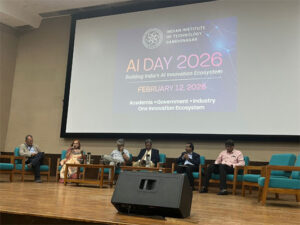
A highlight of the event was the high-level panel discussion on “Expectations from Academia, Government and Industry to Design, Build and Deploy AI Solutions at Scale,” moderated by Dr Anirban Dasgupta.
The panel featured:
- Dr Anasuya Bhadalkar, Joint Director (R&D), Gujarat State Biotechnology Mission (GSBTM)
- Narottam Sahoo, Advisor and Member Secretary, Gujarat Council on Science and Technology (GUJCOST)
- Chandrakant Pendor, Superintending Engineer, Gujarat Urja Vikas Nigam Limited (GUVNL)
- Sapan Oza, Regional Head – Academic Alliance Group, Tata Consultancy Services (TCS)
- Satyarth Srivastava, Chairman, Gujarat Electronics and Software Industries Association (GESIA)
The panellists emphasised policy support, ethical AI frameworks, scalable digital infrastructure, skill development, and structured collaboration as pillars of a sustainable AI ecosystem. Discussions focused on strengthening research infrastructure, building balanced governance mechanisms, and establishing clarity in academia–industry partnerships — particularly around funding models and intellectual property.
The consensus was clear: India must adopt a flexible, context-driven AI policy framework while enabling innovation through coordinated ecosystem support.
AI Day also showcased six major AI Research and Development projects reflecting robust industry–academia–government partnerships, offering tangible proof-of-concept models for large-scale deployment.
The second session, titled “The Future of AI @ IITGN,” featured one-to-one discussions with vertical leads, moderated by Dr Yogesh Kumar Meena, Assistant Professor, Computer Science and Engineering, IIT Gandhinagar, followed by a roadmap dialogue on the Centre’s strategic trajectory.
With AI Day @ IITGN, the institute signalled more than an academic gathering — it marked a strategic milestone in advancing interdisciplinary AI research, strengthening ecosystem partnerships, and aligning innovation with national development priorities ahead of the India AI Impact Pre-Summit 2026.