NE NEWS SERVICE
NEW DELHI, FEB 14
In a landmark step symbolising India’s transition from colonial legacy to citizen-centric governance, the Union Cabinet has approved the relocation of government operations from the historic North and South Blocks to the newly inaugurated ‘Seva Teerth’ and ‘Kartavya Bhavans’, while also resolving to transform the iconic colonial-era buildings into the “Yuge Yugeen Bharat National Museum.”
Seva Teerth, Kartavya Bhavan 1 and 2 mark an important milestone in India’s journey towards Viksit Bharat. These reflect our commitment to citizen-centric governance and national progress. https://t.co/vCeE8Uyz69
— Narendra Modi (@narendramodi) February 13, 2026
The decision marks a defining moment in India’s administrative evolution, nearly 95 years after the South Block began functioning as the nerve centre of governance under British rule and later as the Prime Minister’s Office in independent India.
- Union Cabinet approves historic transition from British-era governance buildings to modern Seva Teerth and Kartavya Bhavans
- Prime Minister Narendra Modi dedicates new PMO, calling it a symbol of duty, service and ‘India First’ governance ethos
- North and South Blocks to be transformed into a national museum celebrating India’s timeless civilisation and democratic journey
- Major welfare decisions signed at Seva Teerth include PM RAHAT scheme, Startup India Fund 2.0 and expansion of Lakhpati Didi mission
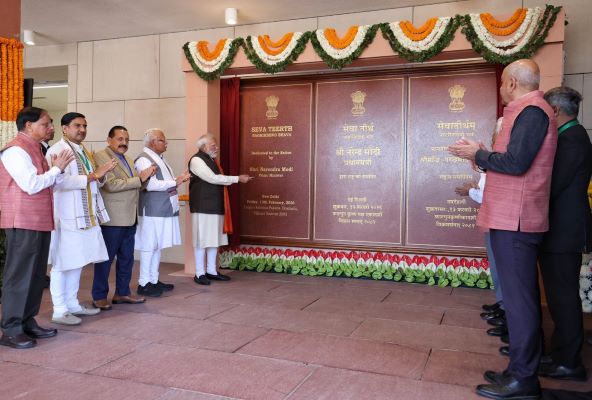
On February 13, 2026, Prime Minister Narendra Modi dedicated the new Prime Minister’s Office, named ‘Seva Teerth’, to the nation, describing it as a sacred space committed to public service and national transformation.
At Seva Teerth earlier today, signed files that are connected with the empowerment of the poor, downtrodden, our hardworking farmers, Yuva Shakti and Nari Shakti. The key decisions include:
Approval for the launch of PM RAHAT scheme, as per which victims of accidents will get… pic.twitter.com/dVn5LyrVNX
— Narendra Modi (@narendramodi) February 13, 2026
In a message shared on X, the Prime Minister said, “With an unwavering resolve to serve the people of India and guided by the sacred spirit of Nagrikdevo Bhava, Seva Teerth is humbly dedicated to the nation. May Seva Teerth always stand as a radiant symbol of duty, compassion, commitment to the principle of India First. May it inspire generations to walk the path of selfless service and tireless dedication to the welfare of all.”
With an unwavering resolve to serve the people of India and guided by the sacred spirit of Nagrikdevo Bhava, Seva Teerth is humbly dedicated to the nation.
May Seva Teerth always stand as a radiant symbol of duty, compassion, commitment to the principle of India First. May it… pic.twitter.com/xVRoEcbtE9
— Narendra Modi (@narendramodi) February 13, 2026
Reflecting on the historic transition, the government described the relocation as not merely a physical shift but a symbolic movement from the “culture of power” associated with colonial governance to a modern ethos rooted in service, accountability, and efficiency.
For decades, the South Block bore witness to defining moments in India’s journey—from the trauma of Partition and wartime decisions to landmark economic reforms, welfare initiatives, and technological transformation. Cabinets led by successive Prime Ministers—from Jawaharlal Nehru to Narendra Modi—took critical decisions within its chambers that shaped India’s political, economic and strategic trajectory.
Over the past decade, the complex served as the launchpad for transformative reforms under Prime Minister Modi’s leadership, including Direct Benefit Transfer (DBT), Digital India, GST implementation, Swachh Bharat Abhiyan, and key national security decisions such as surgical and air strikes.
With the relocation now complete, the government emphasised that the modern Seva Teerth and Kartavya Bhavans offer technologically advanced, environmentally sustainable workspaces designed to enhance efficiency, collaboration and productivity among officials and policymakers.
The Cabinet also approved the conversion of the historic North and South Blocks into the Yuge Yugeen Bharat National Museum, envisioned as a landmark cultural institution celebrating India’s civilisational continuity, democratic evolution, and heritage. The museum aims to inspire future generations by showcasing India’s journey from ancient civilisation to global leadership.
During the inaugural event, Prime Minister Modi congratulated the Prime Minister’s Office staff, Cabinet Secretariat officials, engineers, and workers involved in the construction, describing the new facilities as milestones in India’s governance transformation.
At Seva Teerth, the Prime Minister also signed key decisions aimed at strengthening welfare and economic empowerment. These include approval of the PM RAHAT scheme, which will provide accident victims cashless treatment of up to Rs. 1.5 lakh, expansion of the Lakhpati Didi scheme target to six crore women, doubling of the Agriculture Infrastructure Fund to Rs. 2 lakh crore, and launch of the Startup India Fund of Funds 2.0 with a Rs. 10,000 crore corpus to support early-stage and deep-tech startups.
He noted, “At Seva Teerth earlier today, signed files that are connected with the empowerment of the poor, downtrodden, our hardworking farmers, Yuva Shakti and Nari Shakti.”
The government described the transition as a historic convergence of India’s past, present, and future—honouring the legacy of its governance institutions while building modern infrastructure aligned with the vision of a developed and self-reliant India.