R ARIVANANTHAM
CHENNAI, FEB 14
In a sweeping infrastructure push poised to transform India’s mobility landscape, the Cabinet Committee on Economic Affairs chaired by Prime Minister Narendra Modi has approved a series of mega road, rail and tunnel projects collectively valued at nearly Rs 48,000 crore, aimed at enhancing connectivity, reducing logistics costs and accelerating economic growth across multiple regions.
The approvals cover strategic national highways in Gujarat, Maharashtra and Telangana, three critical railway multitracking corridors spanning four states, and a groundbreaking road-cum-rail underwater tunnel beneath the Brahmaputra in Assam — marking one of India’s most ambitious multimodal connectivity expansions.
- Six landmark approvals spanning highways, rail corridors and India’s first underwater road-rail tunnel signal a historic leap in national mobility and logistics efficiency
- From Gujarat to Assam, Telangana to Maharashtra and key rail arteries, projects aim to cut travel time, ease congestion and unlock tribal and industrial growth corridors
- 389-km rail multitracking, NH expansions and Brahmaputra tunnel to transform freight movement, slash logistics costs and strengthen PM GatiShakti integration
- Major employment surge expected with over 4 crore human-days of direct and indirect job generation across projects
- Connectivity boost to economic nodes, logistics hubs, tourism centres and aspirational districts to accelerate inclusive development
- Projects aligned with Prime Minister Narendra Modi’s vision of ‘New India’, fostering self-reliance, sustainability and seamless multimodal transport ecosystem
These transformative projects are aligned with the PM GatiShakti National Master Plan, ensuring seamless connectivity between economic, social and logistics nodes while fostering employment, industrial growth and regional integration.
Gujarat NH-56 Upgrade to Boost Tribal Connectivity and Tourism
The Cabinet approved the upgradation of the Dhamasiya–Bitada/Movi and Nasarpore–Malotha sections of National Highway-56 in Gujarat into four-lane corridors spanning 107.67 km at a cost of Rs 4,583.64 crore.
The strategic corridor traverses aspirational and tribal districts including Dahod, Chhota Udepur, Tapi, Bharuch and Narmada, significantly enhancing connectivity and economic prospects. It will also improve access to the Statue of Unity, one of India’s premier tourist destinations.
Designed for speeds of up to 100 kmph, the upgraded highway will reduce travel time by nearly 40%, from 2.5 hours to 1.5 hours. The project is expected to generate approximately 19.38 lakh man-days of direct employment and 22.82 lakh man-days of indirect employment.
Once completed, the project will establish seamless four-lane connectivity between Bodeli and Malotha, easing congestion and improving linkages with NH-48, NH-53 and the Delhi-Mumbai Expressway.
Maharashtra NH-160A Corridor to Ease Nashik Industrial Congestion
In Maharashtra, the Cabinet approved rehabilitation and upgradation of the Ghoti–Trimbak–Jawhar–Manor–
The corridor serves major industrial clusters developed by Maharashtra Industrial Development Corporation around Nashik, Ambad and Satpur. Currently, freight traffic moving through Nashik city via NH-848 causes severe congestion, with traffic volumes reaching up to 60,000 PCUs per day.
The upgraded corridor will provide an alternate industrial bypass route, reducing congestion, improving logistics efficiency and facilitating smoother connectivity to the Samruddhi Expressway, Delhi-Mumbai Expressway, NH-48 and coastal economic zones.
The project will also enhance infrastructure in tribal regions of Palghar and generate over 44 lakh person-days of employment while strengthening Maharashtra’s logistics network.
Telangana Economic Corridor Expansion to Accelerate Regional Growth
The widening of NH-167 from Gudebellur to Mahabubnagar on the Hyderabad-Panaji Economic Corridor has been approved at a cost of Rs 3,175.08 crore.
The 80.01-km project will convert the existing congested highway into a four-lane access-controlled corridor, benefiting major urban and rural areas including Makthal, Devarkadra, Marikal and Narayanpet.
By integrating with NH-150 and NH-167N and connecting economic, logistics and social nodes, the corridor will enhance freight efficiency, reduce logistics costs and spur industrial growth in Telangana.
The project will generate approximately 14.4 lakh person-days of direct employment and 17.9 lakh person-days of indirect employment.
Railways Multitracking to Expand Capacity and Cut Logistics Costs
The Cabinet also approved three major railway multitracking projects at an estimated cost of Rs 18,509 crore, covering Kasara–Manmad, Delhi–Ambala, and Ballari–Hosapete corridors.
These projects will increase the Indian Railways network by about 389 km and enhance connectivity across Delhi, Haryana, Maharashtra and Karnataka.
The capacity expansion will significantly improve operational efficiency, reduce congestion and support additional freight traffic of nearly 96 million tonnes annually.
The initiative will benefit approximately 3,902 villages with a population of nearly 97 lakh and improve connectivity to key tourist destinations including Trimbakeshwar Jyotirlinga, Shri Mata Vaishno Devi Katra, and the UNESCO World Heritage Site of Hampi.
The projects are also expected to generate about 265 lakh human-days of direct employment while reducing oil imports by 22 crore litres and lowering carbon emissions equivalent to planting four crore trees.
India’s First Underwater Road-Rail Tunnel Approved in Assam
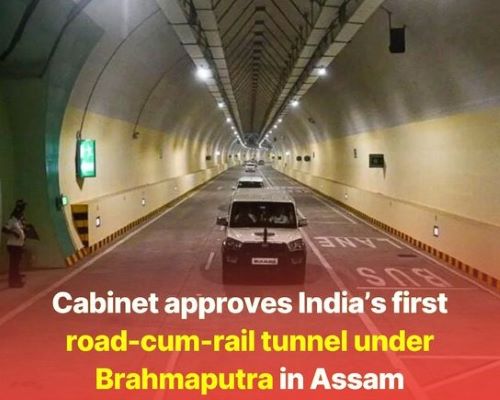
In a historic milestone, the Cabinet approved construction of India’s first underwater road-cum-rail tunnel beneath the Brahmaputra River in Assam, at a cost of Rs 18,662 crore.
The project will connect Gohpur and Numaligarh through a 33.7-km access-controlled corridor, including a 15.79-km tunnel, dramatically reducing travel distance and time across the river.
Currently, commuters travel about 240 km via existing bridges, taking nearly six hours. The tunnel will provide direct connectivity, boosting economic growth across Assam, Arunachal Pradesh, Nagaland and other northeastern states.
This engineering marvel — only the second such tunnel globally — will connect major highways, railway lines, airports and inland waterways while generating around 80 lakh person-days of employment.
Mobility Revolution to Power India’s Economic and Strategic Future
The Cabinet emphasised that the projects will significantly enhance mobility, reduce travel time, cut vehicle operating costs, and improve logistics efficiency, while strengthening multimodal integration under the PM GatiShakti framework.
The increased rail capacity will streamline operations, improve reliability and enhance connectivity for movement of people, goods and services, contributing to comprehensive regional development.
The infrastructure push is aligned with the Prime Minister’s vision of a modern, self-reliant India, with integrated transport systems serving as catalysts for economic transformation, employment generation and sustainable growth.