- Four-lane transformation of NH-56 corridor to unlock economic potential across Dahod, Narmada, Bharuch and Chhota Udepur districts
- Boost to Statue of Unity access and seamless integration with Delhi–Mumbai Expressway and key national freight routes
- Travel time to drop by 40%, enhancing mobility efficiency and logistics competitiveness across eastern Gujarat belt
- Project to generate over 42 lakh man-days of employment, catalysing regional development and job creation
- Strategic upgrade to strengthen connectivity across Gujarat, Rajasthan and Madhya Pradesh, reinforcing national logistics network
NE MOBILITY BUREAU
AHMEDABAD, FEB 14
In a major infrastructure boost set to transform mobility and economic prospects across eastern Gujarat, the Cabinet Committee on Economic Affairs chaired by Prime Minister Narendra Modi has approved the upgradation of key stretches of National Highway-56 into a four-lane corridor at a total capital cost of Rs 4,583.64 crore.
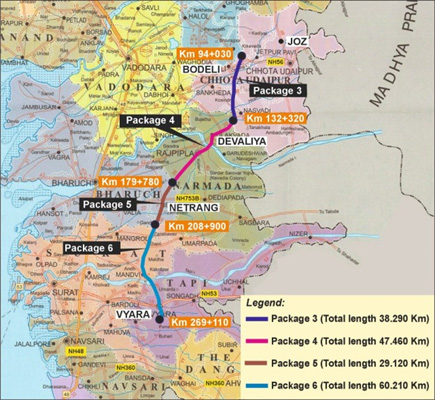
The approved project covers construction of four-lane sections between Dhamasiya–Bitada/Movi (47.46 km) and Nasarpore–Malotha (60.21 km), spanning a total length of 107.67 km under Hybrid Annuity Mode (HAM).
The strategic highway corridor is expected to significantly enhance connectivity, reduce travel time and unlock new economic opportunities across tribal and aspirational districts of Gujarat.
Strategic Corridor to Power Gujarat’s Tribal and Economic Heartland
The NH-56 corridor originates at Nimbahera in Rajasthan, passes through Dahod district in Gujarat, continues via Alirajpur in Madhya Pradesh, and re-enters Gujarat near Chhota Udepur before terminating at its junction with NH-48 near Vapi.
The project passes through the Aspirational District of Narmada and will strengthen connectivity to tribal regions in Dahod, Chhota Udepur, Tapi and Bharuch, facilitating inclusive economic development and improved access to markets, education and healthcare.
Critically, the upgraded highway will also improve access to the Statue of Unity at Kevadia, located about 11 km from NH-56, strengthening tourism infrastructure and boosting visitor inflow to the globally recognised monument.
Faster Travel, Lower Logistics Costs and Improved Efficiency
Designed for speeds of up to 100 kmph, the upgraded highway will enable an average travel speed of 70 kmph, cutting travel time by nearly 40% — from 2.5 hours to just 1.5 hours.
This enhanced mobility will significantly reduce vehicle operating costs, improve freight efficiency and ease congestion along the existing corridor, benefiting industries, transporters and commuters alike.
The upgraded highway will also strengthen connectivity with major national corridors including NH-53, NH-48 and the Delhi–Mumbai Expressway (NE-4), integrating Gujarat more deeply into India’s national logistics network.
Massive Employment and Economic Multiplier Impact
The project is expected to generate approximately 19.38 lakh man-days of direct employment and 22.82 lakh man-days of indirect employment, providing a substantial boost to livelihoods and regional economic activity.
Beyond construction jobs, the improved corridor will spur industrial growth, logistics expansion, tourism and ancillary economic activities across the region.
Seamless Four-Lane Connectivity to Become Reality Soon
The Ministry of Road Transport and Highways, through the National Highways Authority of India (NHAI), has already initiated the upgradation of the congested Jambugam (Bodeli)–Malotha section of NH-56 under four packages.
Construction work on stretches between Jambugam and Dhamasiya and Movi to Nasarpore commenced in November 2025 and is progressing with a target completion timeline of two years.
Upon completion of the newly approved packages, continuous four-lane connectivity from Bodeli to Malotha will be established, dramatically easing congestion and enhancing seamless connectivity across Gujarat’s eastern growth corridor.
The project marks a major milestone in strengthening Gujarat’s infrastructure backbone, accelerating tribal development, boosting tourism and reinforcing the state’s position as a key logistics and industrial hub.