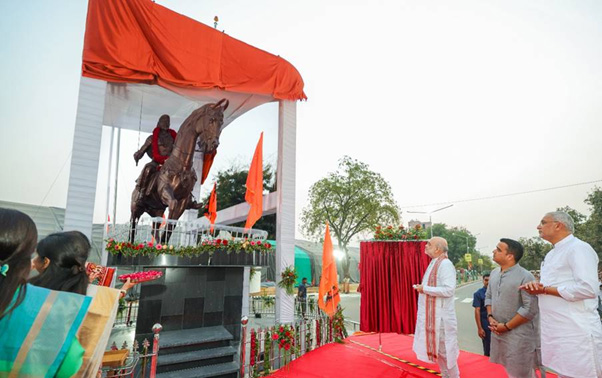
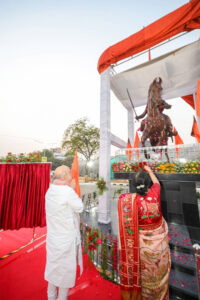
- Historic tribute in Gandhinagar honours the founder of Hindavi Swaraj and his enduring legacy of self-rule, cultural pride and naval power
- Amit Shah recalls Shivaji Maharaj’s teenage pledge at Raireshwar temple that reshaped India’s destiny and broke centuries of subjugation
- Statue expected to inspire youth with ideals of Swaraj, Swadharma and Swabhasha amid renewed national civilisational consciousness
- Government highlights restoration of sacred sites like Kashi Vishwanath Corridor and Somnath Temple as continuation of Shivaji’s vision
- Removal of colonial insignia from Indian Navy flag seen as symbolic reclaiming of India’s maritime sovereignty and heritage
NE NEWS BUREAU
GANDHINAGAR, FEB 18
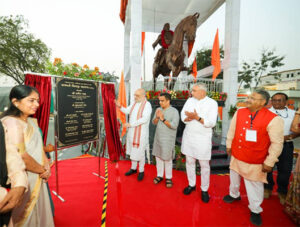
Union Home Minister and Minister of Cooperation Amit Shah unveiled a grand equestrian statue of Chhatrapati Shivaji Maharaj in Gandhinagar, Gujarat, marking a powerful tribute to the legendary founder of Hindavi Swaraj and his enduring influence on India’s civilisational identity. The 21-foot statue, built by Maharashtra Samaj Gandhinagar, stands as a symbol of courage, self-rule and cultural pride.
Several dignitaries, including Gujarat Minister of State Harsh Sanghavi, were present at the ceremony.
Addressing the gathering, Amit Shah said it was a moment of immense pride for Gandhinagar to honour the founder of Hindavi Swaraj with such a monumental tribute.
He said the statue would inspire generations, especially young people, to embrace the ideals of courage, self-respect and national service.
“In the dark darkness of slavery, at the age of just 16, Chhatrapati Shivaji Maharaj took a firm resolve to establish ‘Hindavi Swaraj’.”
Amit Shah emphasised that Shivaji Maharaj’s contributions would remain timeless and that the nation would forever remain indebted to his leadership and vision.
He described the historical context in which Shivaji Maharaj rose to prominence, noting that India was engulfed in foreign domination and the concept of self-rule had nearly vanished.
“Chhatrapati Shivaji Maharaj took a pledge to fight throughout his life for the protection of Swaraj, Swadharma and Swabhasha.”
He recalled that Shivaji Maharaj took his historic oath at the Raireshwar Temple, despite having no army, weapons or established kingdom, and went on to break the chains of centuries of subjugation within just four decades.
Amit Shah said Shivaji Maharaj’s relentless struggle against Mughal emperor Aurangzeb demonstrated unmatched resolve and leadership.
“Shivaji Maharaj, who protected the country’s pilgrimages and temples, gave a message to the Mughals that demolition of temples would not end Sanatan Dharma.”
He added that the present government, led by Prime Minister Narendra Modi, has continued efforts to restore India’s sacred heritage.
“Narendra Modi has undertaken the work of restoration of Kashi Vishwanath Corridor and Somnath Temple, which were damaged by invaders.”
The restoration of the Kashi Vishwanath Corridor and the Somnath Temple was described as a reaffirmation of India’s commitment to preserving its spiritual and civilisational legacy.
Highlighting Shivaji Maharaj’s strategic brilliance, Amit Shah noted that he established India’s naval strength and articulated the doctrine:
“Jayache Armar, Tyacha Samudra — he who has the navy, has control over the sea.”
He said the government honoured Shivaji Maharaj’s maritime legacy by removing colonial symbols from the Indian Navy flag.
“The Modi government has honored the legacy of Chhatrapati Shivaji Maharaj by removing colonial symbols from the Indian Navy flag.”
Amit Shah also recalled how Shivaji Maharaj’s coronation inspired scholars like Gaga Bhatt to predict India’s future resurgence.
He noted that prominent national icons such as Bal Gangadhar Tilak, Rabindranath Tagore, Subramania Bharati, Sri Aurobindo and Zaverchand Meghani immortalised Shivaji Maharaj’s heroism through literature and poetry, instilling courage and patriotism across generations.
He further highlighted Shivaji Maharaj’s role in promoting Indian languages, strengthening Marathi and Sanskrit in governance, and building a society rooted in cultural pride and national consciousness.
Amit Shah concluded that the ideals of Shivaji Maharaj continue to guide modern India, and that the nation now stands before the world with renewed strength, confidence and civilisational glory.