- Science meets policy as IIT Gandhinagar and IWMI move to formalise a strategic MoU
- Groundwater research, climate resilience and water security at the core of collaboration
- Interdisciplinary clusters, digital innovation and field projects to drive impact
- Partnership to bridge livelihoods, ecosystems and inclusive growth across India
NE SCIENCE & TECHNOLOGY BUREAU
GANDHINAGAR, MAR 3
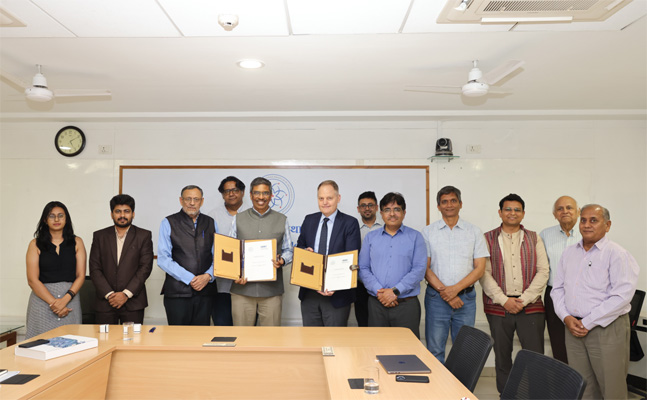
In a decisive move to bridge cutting-edge research with real-world policy outcomes, the Indian Institute of Technology Gandhinagar (IITGN) and the International Water Management Institute (IWMI) have initiated steps towards a strategic partnership to strengthen water management, climate resilience and policy research in India.
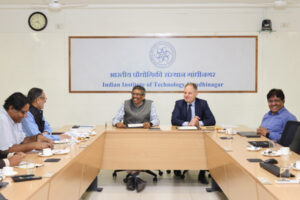
The discussions, held on February 26, 2026, marked a significant milestone towards formalising a Memorandum of Understanding (MoU) aimed at connecting rigorous scientific research with actionable field-level impact — especially in groundwater sustainability, water security, and climate adaptation.
Opening the dialogue, Prof Praharsh Patel, Faculty of Environmental Economics at IITGN, presented a comparative review of groundwater depletion across Gujarat and Western India. He observed that several regions in Gujarat have experimented with policy innovations to arrest further depletion — underlining the urgent need for science-backed and socially grounded water management research to shape pragmatic policy and on-ground action.
Setting the tone for interdisciplinary collaboration, Prof Vimal Mishra, Dean of Research and Development, IITGN, highlighted the institute’s newly established research clusters spanning Climate, Water and Infrastructure; Advanced Materials; Energy; Healthcare and Medtech; and Artificial Intelligence.
“The cluster model is designed to encourage flexible collaboration across domains, enabling researchers to collectively address complex challenges such as groundwater sustainability, climate adaptation, and resource governance,” explained Prof Mishra.
Both IITGN and IWMI expressed keen interest in aligning faculty and researchers within these clusters to jointly develop research initiatives, policy dialogues and field-based projects that integrate science, governance and community realities.
The IWMI delegation was led by Dr Mark Smith, Director General, and included Dr Alok Sikka, Country Representative; Shilp Verma, Deputy Country Representative; along with officials from IWMI’s Anand office — Nikunj Usadadia and Punjan Patel.
Dr Mark Smith traced the evolution of IWMI’s Water Policy Programme, launched in 2001 with support from the Tata Trusts.
“The programme was established with a clear mandate: to translate science into policy and field action,” stated Dr Smith. “While rooted in water research, its focus extends to livelihoods, energy, and broader socio-economic systems.”
Over the years, the programme has worked to ensure that scientific evidence meaningfully shapes public policy and development practice.
He further remarked, “Although IWMI is a global institute, it is very much Gujarati as IWMI-Tata Program that was based out of Anand produced exceptional research and impact in the water sector.”
Under the proposed MoU, IITGN and IWMI will collaborate across key thematic areas including Water, Food and Ecosystems; Water, Climate Change and Resilience; and Water, Growth and Inclusion. The partnership will advance science, technology and digital innovation in water management, climate action, food and land systems, and resource governance.
The alliance will foster applied policy research, interdisciplinary academic programmes, joint proposals to national and international funding agencies, student internships, co-organised training sessions and seminars, and expanded stakeholder outreach in India and globally.
Prof Rajat Moona, Director, IITGN, spotlighted the institute’s thriving innovation ecosystem and research park, which currently incubates over 30 startups working at the intersection of water, agriculture, climate science and artificial intelligence.
“It is this integration of academic research, entrepreneurship, and policy engagement that will provide a strong foundation for future collaboration,” expressed Prof Moona.
With groundwater depletion intensifying, climate variability increasing, and rural livelihoods under pressure, the IITGN–IWMI partnership positions itself as a forward-looking model of institutional collaboration — blending scientific excellence, institutional experience, grassroots understanding and the dynamism of young innovators.
The proposed alliance reflects a shared commitment to strengthening India’s water security framework — ensuring that research does not remain confined to laboratories but flows into policies, practices and communities where it matters most.