NE BUSINESS BUREAU
CHENNAI, MAR 15
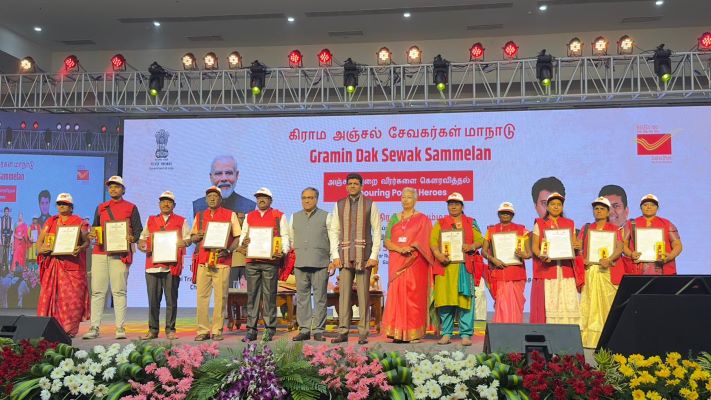
Union Minister of State for Communications Pemmasani Chandra Sekhar has underscored the pivotal role of India Post and its vast Gramin Dak Sevak (GDS) network in delivering governance and services to the remotest corners of the country.
Addressing the Gramin Dak Sevak Sammelan in Chennai, the Minister described GDS employees as the “heartbeat of rural India”, emphasising that they serve as the crucial bridge between government programmes and citizens.
- MoS Communications Dr. Pemmasani Chandra Sekhar hails Gramin Dak Sevaks as the “first mile of governance”, not merely the last mile
- India Post begins transformation into a modern, data-driven logistics and service powerhouse amid booming e-commerce economy
- Tamil Nadu Postal Circle earns national praise for securing second place in overall revenue performance
- ₹5,000-crore IT 2.0 upgrade, DigiPIN geo-coded address system to redefine postal delivery and digital governance
- Government urges postal workforce to capture massive logistics market projected to double to $20 billion by 2031
- GDS employees called upon to deliver service excellence while strengthening the vision of ‘Viksit Bharat’
“From letters to parcels, from government schemes to banking, from Aadhaar to passport services — you reach every village, every street and every household. Through burning sun and pouring rain, you have been a bridge of trust and a story of service for rural India,” he said.
“First Mile of Governance”
Highlighting their critical role in public service delivery, the Minister said the country’s rural communication system rests heavily on the dedication of postal workers.
“Gramin Dak Sevaks are not the last mile of governance — they are the first mile. Without them, government services cannot reach the village.”
He noted that while private logistics companies operate where profits exist, India Post operates where people exist, including remote tribal regions and difficult terrain.
Tamil Nadu Circle Wins National Praise
The Minister commended the Tamil Nadu Postal Circle for its strong operational performance.
“Tamil Nadu Postal Circle has performed exceptionally well and ranks second in the country in terms of overall revenue,” he said, congratulating postal employees for their contribution.
Historic Institution, Modern Transformation
Tracing the evolution of India’s communication networks, the Minister recalled that organised messenger systems existed during the Chandragupta Maurya era and were also maintained by the Chola, Pandya and Chera dynasties in the Tamil region.
The modern postal system took shape with the establishment of the General Post Office in Calcutta in 1774, and India Post in its current structure was established on October 1, 1854.
Today, the network has grown into one of the world’s largest postal systems, employing nearly four lakh regular staff and more than 2.5 lakh Gramin Dak Sevaks, operating through over 1.6 lakh post offices nationwide.
Logistics Boom: A $20-Billion Opportunity
The Minister pointed to the explosive growth of India’s logistics and e-commerce sector as a major opportunity for the postal network.
“India Post’s parcel revenue today is under ₹1,000 crore, while a single private courier company generates around ₹6,000 crore.”
He added that the logistics market is currently valued at about $10 billion (₹90,000 crore) and is expected to double to $20 billion (₹1.8 lakh crore) by 2031, urging postal employees to capture a larger share of the market.
“The focus should not only be on reducing costs but on increasing revenue and seizing emerging opportunities.”
Digital Revolution in India Post
Under the leadership of Prime Minister Narendra Modi and the guidance of Union Communications Minister Jyotiraditya Scindia, the Department of Posts is undergoing a major transformation.
Key initiatives include:
- IT 2.0 platform with an investment of nearly ₹5,000 crore
- End-to-end mail and parcel tracking systems
- SMS alerts and digital dashboards
- UPI-enabled cashless transactions
- Geotagging of delivery services
The Minister also highlighted the introduction of DigiPIN, a 10-digit geo-coded national addressing system expected to support e-commerce, drone logistics, emergency services and smart governance.
Recognition and Support for GDS Workforce
The government has also introduced revised remuneration structures, incentives, training programmes and promotion opportunities for Gramin Dak Sevaks to recognise their contribution to the nation’s development.
Calling upon postal employees to uphold the legacy of India Post, the Minister urged them to deliver services with dedication.
“Open your post office on time every day. Deliver with pride. Every savings account opened and every insurance policy issued strengthens both the department and the nation.”
In a powerful closing message, he reminded the GDS workforce of their larger role in India’s progress.
“You may think you are just a postman or a GDS. But that bag you carry holds more than letters — it carries the trust of a nation.”