NE ENERGY BUREAU
CHENNAI, MAR 15
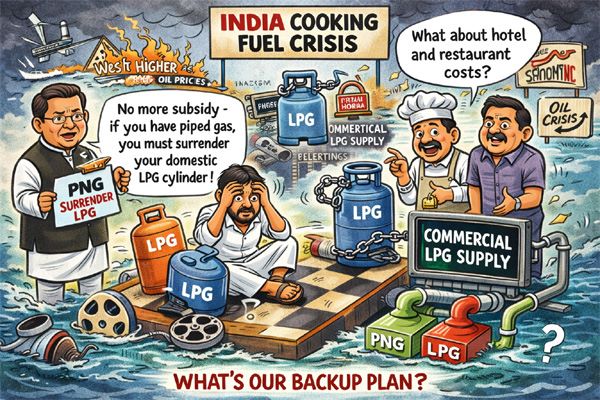
In a sweeping move to safeguard domestic cooking fuel supplies amid global energy disruptions, the Ministry of Petroleum and Natural Gas has mandated that households with Piped Natural Gas (PNG) connections must surrender their domestic liquefied petroleum gas (LPG) cylinders.
- Government bars PNG households from retaining subsidised LPG cylinders to prioritise supply for non-pipeline homes
- Middle East tensions and Strait of Hormuz disruptions tighten global energy flows, pushing India into precautionary rationing
- Hotels, restaurants and caterers face shrinking commercial LPG supplies amid rising fuel costs
- Consumers scramble to understand new rules as oil companies begin enforcing surrender of LPG connections
- Regulator urges rapid PNG expansion as India’s energy security debate returns to the national spotlight
The decision follows an amendment to the Liquefied Petroleum Gas (Regulation of Supply and Distribution) Order, 2000 under the Essential Commodities Act, which now prohibits PNG consumers from retaining or refilling subsidised LPG cylinders.
According to a notification issued on March 14, the government stated: “No person having a piped natural gas (PNG) connection and also having a domestic LPG connection shall retain a domestic LPG connection, or take refills of domestic LPG cylinders from any Government oil company, or through their distributors. Such persons will be required to immediately surrender their domestic LPG connection.”
The order also directs oil marketing companies and distributors not to provide new LPG connections or refills to households already connected to PNG pipelines.
Energy security drives policy shift
Officials say the move aims to prioritise LPG supplies for households that lack piped gas infrastructure, particularly in semi-urban and rural regions.
A senior official in the petroleum ministry explained: “The objective is to ensure equitable distribution of cooking fuel during a period of global uncertainty. LPG must reach homes that do not yet have access to piped gas.”
India’s heavy dependence on imports has heightened vulnerability to supply disruptions.
According to energy data, the country imports:
- 88% of its crude oil
- About 50% of its natural gas
- Nearly 60% of its LPG
A large share of these imports originates from West Asian suppliers such as Saudi Arabia and the United Arab Emirates, while tanker routes through the Strait of Hormuz—a crucial global oil transit corridor—have recently witnessed disruptions amid geopolitical tensions.
Consumers caught in confusion
For many urban households that keep LPG cylinders as a backup during PNG outages, the decision has triggered uncertainty and concern.
A Chennai resident said: “PNG supply is convenient, but sometimes pressure drops or there are maintenance shutdowns. LPG cylinders were our safety net. Now we are not sure what the backup will be.”
Consumer groups have urged authorities to clarify emergency provisions in case of pipeline disruptions.
Hospitality sector feels the heat
Hotels, restaurants and caterers are among the sectors feeling the immediate impact.
With LPG supplies being diverted to households, commercial LPG availability has been curtailed, raising concerns across the hospitality industry.
A representative of the National Restaurant Association of India said: “Restaurants depend heavily on commercial LPG cylinders. Any reduction in supply could increase operating costs and eventually affect food prices.”
A Chennai-based hotelier added: “Energy costs are already rising. If LPG availability tightens further, many small eateries will struggle to absorb the additional burden.”
Push for faster PNG expansion
Meanwhile, the Petroleum and Natural Gas Regulatory Board (PNGRB) has directed city gas distribution companies to accelerate PNG rollout.
The regulator has asked companies to prioritise households in areas where pipelines have already been laid, ensuring faster transition to piped gas networks.
According to the regulator, India’s natural gas consumption stands at about 189 million metric standard cubic metres per day (mmscmd), with roughly 97.5 mmscmd produced domestically.
Food for Thought
The latest move has revived a larger debate on India’s energy security and urban fuel transition.
While PNG offers a cleaner and continuous supply of cooking fuel, the policy shift raises questions about backup systems, infrastructure reliability and the balance between affordability and energy resilience.
Energy analysts say the decision highlights the need for diversified energy sources, strategic reserves and accelerated domestic production to shield consumers and industries from global supply shocks.