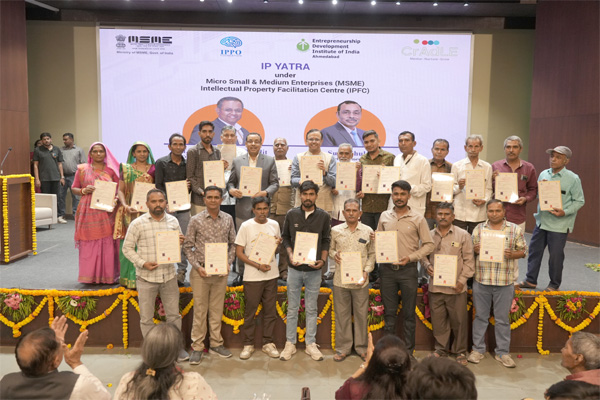
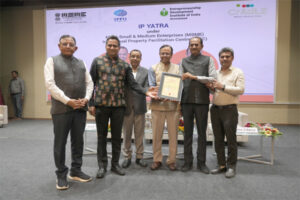
Dr. Unnat Pandit presents the GI certificate for “Surat Cut (Diamond)” to Jagdishbhai Khunt, President of the Surat Diamond Association, during the IP Yatra programme hosted by the Entrepreneurship Development Institute of India in Ahmedabad — NE photo
- Entrepreneurship Development Institute spearheads IP Yatra to protect traditional crafts and knowledge systems
- Over 500 innovators, MSMEs, artisans and academicians gather for nationwide IPR awareness initiative
- GI certificate for Surat Cut Diamond marks milestone for India’s global diamond craftsmanship
- EDII drives GI recognition for five crafts, with 15 more Gujarat products in advanced stages
NE ENTREPRENEURSHIP BUREAU
AHMEDABAD, MAR 16
In a significant boost to India’s intellectual property ecosystem and artisan economy, the Entrepreneurship Development Institute of India (EDII), Ahmedabad facilitated the Geographical Indication (GI) certification for “Surat Cut (Diamond)”, recognising the centuries-old craftsmanship that has positioned Surat as the world’s leading diamond cutting and polishing hub.
The certificate was presented during the IP Yatra outreach programme organised under the MSME Intellectual Property Facilitation Centre (MSME-IPFC) scheme supported by the Ministry of Micro, Small and Medium Enterprises, Government of India.
The two-day national event, held on March 13–14, brought together over 500 stakeholders including MSMEs, startups, innovators, artisans, academicians and industry leaders, highlighting the growing importance of intellectual property rights in protecting India’s traditional knowledge and craft heritage.
A landmark recognition for the global diamond hub
The GI Certificate for “Surat Cut (Diamond)” was presented by Dr. Unnat Pandit, Controller General of Patents, Designs & Trade Marks (CGPDTM), DPIIT, to Jagdishbhai Khunt, President of the Surat Diamond Association.
The recognition is particularly significant because Surat processes nearly 90% of the world’s rough diamonds, making it one of the most important centres in the global diamond value chain.
Speaking at the event, Dr. Unnat Pandit said: “India is home to a rich repository of knowledge built over centuries of practice in multiple fields. It is essential to protect the ideas and processes involved at the right time. GI facilitation helps promote the social and economic well-being of producers and artisans, enabling their products to gain greater visibility and recognition.”
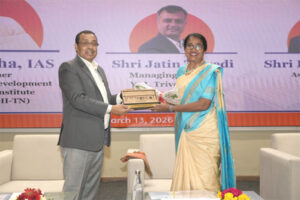
Dr. Sunil Shukla felicitates G. Latha, IAS, Commissioner, Entrepreneurship Development and Innovation Institute – Tamil Nadu (EDII-TN), — NE photo
Lessons from the Neem Patent dispute
The programme was inaugurated by G. Latha, IAS, Commissioner, Entrepreneurship Development and Innovation Institute – Tamil Nadu (EDII-TN), along with Jatin Trivedi, Managing Partner, Y.J. Trivedi & Co., and Rajesh Kumar, Assistant Director, MSME Development & Facilitation Office, Ahmedabad.
Highlighting the importance of intellectual property protection, G. Latha cited the well-known global patent dispute involving neem.
“In 1995, a US-based company patented neem despite its medicinal usage in India for thousands of years. Because we lacked awareness about protecting our traditional knowledge, others tried to claim it. India fought the case for nearly a decade before the patent was revoked. This shows why protecting our knowledge and legacy through patents and GI tagging is vital.”
Empowering artisans through GI recognition
During the event, GI Authorised User Certificates were also presented to artisans representing Gujarat’s traditional crafts.
These included:
- 57 authorised users of Tangaliya Shawl, represented by Lavjibhai Parmar
- 34 authorised users of Mata ni Pachhedi, represented by Bhanubhai Chitara
The recognition highlights the importance of GI tags in preserving cultural heritage while enhancing market value for artisan communities.
EDII’s expanding GI Mission
The Entrepreneurship Development Institute of India has been actively facilitating GI registrations across Gujarat.
So far, EDII has supported GI tagging for five crafts:
- Gujarat Suf Embroidery
- Ahmedabad Sodagari Block Print
- Bharuch Sujani Weaving
- Surat Sadeli Craft
- Surat Cut (Diamond)
Additionally, 15 more crafts and agricultural products from Gujarat are currently in advanced stages of GI registration under the MSME-IPFC initiative.
To strengthen this ecosystem, EDII has also established a NABARD-supported Regional Geographical Indication Facilitation Centre, the first of its kind in Gujarat, to assist artisans, producer groups and entrepreneurs with GI registration and market linkages.
The centre has already generated cumulative sales exceeding ₹3 lakh within six months, helping artisans connect with broader markets.
Innovation must lead to commercialisation
Highlighting the economic importance of intellectual property, Dr. Sunil Shukla, Director General of Entrepreneurship Development Institute of India, said:
“Filing patents plays a crucial role in protecting our rich knowledge and traditions. Ideation must lead to innovation, and innovation must lead to commercialisation for ideas to create economic and social value. Geographical Indications are a powerful tool to safeguard unique products and ensure that communities benefit from their heritage.”
The IP Yatra also featured expert sessions by Nilesh Pandit, Lead (IPR – Patents) at Tata Consultancy Services, and Neha Verma, General Counsel at Puniska Group, who shared insights on patent strategies, intellectual property protection and converting brands into valuable business assets.