
R ARIVANANTHAM
CHENNAI, MAR 23
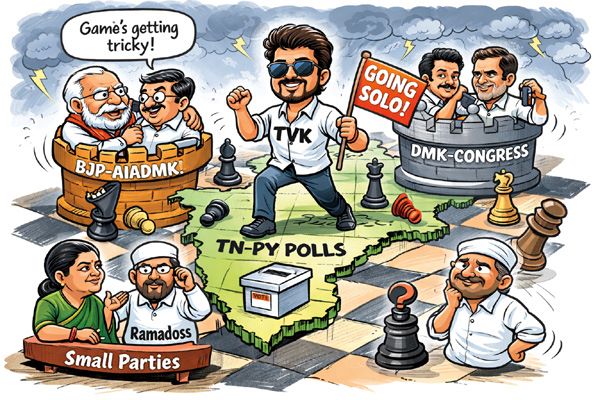
In a dramatic turn ahead of the southern electoral battle, Tamilaga Vettri Kazhagam (TVK), led by actor-turned-politician Vijay, has chosen to go it alone—announcing candidates for all 30 Assembly constituencies in Puducherry and firmly shutting the door on alliance speculation.
- Tamilaga Vettri Kazhagam springs a surprise, rules out tie-ups and unveils full Puducherry slate
- Bharatiya Janata Party–All India Anna Dravida Munnetra Kazhagam equations under watch as alliance arithmetic evolves
- Dravida Munnetra Kazhagam–Indian National Congress camp banks on incumbency and welfare plank
- Regional players like V. K. Sasikala and S. Ramadoss weigh options amid shifting loyalties
- Smaller parties emerge as kingmakers in fragmented mandate battle across Tamil Nadu and Puducherry
The move has added a fresh layer of unpredictability to the already complex political matrix involving the Bharatiya Janata Party (BJP), All India Anna Dravida Munnetra Kazhagam, Dravida Munnetra Kazhagam and the Indian National Congress, alongside a host of regional and caste-based outfits.
TVK’s solo surge reshapes contest
By fielding candidates across all constituencies in Puducherry—where polling is slated for April 9 and counting on May 4—TVK has signalled its intent to emerge as a third force.
Key entrants include former BJP leader A.K. Sai J. Saravanan Kumar, ex-AIADMK legislators K.A.U. Asana and L. Periyasamy, and former Puducherry BJP chief V. Saminathan—indicating a strategic poaching of leaders across party lines.
Political observers say this “all-in” strategy could split anti-incumbency votes, particularly impacting traditional Dravidian majors.
BJP–AIADMK: Still fluid
While the Bharatiya Janata Party has already moved ahead with candidate announcements in alliance with the All India N.R. Congress in Puducherry, its broader equation with the All India Anna Dravida Munnetra Kazhagam in Tamil Nadu remains under close watch.
A senior BJP functionary, requesting anonymity, said: “Alliance decisions will be driven by winnability and ground realities. The emergence of new players like TVK requires recalibration at every level.”
DMK–Congress camp banks on stability
On the other side, the ruling Dravida Munnetra Kazhagam, in alliance with the Indian National Congress, is banking on governance continuity and welfare delivery.
A DMK strategist noted: “Fragmentation of opposition votes only strengthens our position. The alliance remains cohesive and focused on development narratives.”
Sasikala, Ramadoss & the regional puzzle
The roles of key regional influencers like V. K. Sasikala and S. Ramadoss are being keenly tracked.
While Sasikala’s re-entry into active politics could impact AIADMK’s internal dynamics, Ramadoss-led PMK continues to hold sway in northern Tamil Nadu with its Vanniyar vote base—making it a crucial ally for any major front.
A political analyst said: “These leaders may not dominate headlines daily, but their electoral arithmetic can tilt results in dozens of constituencies.”
Small parties, big impact
Beyond the big players, smaller parties and independents are poised to play spoiler or kingmaker roles, especially in closely fought seats.
With multi-cornered contests becoming the norm, even marginal vote shares could prove decisive in determining the final outcome.
High-stakes battle ahead
In the 2021 Puducherry Assembly elections, the All India N.R. Congress emerged as the single largest party with 10 seats, followed by the DMK with six, while both the BJP and Congress secured six seats each—underscoring the tight margins that define the Union Territory’s politics.
With TVK now entering the fray independently and alliance dynamics still evolving, the 2026 contest is shaping up to be a multi-polar, high-voltage electoral battle.